


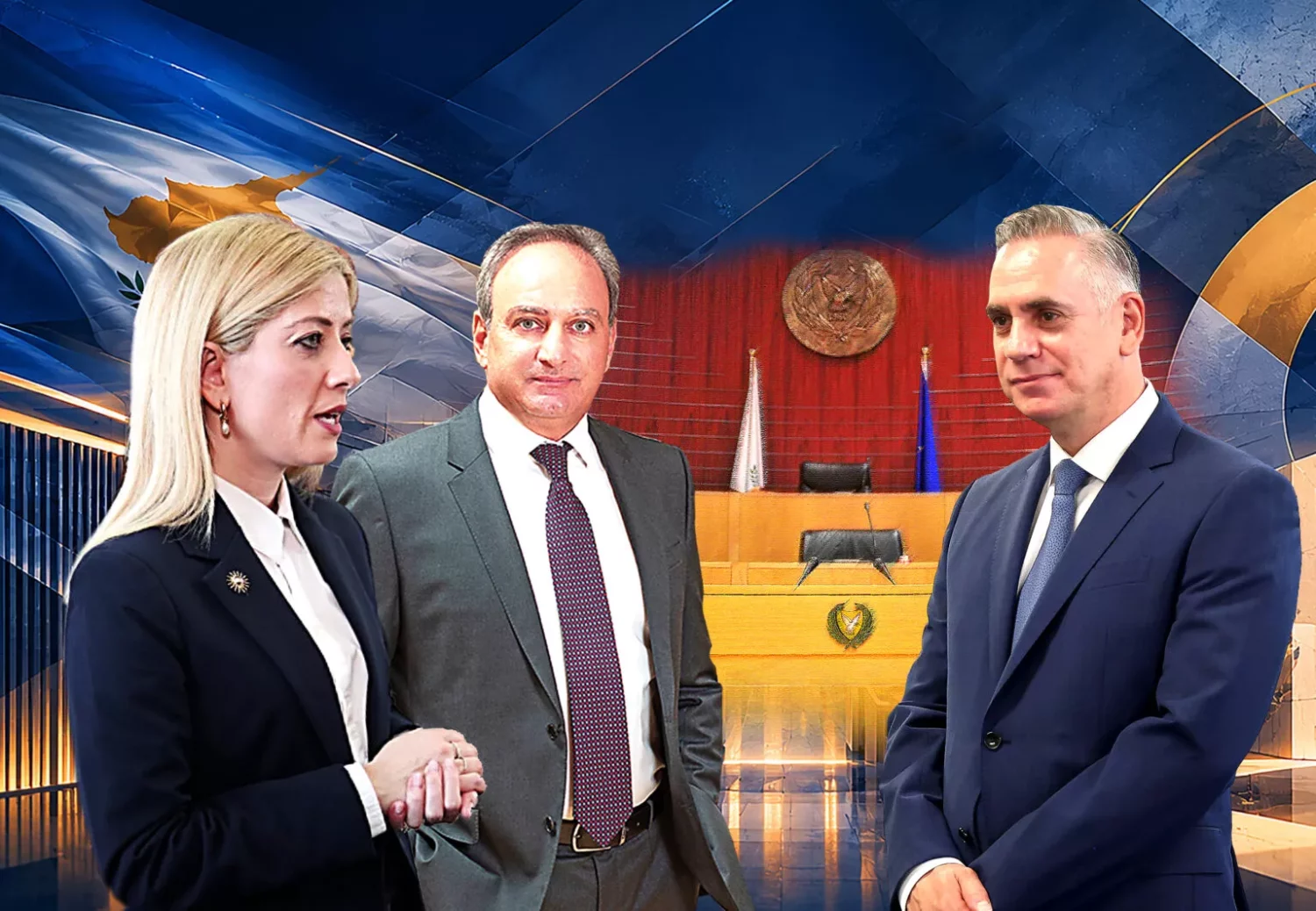
The centre-right axis that began taking shape ahead of the elections through a common line between DISY and DIKO, occasionally involving the government as a third party, collapsed the day after the polls before the celebrations in both parties could even die down.
Annita Demetriou and Nicolas Papadopoulos face a difficult puzzle that involves both their legitimate personal ambitions and the post-election equation. In the centre-right camp, the House of Representatives presidency is now directly linked to the opening moves toward the 2028 presidential elections.
Rupture and head-on collision
The coming week is considered critical. The political landscape may begin to clear up by Tuesday, following the first meeting of AKEL’s political bureau.
Relations between DISY and DIKO are walking a tightrope. Under current conditions, a joint stance by the two parties in the vote for the House presidency is extremely difficult to unlikely. This friction also calls into question their broader future cooperation.
While cooperation will still occur on major parliamentary matters—particularly on the economy, where their views align on issues like the upcoming pension reform—a political rupture is considered certain. Furthermore, the truce between the Presidential Palace and DISY’s Pindarou headquarters appears to be expiring, with both sides expected to gradually head into a full-scale confrontation with an eye on the 2028 presidential elections.
Monday’s backstage negotiations
Demetriou and Papadopoulos met at parliament last Monday. Demetriou expressed her interest in remaining House president, while Papadopoulos responded by putting forward his own interest. The mutual interest was already known beforehand.
Pre-election calculations based on polls indicated that ELAM’s votes would be required to form a majority. Post-election, this scenario no longer applies. However, instead of smoothing out the process, the puzzle has become more complicated as the issue links directly to the presidential elections.
Demetriou wants to reclaim the post, arguing that DISY, as the largest party with 17 MPs, is entitled to it. Behind this approach, however, lies her clear focus on the 2028 presidential elections and her intention, as an election winner, to run as a candidate.
Given DIKO’s election performance, Papadopoulos lacks a narrative to exit the Christodoulides government, especially since the president maintains a group of supporters within the party. Consequently, if DIKO supported Demetriou, it would create internal friction by strengthening a potential rival presidential candidate.
The Presidential Palace is equally opposed to supporting Demetriou, whom it now views as a potential challenger. Behind-the-scenes reports indicate that the presidential election issue was raised during Monday’s meeting, though DISY refuses to discuss it. Subsequent attempts to mediate a three-way meeting involving the Presidential Palace yielded no results.
The Presidential Palace and DIKO reportedly want the DISY president to explicitly state that she will not be a candidate in 2028. Demetriou, while publicly stating she is not thinking about the presidential race yet, refuses to commit to not running—a stance many view as logical and justified following the election results.
Conversely, some point out that DISY’s 27.1% vote share was partly achieved thanks to the pre-election climate of cooperation with the government. Members of the administration supported and voted for DISY, while President Christodoulides’s own stance was interpreted by many as supportive of the party. Interior Minister Constantinos Ioannou even attended a pre-election campaign event for Savia Orphanidou.
These dynamics are creating a post-election atmosphere of awkwardness and discontent that is expected to eventually erupt into intense political confrontation.
Scepticism is also growing within DISY’s own ranks. In recent days, serious discussions and gossip have circulated regarding private conversations between leadership and party officials. Questions are being raised about how many officials are being promised the party’s “endorsement” for 2028, and who has reportedly “locked down” ministerial portfolios, such as the ministries of foreign affairs and finance.
On the other hand, no matter how much the Presidential Palace wants to distance itself from the legislative election results, it remains central to their interpretation. This applies not only to DISY’s percentage but also to the performance of the pro-government parties, alongside the fact that DEPA and EDEK were left out of parliament. A cabinet reshuffle is certain, and the president is expected to make moves with an eye toward 2028.
AKEL enters the frame
Faced with these conditions on the centre-right, Papadopoulos turned in other directions for alliances regarding the House presidency, bringing AKEL into the equation and decoupling the issue from the presidential elections.
Stefanos Stefanou believes that AKEL’s vote share allows it to play a decisive role for the opposition camp in the presidential elections. For now, he is keeping the option of supporting Papadopoulos for the House presidency open. Reports indicate Stefanou has made it clear that this is not an easy decision, though he has not ruled out supporting the DIKO president or suggesting an alternative figure.
The prospect of Irene Charalambidou, which was floated by Odysseas Michaelides, has been largely rejected. Stefanou is looking toward 2028 and says so openly. The current landscape favors AKEL and the broader centre-left. With the centre-right fragmented, the path opens wide for a centrist or centre-right candidate, an outcome AKEL aims to capitalize on.
Depending on how events unfold, AKEL could ultimately benefit in the race for the House presidency itself, as certain scenarios could bring this to fruition.
ELAM and ALMA positioning
ELAM currently intends to field its own candidate in the first round. Party leader Christou is considered the most likely choice, though Pelekanos has not been ruled out. Linos Papagiannis or Sotiris Ioannou will take up the roles of parliamentary representative and committee chair respectively.
ELAM may adjust its strategy depending on developments. The party will not support Demetriou or any AKEL MP, and its votes combined with DIKO are insufficient to elect Papadopoulos in the second round without securing votes from other quarters.
Odysseas Michaelides’s ALMA party is seeking a role in the unfolding landscape by ruling out both Demetriou and Papadopoulos, while looking favorably on a potential alignment with AKEL. If AKEL supports Papadopoulos, ALMA will logically run independently. Meanwhile, Amesi Dimokratia, with its four MPs, remains an unknown factor for now.

