


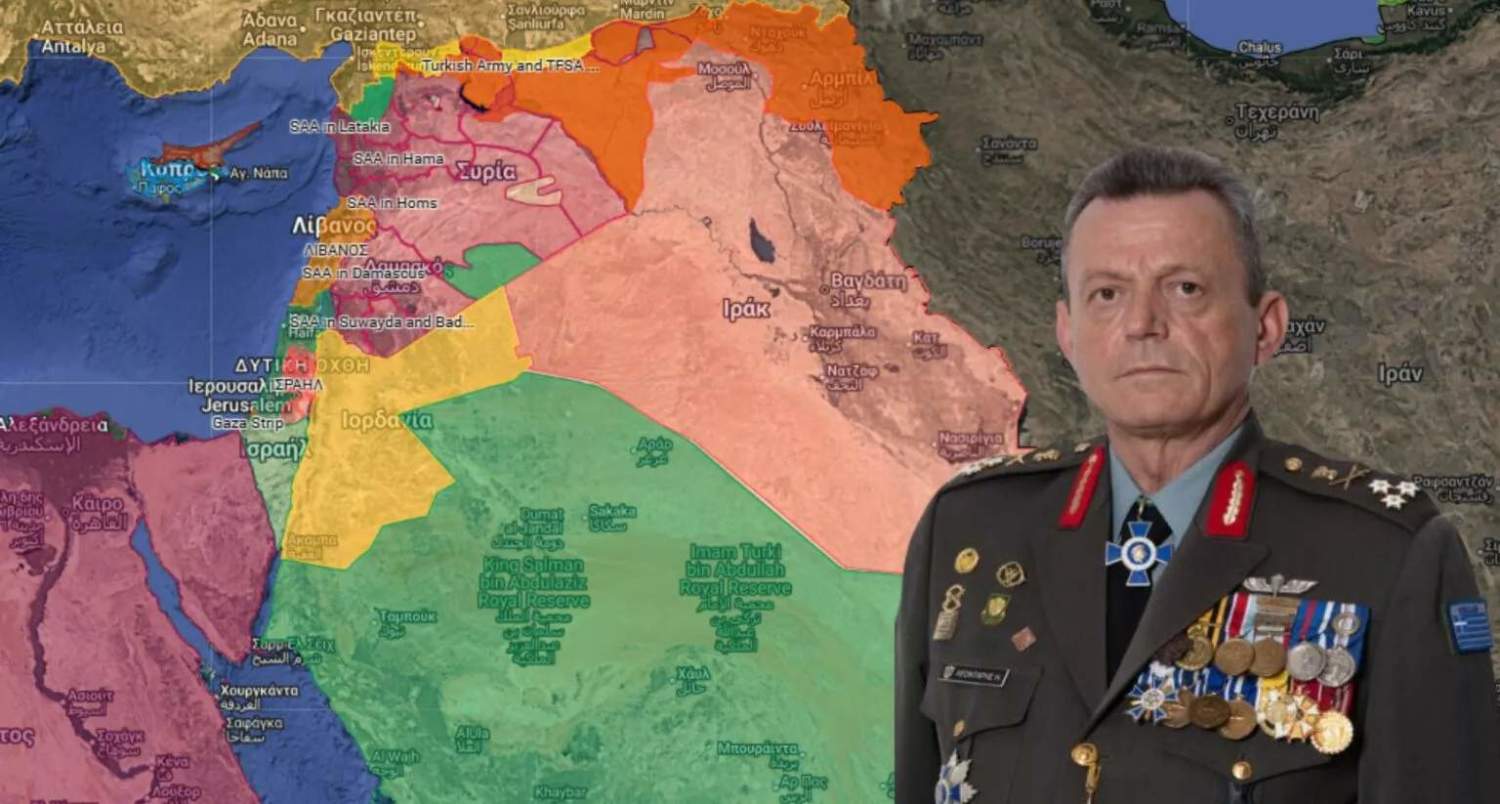
Cyprus is not Iran’s primary target but remains exposed because of the British bases on its soil, and the consequences of the current war will be severe, retired General Elias Leontaris, former Chief of the National Guard, has told philenews.
Leontaris, who led the National Guard from 2017 to 2020, said the conflict — decided by Israel and the United States last Saturday morning — was spreading “as far as the range of weapons reaches” and was already affecting every aspect of state function, from the economy and tourism to shipping and security.
He said there was a clear plan to start the war but no visible plan to end it. Citing the Prussian military theorist Clausewitz, he said war’s purpose was to satisfy political objectives — but those objectives, he argued, were not clear in this case. Regime change, he added, could not be achieved by bombing alone or by the wishes of another people; it required the internal will of the population itself.
On Iran’s motives for striking targets in countries not directly involved in the conflict, such as Cyprus, Leontaris said Tehran was seeking to provoke those countries into pressuring Washington to end the war, given that US-aligned military bases were present on their soil. At sea, he said, no distinction could be made between vessels of different nations, meaning the risk was shared equally by all.
Cyprus could not remain outside this framework, he said, due to its proximity to the conflict and the presence of the British bases. He dismissed the need for panic, however, saying the first drone strike had shown that Cyprus itself was not the target — though it could be affected as a consequence.
The deployment of Greek forces was, in his view, the right response. He linked the decision directly to a call between President Christodoulides and Greek Prime Minister Mitsotakis, followed by a KYSEA decision to deploy two frigates and four fighter aircraft to Cyprus. The frigate Belhara, he said, was the most modern vessel in the Greek Navy — among the most advanced in Europe — while the Psara carried the Centaurus anti-drone system, which had been combat-tested during Operation ASPIDES against Houthi drones in the Red Sea. The four F-16s, deployed to Andreas Papandreou base, completed what he described as a security umbrella over Cyprus.
On the prospect of a ground invasion of Iran, Leontaris was categorical. “I find it neither probable, nor easy, nor feasible,” he said. A full-scale ground operation would require enormous preparation time and face near-impossible logistical challenges — whether approaching from the northwest through Kurdish territory or from the sea, given Tehran’s position at the northern end of the country. He did not rule out special operations targeting specific objectives, but described a broad ground campaign as ranging from very difficult to impossible.
Assessing the National Guard, Leontaris said Cyprus’s operational capabilities were satisfactory for its normal needs but required reinforcement in a wartime environment. He expressed confidence in the National Guard’s current leadership and its layered air defence systems — from short to long range — to deploy the right response to any threat. He said the Andreas Papandreou base, built under the Joint Defence Doctrine, remained capable of handling fifth-generation aircraft decades after its construction, but called for further development of naval infrastructure and suggested that the PAT Ioannidis could benefit from one or two similarly equipped sister vessels. He also predicted that Cyprus would eventually move towards American-made weapons systems.
The war’s consequences would be major, he said, and the day after would be difficult. “Vigilance is needed, not panic — and I believe we are ready to handle an emergency.”
Read more:

