


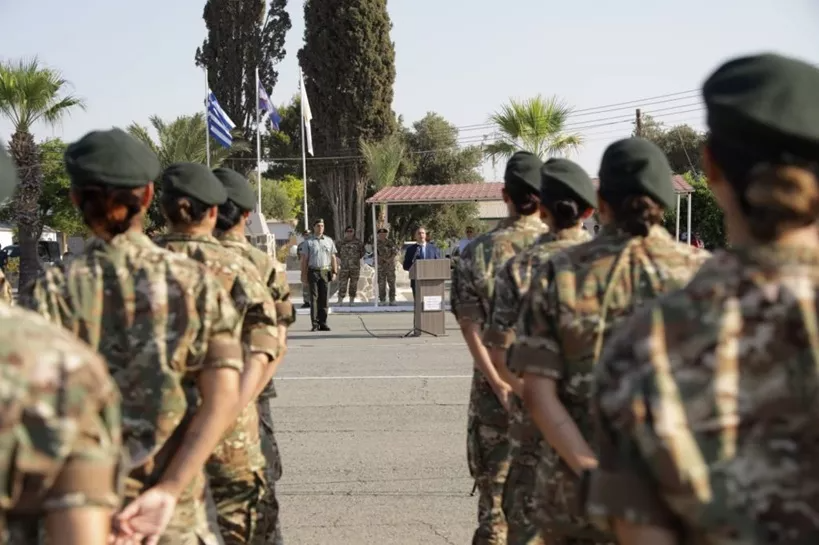
Defence Minister Vasilis Palmas has candidly admitted that the women’s voluntary military service initiative has not achieved its objectives, stating plainly during a parliamentary budget discussion that “the initiative has failed.”
The minister made this frank assessment while addressing the House Finance Committee on Monday, though he was careful to add that “the institution itself did not fail,” suggesting implementation rather than concept may be at fault.
During the discussion, MPs also highlighted numerous vacant positions at military academies in Greece, as interest in military studies has notably decreased. Defence Committee Chairman Marinos Sizopoulos raised concerns about cadet allowances, noting that their Greek colleagues receive substantially higher amounts. The minister responded that allowance levels have been restored to pre-2013 crisis levels.
One of the primary concerns involves the future of Contract Soldiers. Palmas reminded the committee that steps have been taken to improve the institution, including upgrading their salary scale from A1 to A2 and providing a monthly €100 allowance, increasing to €200 for those in special forces like the underwater demolition units and special forces.
Nevertheless, he acknowledged these measures are insufficient to maintain or increase interest. “If we don’t secure their future, unfortunately even if we provide a €300 allowance, interest will remain low,” he stated. Sizopoulos added that the first cohort of Contract Soldiers who enlisted in 2016 will complete their service in 2026, warning the problem will intensify without intervention.
The discussion also revisited allowance discrepancies for Contract Soldiers seconded to police duties, with MPs pointing out that police officers receive €200 for the same assignment while accompanying Contract Soldiers receive just €40.
The Defence Committee Chairman renewed his proposal to create a specialised security force for ports and airports, where Contract Soldiers could transition after their service, ending the current practice of seconding National Guard and police personnel. However, the minister cautioned that without long-term prospects, the institution cannot survive.
DISY MP George Karoullas criticised the government, claiming “no progress on personnel issues in the last three years,” noting this serves as a disincentive for officers and non-commissioned officers. “Zero progress unfortunately on Contract Soldier issues. Women’s voluntary enlistment appears to be a major failure,” he stated.
In response, the Defence Minister revealed that a study on hierarchical progression for officers and non-commissioned officers in the National Guard is underway and will be sent to the Finance Ministry for comments and approval. “The irregular career progression of specific National Guard personnel groups is a persistent problem that negatively affects both members’ personal development and military functionality,” he said.
He also noted a concentration of personnel at captain and major ranks, potentially leading to future retirements and loss of significant experienced personnel.
The committee members acknowledged that the ministry faces longstanding issues requiring solutions in a short timeframe. Defence Committee members reiterated that parliament would support efforts to resolve these challenges.
Read more:

