


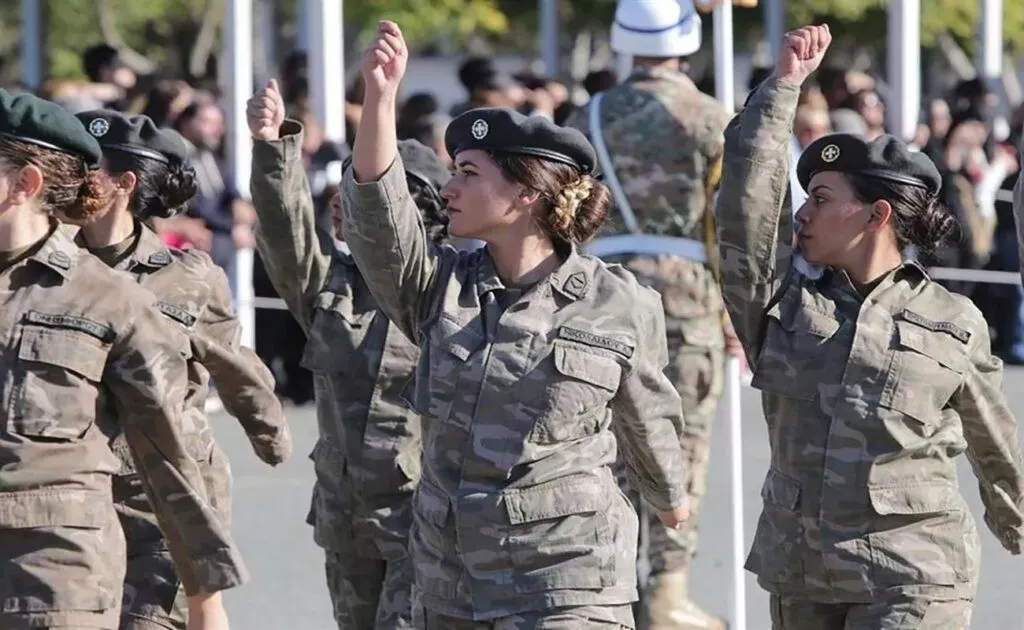
The debate over voluntary military service for women in Cyprus reignites an old but perennially relevant question: where does equality end when it clashes with coercion?
On one hand, the proposal for voluntary service reflects a logical alignment with social developments. Cyprus is no longer the society of the 1960s or 1970s. Women actively participate in all sectors of public life—from politics to the armed forces. Voluntary military service could serve as a tool for reinforcing equality, offering women who wish to do so the opportunity to train, serve, and assume roles of high responsibility.
On the other hand, choosing voluntarism over compulsory service raises questions about whether the state genuinely seeks substantive equality or merely a symbolic gesture. Men continue to face mandatory military obligation, with all the social and professional consequences this entails, whilst women would have the option to choose. This gap, however much it may be cloaked in the mantle of “freedom of choice,” actually undermines the very equality it purports to promote.
There is also the question of military effectiveness. The National Guard faces chronic staffing problems. Voluntary enlistment of women may contribute to partial relief of the problem, but it does not constitute a solution and is certainly no panacea. Without institutional reforms to the structure, technology, and professional orientation of the armed forces, the voluntary presence of women will function more as a “badge of progress” than as a substantive step towards modernisation.
Society must answer honestly: do we want equality of obligations or the implementation of a differentiation regime masquerading as choice? If equality is the goal, then the discussion cannot be exhausted by voluntary service. What is needed is a comprehensive redefinition of defence’s role, duration of service, and military culture.
Voluntary military service for women, however much it may be presented as a step towards modernisation, is in reality a half-measure. The challenge for Cyprus is not simply to distribute “rights of choice,” but to shape a defence institution that responds to principles of equality and social justice, as well as to the needs of contemporary strategic reality.
By choosing voluntary service for women, the government avoids the substance. It neither addresses the problem of equality nor solves the chronic staffing issues of the National Guard. Military service cannot be a “right” for some and an “obligation” for others. If equality constitutes a genuine value, then the state must either establish universal military obligation or proceed with creating a fully professional army.
One might conclude that the proposal for voluntary military service for women is politically convenient but strategically ineffective. It creates the illusion of modernisation without offering substantive equality and without strengthening the country’s defence. At a time when Cyprus needs clear answers, we cannot settle for half-measures. Equality of obligations or complete reform of the armed forces are the only honest choices.

