


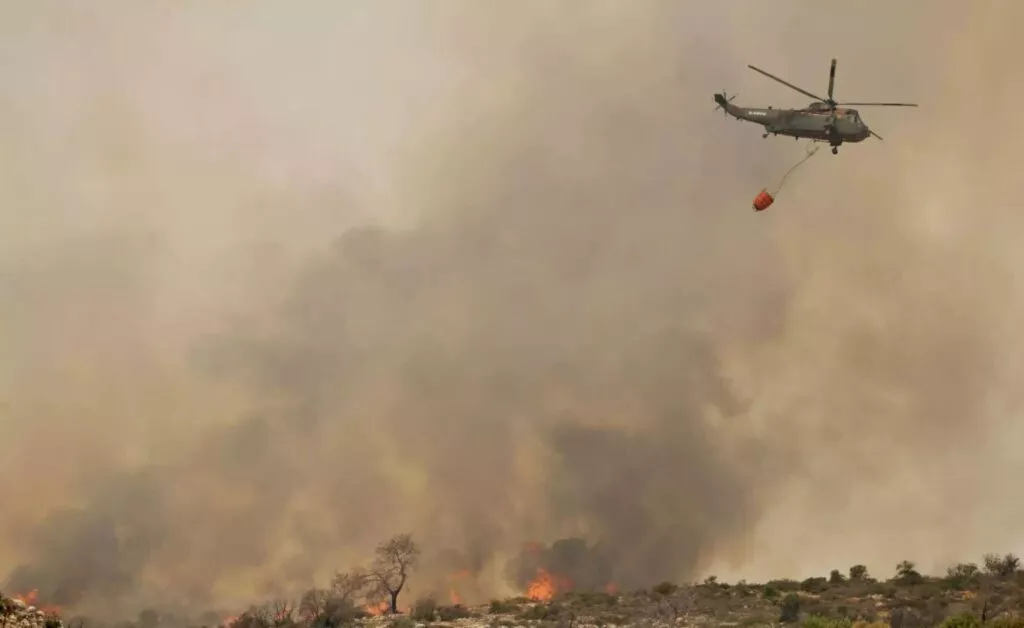
As wildfires ravaged the Limassol region, a sense of anger mounted among residents, who demanded answers regarding the delayed or insufficient arrival of aid.
Questions remain about crucial hours during the inferno: Why did the Greek “forest commandos” arrive only after the fires were largely extinguished? Why did Spanish aircraft never materialize? When was the request sent via the EU’s RescEU mechanism, and which countries responded positively to Cyprus’s call for assistance? How does the EU mechanism work, and what happened with aid from Israel, Jordan, Egypt, and Lebanon?
The Ministry of Foreign Affairs of the Republic of Cyprus expressed gratitude to several countries for their positive response to provide aid. In a social media post, the ministry stated, “Our most sincere thanks to Jordan, Egypt, Israel, Spain, Greece, Lebanon, and Sweden, as well as to the European Civil Protection Mechanism #EUCivicProtectionMechanism, for offering assistance via firefighting aircraft to combat the devastating fires in the Limassol region.”
Further appreciation was extended to countries that declared readiness to respond in a second Foreign Ministry post. It read, “We would like to express our sincere gratitude to Slovenia, Italy, and Serbia for their proven willingness and generous offers to send firefighting aid to help us combat the fires destroying the Limassol area. This spirit of cooperation and compassion is commendable and appreciated in this time of crisis.”
This indicates that beyond the countries that ultimately sent aid, others declared their readiness to respond. However, the entire process typically requires a 36-48 hour timeframe – from sending the request to each country assessing its own situation and then responding. Despite the apparent delay, aid from some countries reached Cyprus within 24 hours, much sooner than expected. Aircraft from Spain were expected on Friday but ultimately did not arrive due to the fire’s progression, while firefighting forces from Italy, via the EU mechanism, and from Serbia were also ready to deploy to Cyprus on Friday. A critical factor in this situation was the concurrent wildfires raging in Greece, Italy, and Albania during the same period.
Aid from the Region Proves Crucial
In the battle against the flames, helicopters from Lebanon initially joined the fight, followed by helicopters from Egypt on Thursday, and two from Jordan. These were in addition to the two Jordanian helicopters permanently stationed in Cyprus under an existing cooperation agreement.
A decisive intervention came on Thursday night from two C-130 aircraft from Israel, which dropped 34 tons of fire retardant, contributing significantly to the successful suppression of the fires. Notably, these two Israeli aircraft were sent to Cyprus for assistance despite Israel itself being in a state of emergency due to its own wildfires.
Is Cyprus Too Far? Scrutiny of RescEU
The fact that EU aid essentially never materialized effectively, due to the time required by the entire process, raises a question about whether permanent aerial firefighting assets should be stationed in Cyprus. This issue was raised by EPP MEP Loukas Fourlas, who submitted an urgent question to the European Commission, criticizing the RescEU mechanism’s inability to respond immediately and effectively to natural disasters in Cyprus.
How RescEU Works
The EU Civil Protection Mechanism coordinates pan-European assistance, ensuring all EU member states and the 10 additional participating states receive timely information during crises. When activated by any country worldwide, the mechanism facilitates the rapid deployment of resources and personnel tailored to the specific needs of each emergency.
At the operational core of the mechanism is the European Commission’s Emergency Response Coordination Centre (ERCC). The ERCC monitors wildfire risks and emergencies across Europe and globally, supported by national and European monitoring services, such as the European Forest Fire Information System (EFFIS).
At the start of each forest fire season, the ERCC collaborates with the national authorities of EU member states and participating states to:
- Exchange information on prevention, preparedness, and response activities.
- Maintain close contact with these authorities throughout the forest fire season to ensure effective coordination.
In an emergency, any country can request assistance through the mechanism to enable a coordinated, rapid, and effective international response. When large forest fires occur, member states and participating states often show solidarity by providing firefighting aircraft, helicopters, equipment, and specialized teams. The mechanism co-finances the transport and/or operational costs for providing assistance to affected areas.
Preparing for Forest Fires
While national and regional authorities manage forest fire prevention, preparedness, and response activities, the EU can co-finance and coordinate additional support when needed.
In 2019, the EU Civil Protection Mechanism was strengthened with the RescEU fleet, the EU’s common strategic reserve, which includes fully EU-funded firefighting aircraft and helicopters.
Since 2022, the EU has also been strategically pre-positioning firefighters from across Europe in the southern part of the continent during summer months when the risk of forest fires increases.
In 2023, the EU further strengthened its common RescEU firefighting fleet, ensuring better availability of firefighting aircraft and helicopters in the event of severe and overlapping emergencies. The EU also co-finances the reserve availability of additional aerial firefighting resources to address potential shortages in forest fire response.
Long-term, the European Commission has allocated significant funding for the acquisition of 12 new firefighting aircraft, to be based in Portugal, Spain, France, Italy, Croatia, and Greece, and 5 helicopters, 3 of which will be based in Slovakia, Czechia, and Romania. The confirmation of hosting locations for two other helicopters remains pending.
These aircraft will form the “permanent RescEU fleet.” The first helicopters are expected to be delivered in 2026, with the first available aircraft during the 2028 forest fire season.
In addition to response efforts, the EU supports and complements countries’ and regions’ prevention and preparedness measures where a common European approach proves more effective than separate national actions. These include conducting disaster risk assessments, encouraging research to promote disaster resilience, and strengthening early warning tools.
Permanent RescEU Fleet for 2028
To enhance the EU’s response to forest fires, the Commission is funding the availability of a ready firefighting fleet. In light of several unprecedented forest fire seasons across Europe, RescEU is continuously being strengthened to make more aerial assets available each year.
The deployment of these resources is jointly decided by the Commission and member states, ensuring a coordinated and effective response. This initiative complements other measures under the EU Civil Protection Mechanism, including the use of pre-positioned ground firefighting teams to ensure rapid response in fire-prone countries.

