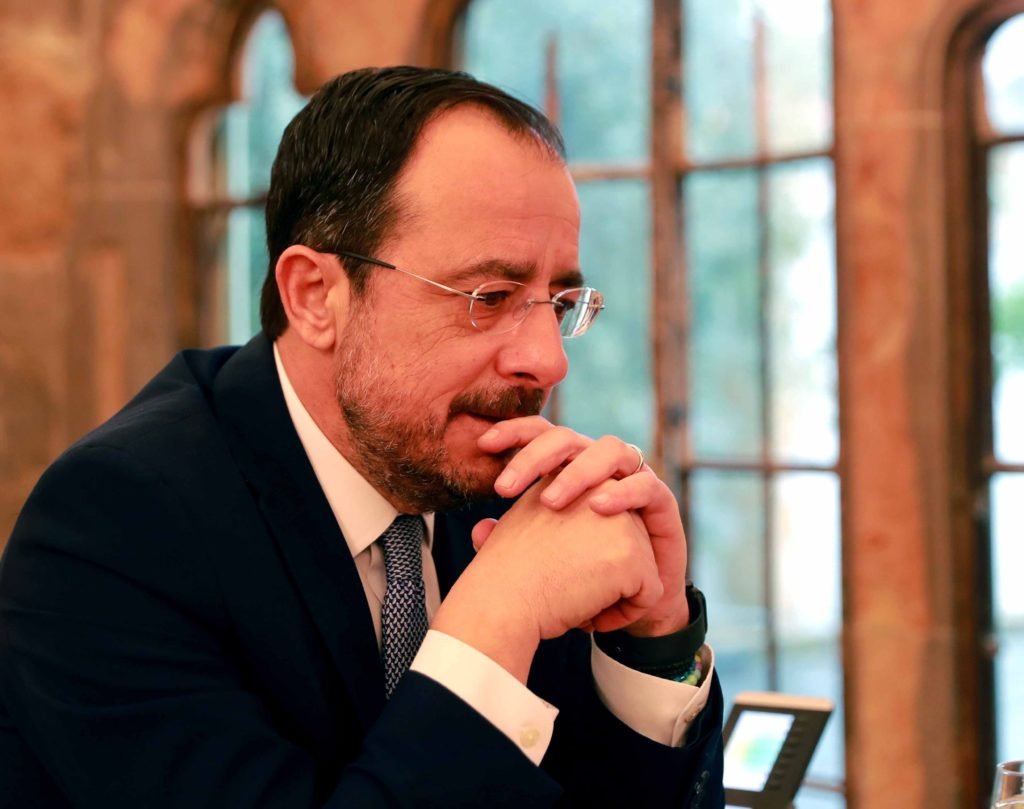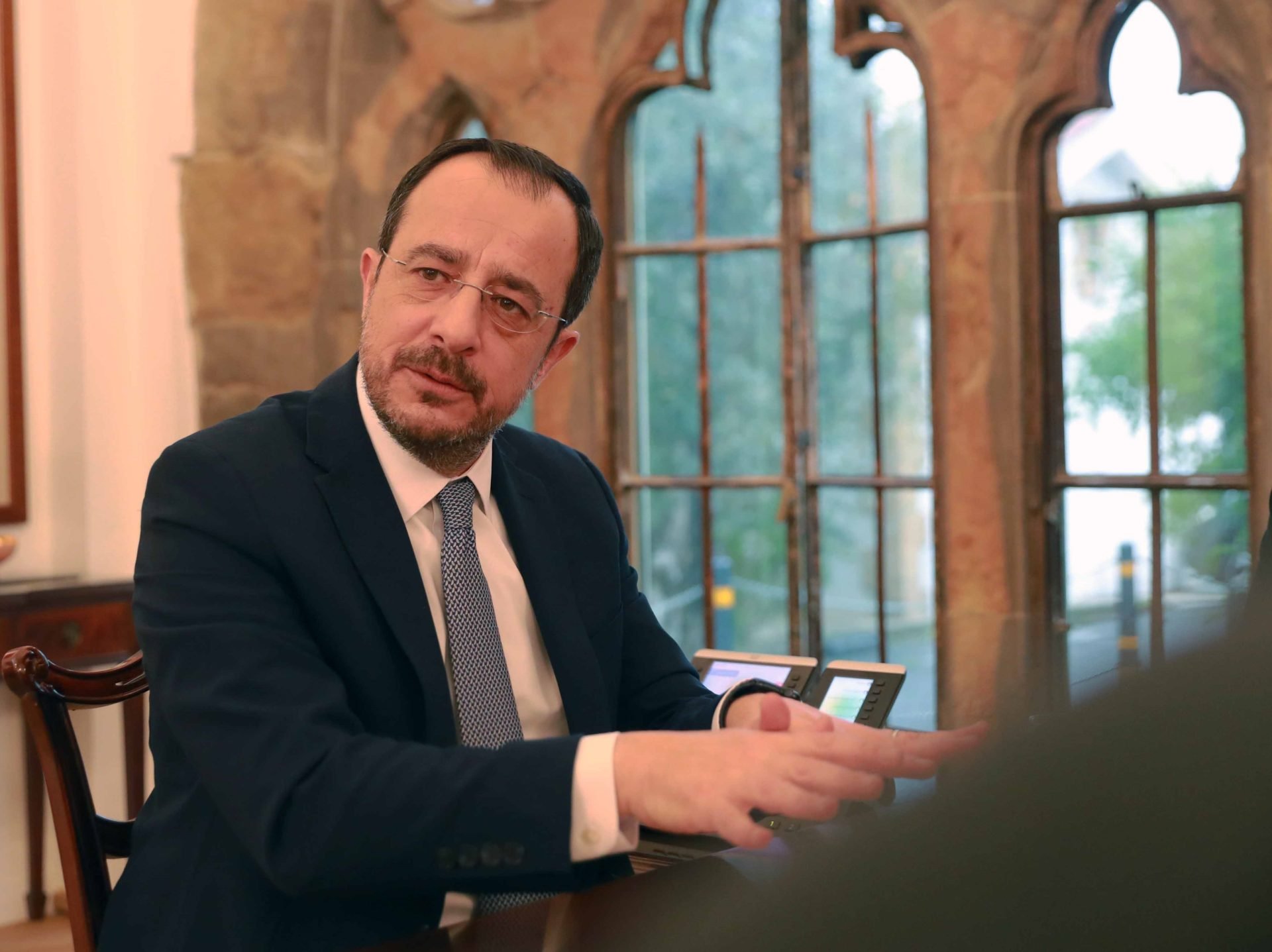
In his first assessment of the informal Geneva conference, President Christodoulides, tells Phileleftheros that we are faced with the first significant developments. According to the President, “the momentum that is being observed, and which we aim to intensify even further, cannot be considered coincidental.”
Referring to the planned April 2 meeting with Ersin Tatar, President Christodoulides reminds that certain commitments have been made before the Secretary-General and they have agreed with him both on the discussion of Confidence Building Measures (CBMs) and on how we can lead to the resumption of negotiations.
On the issue of Maria Angela Holguin Cuellar‘s appointment, the President notes that “we are not cautious about the reappointment” and emphasises that “what interests us and what we desire is a personality who will have the ability to maintain continuous contacts in Cyprus, Greece, Turkey, the United Kingdom and Brussels so as to prepare the ground with the aim of announcing the resumption of negotiations.”
Since much is being written and even more is being said about the informal conference in Geneva, what is your own assessment? Did you get what you wanted?
Our goal and pursuit is the resumption of negotiations from the point where they were suspended in the summer of 2017. This was not feasible to achieve in Geneva due to the refusal and stance of the Turkish side. Taking this fact into account, at the informal conference, a first significant step was taken towards the resumption of negotiations. I refer you to the statements of the Secretary-General himself.
His decision to appoint a Personal Envoy regarding the next steps, as well as the agreement and scheduling of a new meeting next July, constitute basic elements of this significant step. Of course, the agreed categories of Confidence Building Measures to be discussed represent a development that will contribute to further progress, since any CBMs aim to serve the goal of resolving the Cyprus issue on the basis of the agreed framework and certainly not as a substitute for the solution. Let me remind you regarding the categories of CBMs, most of the issues that have been adopted are our own suggestions that we had submitted.
As for the overall assessment, I repeat, I refer you to the statements of the UN Secretary-General himself, who acknowledged that for the first time since 2017, positive steps of progress are being made and significant developments have emerged.
Taking into account both the public statements he was making and the claims and prerequisites Mr Tatar was setting, combined with the prolonged stagnation of recent years and the outcome of Geneva in 2021, the fact that momentum has been secured and the effort continues is certainly something worth noting as positive in our assessment.
At the same time, in any assessment of Geneva, we should also take into account the avoidance of any references, directly or indirectly, that would in any way allude to pursuits that deviate from the agreed framework. For example, the other side’s aim was to declare a deadlock after the meeting and include references about the deadlock, so as to build their narrative about a two-state solution. Even on the issue of appointing an Envoy by the UN Secretary-General, let me remind you of the negative stance of the Turkish side and the fact that when they realised that the SG would proceed with such an appointment, they sought for the Envoy to deal with CBMs, something that was certainly not accepted in any case. Even in the categories of CBMs to be discussed, the pursuit and suggestions of the Turkish side were for issues related to the sovereignty of states, and this was not accepted. These pursuits, the references that the other side set as a goal, were avoided through presenting arguments and substantiated positions from our side, as well as from the other parties. In other words, it is necessary in the equation of any assessment to take into account and calculate what the goals of the other side were and what was avoided.
I would also like to note the reaffirmation of commitment to the agreed framework in an explicit and clear manner, both by the UN Secretary-General and the UK’s Europe Minister, and of course by the Greek Foreign Minister.
The effort has certainly not been completed, but we are facing the first significant developments which we will work to utilise in order to achieve the goal of resuming talks.
The momentum that is being observed, and which we aim to intensify even further, cannot be considered coincidental, but is the result of intensive and persistent efforts and actions on our part based on a specific plan and design, aimed at breaking the deadlock.
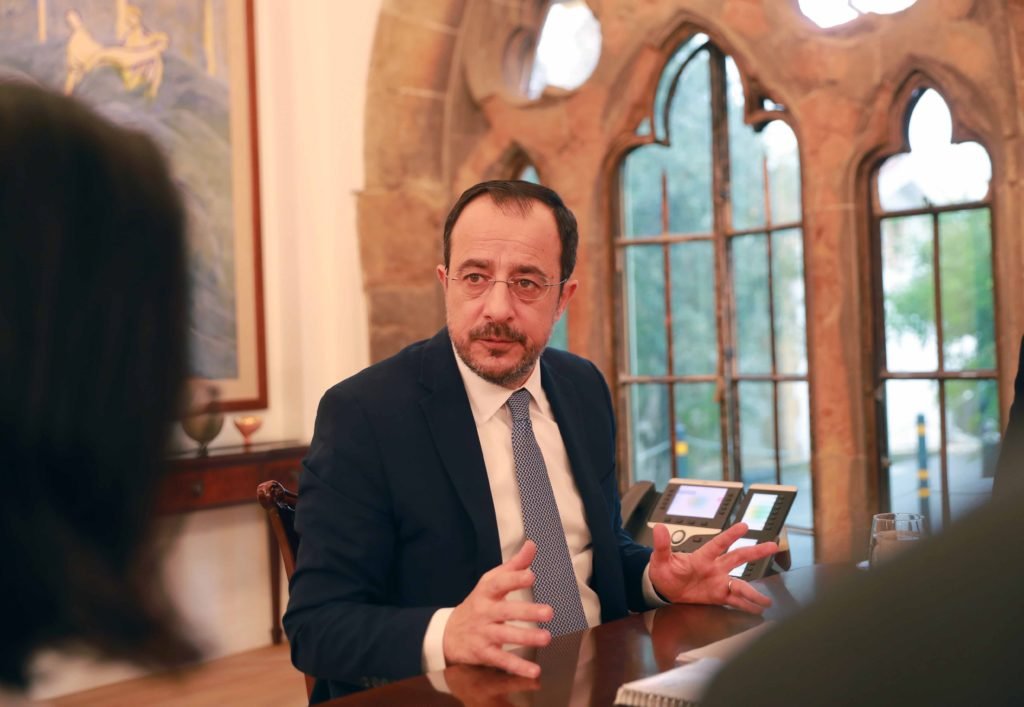
The United Nations spoke of a “new atmosphere” between the two leaders of Cyprus. Do you agree with this assessment? How valid can it be when Tatar went with a two-state agenda?
The “new atmosphere” to which the SG referred primarily concerns the results of the Conference, but also the fact that a substantive discussion took place with Turkey as well, and we exchanged specific views, even expressing our readiness to discuss Confidence Building Measures between the Republic of Cyprus and Turkey, taking into account on one hand Ankara’s aspirations regarding EU-Turkey relations, but also the prerequisite for this to happen, Turkey should respond to its Cyprus-related obligations.
It is true that there can be a “new atmosphere”, what I have been pointing out for some time as a “mutually beneficial situation”, since there are new data, for example, a differentiated geopolitical scene if we also take into account the new climate in Greek-Turkish relations, the reactivation of Turkish interest in improving EU-Turkey relations, as well as developments in our region and in Ukraine. These developments are parameters that we constantly evaluate in order to utilise those opportunities that can contribute to achieving our goals.
Nevertheless, we remain realistic, noting that Mr Tatar and Ankara have not moved from their unacceptable demands for a “two-state” solution that contradicts UN Security Council resolutions and the agreed framework. Substantial progress will be made by returning to the track of the UN framework and resuming negotiations from where they were interrupted in 2017 at Crans-Montana, securing the acquis of the previous negotiation process. Such a move would also allow developments in EU-Turkey relations.
On Wednesday you will go to the first meeting with Ersin Tatar. Given the T/C leadership’s agenda of dialogue between two states, what can one hope for?
Τhe first meeting with Mr Tatar has been arranged for April 2, on our own initiative. The implementation of and progress on what was agreed in Geneva is a priority in view of the already scheduled new Conference in July, and this is why immediately after my return from the European Council meeting we proposed dates for convening this meeting.
We have made certain commitments before the UN Secretary-General in Geneva on the 18th. We are approaching this meeting fully prepared, with the same constructive stance that we have demonstrated and continue to demonstrate in order to make progress on the issues we have agreed with the Secretary-General, both in the discussion on CBMs and on how we can lead to the resumption of negotiations. The outcome of these discussions will also judge the credibility of all of us vis-à-vis the United Nations and in the face of what is being discussed and agreed upon. This is what the SG mentioned at the conclusion of the Conference.
Is it true that you are cautious about the reappointment of Ms Maria Angela Holguin Cuellar to assume again as the personal envoy of the UN Secretary-General?
We are not cautious about the reappointment of Ms Holguin or any other person. What interests us and what we desire is a personality who will have the ability to maintain continuous contacts in Cyprus, Greece, Turkey, the United Kingdom and Brussels, so as to prepare the ground with the aim of announcing the resumption of negotiations from the point where they were interrupted by the next multilateral meeting in July. Taking into account, therefore, the timeframe until the next meeting in July, which of course is not related to the timeframe of the Envoy’s appointment, these contacts should be frequent and regular, and the person who will take on this role should, if possible, deal with it exclusively. We conveyed these positions to the SG. Beyond that, I will repeat that it constitutes at least elementary respect towards the UN Secretary-General to await any announcements on this issue from him.
In any case, however, what I would like to remind once more is that we desired the continuation of Ms Holguín’s mission as Personal Envoy of the UN SG, an opinion I expressed both in my public statements and during my contacts with the UN Secretary-General, an opinion I also conveyed at the dinner on October 15th. And although this was also the wish of the SG, it was not feasible due to the negative Turkish stance. So, to return to your first question, the agreement in Geneva for the appointment of a Personal Envoy was a positive development.
Are you optimistic that positive steps can be taken until next July and that the Cyprus issue can proceed to a next stage, given that the Turkish side will hardly change its approach?
Every action we take, both domestically and internationally, aims to strengthen all the power factors of our country and, by extension, our effort to end the occupation and reunify Cyprus. It is within this framework that we have enhanced the geostrategic footprint of our country, through synergies and strengthening bilateral relations with countries such as the USA, and by highlighting our role in the region as a pillar of security and stability. Indicative of the enhanced role of the Republic of Cyprus is the invitation from President Macron for me to participate in the deliberations of a small but substantial group of state leaders, working to support the peace process in Ukraine.
Within this same framework should be approached the achievements, such as the positive course of the Cypriot economy, which records one of the highest growth rates in the EU and simultaneously the largest reduction in public debt, unemployment recording the lowest rates since 2008, the effective management of migration, and many others. The strengthening of all the power factors of the country also strengthens our negotiating power for the Cyprus issue. Everything is interconnected, and there is no separation between domestic and foreign policy.
At the same time, we have taken initiatives, proving our sincere political will. Through consistency and continuity of words and actions, we have contributed to seeing some momentum. I remind you where we were with the almost universal refusal of the other side. Our own persistence and commitment to the agreed framework, and the utilisation on our part of every possibility and tool we had at our disposal, combined with the political commitment of the UN Secretary-General, have contributed to us being at this point today.
I am well aware of the challenges and difficulties we have to face, but I am determined to dedicate every ounce of my strength towards revitalising the process of substantive negotiations from the point where they were interrupted, with the horizon of course being the reunification of our homeland.
My assessment is that if the other side truly approaches this new period with sincerity and genuine will, positive steps can be taken, leading to a mutually beneficial situation, to the benefit of all residents of our country, but also more broadly to the benefit of security and stability in the region. Despite the negative approach of the other side so far, I have the conviction that the wall of occupation is not impenetrable. We remain committed to our goal, working methodically with clear orientation, with assertive realism, with solid arguments. Besides, the present state of affairs, not only is it not sustainable, not only does it not allow our country to utilise all of its capabilities, it cannot constitute the future of our homeland.
Cyprus continues with “assertive realism”
It was said that exaggerations or celebrations are not needed for the outcome of Geneva. Were there celebrations on your part for what was agreed there?
I agree that neither exaggerations nor celebrations are needed, and in no case were celebrations expressed on our part, although unfortunately some invested in a potential failure of this meeting with the sole aim of blaming our side, in the context of their daily stance and behaviour. I myself personally in my statements after the conference mentioned that this great effort of course was not completed in Geneva, but that it is just beginning. At the same time, however, we cannot downplay the significance of what has been achieved. A first significant, positive step was taken towards the resumption of talks, which is the major goal. We are not there yet, but since 2017 – and I use the SG’s words – a first significant step has been taken.
If I keep something from Geneva, I would like to refer specifically to three issues as the most important.
The first is the SG’s decision to appoint a personal envoy, whose mission will be the next steps in the effort to resume talks on the basis of the agreed framework. Before Geneva, the Turkish side was negative to such a prospect.
The second, I consider it important that a new meeting was decided for the end of July, in this expanded format, to see the progress that will be achieved and the next steps. Before Geneva, the Turkish side was investing in failure and deadlock to strengthen its narrative for the need to change the basis for a solution.
Third, and particularly important I consider the joint letter from the President of the European Commission and the President of the European Council to the UN Secretary-General, copied to both me and Mr Tatar. A letter that I believe defines, without allowing any different interpretation, the position of the European Union (EU) regarding the resolution of the Cyprus issue, something that of course also touches on EU-Turkey relations and Ankara’s desires. Before Geneva, some spoke of downgraded interest from the EU side.
With assertive realism, therefore, soberly, responsibly, with a specific plan and design, we continue the intensive preparation for how we will proceed. Seriously and measured, without exaggerations and grandiloquence, grounded we proceed in this preliminary stage with the aim of having it constitute the transition to substantive negotiation within the Security Council framework.
The presence of the EU in the conference was essential
Let’s also focus on the participation of the EU. You are criticised because you spoke of participation up to commissioner level, but in the end it was a bureaucrat on the sidelines, not even at the table. Some remembered that you also promised an EU envoy for the Cyprus issue, and that the letter from the Institutions was not something new since Borrell had also sent one. What is your response to all this?
The EU, through the joint letter of the two top EU institutions, the President of the European Council and the President of the European Commission to the UN Secretary-General, after our actions, just before the start of the multilateral, set the framework for the desired solution in the most official and categorical way, without leaving any misinterpretation. And the written record remains. A letter that constitutes a milestone towards achieving a solution to the Cyprus issue but also regarding EU-Turkey relations with the clear linking of these with progress on the Cyprus issue in a gradual, proportional, and reversible way, and expressing the will and intention of the EU to play an active role with all means, at all stages of the process, a stance fully harmonised and consistent with the wording of the European Council conclusions. In the exact same spirit was the clear public position of the President of the European Parliament during her statements after the meeting we held on March 19 in Brussels.
I still have the strong conviction that the presence of the EU at the multilateral conference would be catalytic and beneficial. This was also evident at several points during the discussion in the context of the Geneva Plenary. Beyond that, the presence of the EU in Geneva was at the same level as in 2021, again in Geneva.
Allow me here to underline, without in any case downplaying the importance of Mr Borrell’s letter, that the significance of a joint letter – and especially its content – from the heads of the two top institutions addressed to the UN SG at this stage of the effort is different from that of the High Representative to the Foreign Minister of the Republic of Cyprus.
Regarding the other aspect of your question, let me express, first of all, my satisfaction because the aspect of more active involvement of the EU in our efforts is gaining, increasingly, greater substance and also the value of it is more widely recognised. We have engaged in an intensive effort to achieve this goal, resulting in the very important wording of the European Council Conclusions of April 2024 where both the readiness for substantial involvement of the EU at all stages and the linking of the progress of EU-Turkey relations with progress on the Cyprus issue are clearly stated.
This effort continues, we have proven that we do not abandon the effort if we do not immediately achieve a goal we have set. In diplomacy, patience and persistence are needed. I remind you that when we first presented the plan for the “Amalthea” initiative, in October 2023, no one, especially in Cyprus, believed that we would accomplish this ambitious goal. However, through our persistence, intense efforts, we achieved its execution and successful implementation, receiving international praise. In all areas, whether of domestic or foreign policy, we work with the same persistence and focus until our goals become feasible, to implement everything we have promised to the Cypriot people, no matter how ambitious the goals we have set seem.
The effort continues, therefore, in parallel with achieving progress, and I am optimistic that soon there will be significant developments on this issue as well. What I keep is that the contribution of the EU has already proven that it can play a catalytic role in the efforts of the UN SG.