


“Look it up, it must be available illegally”, my colleague said during our cigarette break. “Save yourself a tenner.”
But I stood my ground, insisting this wasn’t some film to watch on a small computer screen with pop-ups of AI-generated bare chests and “smart” vacuum cleaners that supposedly remove cat hair from clothes in a jiffy, interrupting every few minutes.
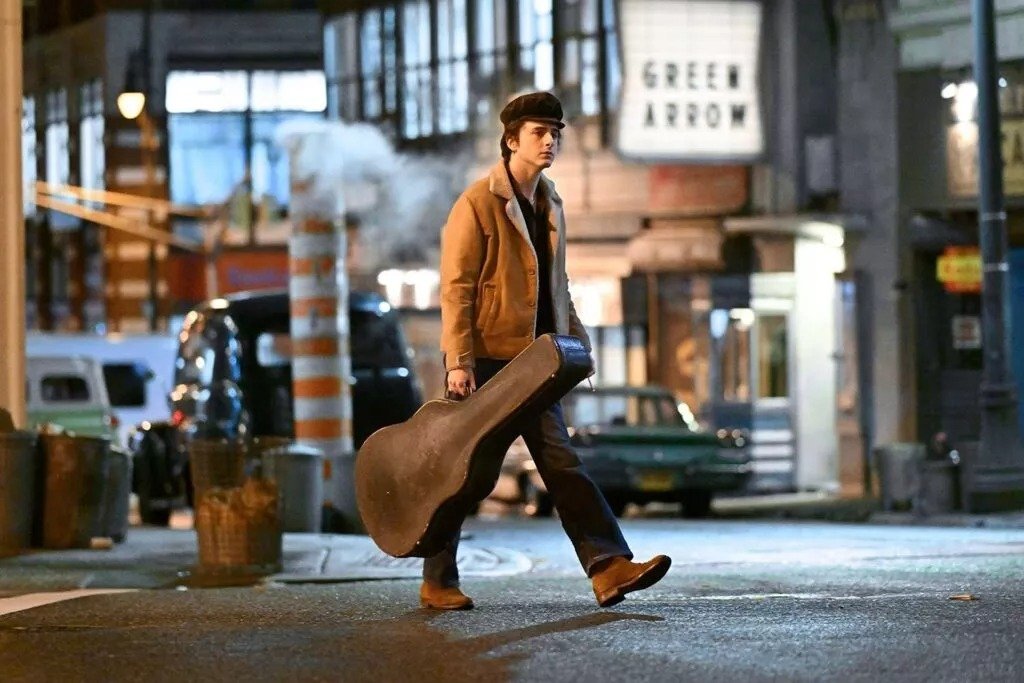
This was a sacred moment demanding undivided attention. Being a Bob Dylan fan since childhood, I wanted to watch the biopic “A Complete Unknown” in the darkness of a proper cinema. And the money would be well spent.
Teenage daughter in tow – not so much for the company or the “Is that your dad? I thought he was your brother!” compliments – but for a masterclass in music history, specifically American folk and folk-rock, a deep dive into what I consider the most crucial period in the giant songwriter Bob Dylan’s life: the 1960s.
When he first appeared in New York’s Village with a guitar and two pennies to his name, before writing and performing the epics that would transform the music and songwriting landscape – “Blowin’ in the Wind”, “Tambourine Man”, “Like a Rolling Stone” and of course, the iconic “The Times They Are A-Changin'”.
Because indeed, times were changing. And so was Bob Dylan, for everything flows, as our ancient ancestor said. With an acoustic guitar and a harmonica, Dylan – born Robert Allen Zimmerman – became a symbol of revolutionary folk music crying out for justice, equality and peace, in an era when humanity stood on the brink of nuclear destruction.
His – now Nobel Prize-winning – lyrics proclaimed: “Come mothers and fathers throughout the land and don’t criticise what you can’t understand, your sons and your daughters are beyond your command, your old road is rapidly agin’. Please get out of the new one If you can’t lend your hand for the times they are a-changin'”.
Yes, times were changing. As they always do. And as always, most of us ignore the small and large, personal and collective fault lines, continuing our deep sleep instead of seizing the moment to break our chains.
Dylan saw it differently. Growing alongside his songs, he reached a point where he said “enough”.
Enough of labelling me as a “folk” performer, enough of putting me on a pedestal as a revolutionary, I’m not a stereotype or anyone’s flag, I want to live freely, write what I want, play whatever music I fancy. And he did just that.
He introduced a rock band into his act and expanded his repertoire wherever his soul led him (something he would continue throughout his career), provoking the wrath of folk purists and jeers from some concert-goers who wanted him to stand forever in the middle of the stage like a statue, with just a guitar and harmonica, singing about… change.
Leaving the cinema that rainy evening, I pondered what I wanted my daughter to take away from all this, beyond of course the excellent performance by her favourite, Timothée Chalamet, in the leading role and whether he truly deserves that Oscar nomination.
First, to have visually encountered an era and music very distant and far from her listening habits, yet whose echoes reach our time.
Second, that beyond the throwaway lyrics of most of today’s glittering music industry performers, a single line on a napkin could then – and still could today – change the world, if only it were true, authentic, sincere.
Third, that pursuing changes and upheavals – especially when comfortable – might save her soul, against the stubbornness of stagnant waters.
And fourth, when they try to box her in or she’s self-trapped like a hypnotised zombie, to break free before she breaks down.
But that would be a later discussion, coming organically through the known Socratic method, between father and daughter. For now, we’re voting Chalamet for the golden statuette.
In a deeply conservative society like ours – because that’s what we are – boxes serve as refuges of safety, inaction, and obedience.
Whether it’s the relentless hunt of political parties wanting to corral you, or people who must absolutely “colour” you, or our one-dimensional, imagination-devoid education, or parents projecting their failed dreams onto their children, everything around us conspires to make us conform to something we probably don’t want, something that makes us dizzy and sick.
Experts say these are symptoms of small societies. I’d put it differently, but I’d be censored. Dylan, however, showed the way.

