


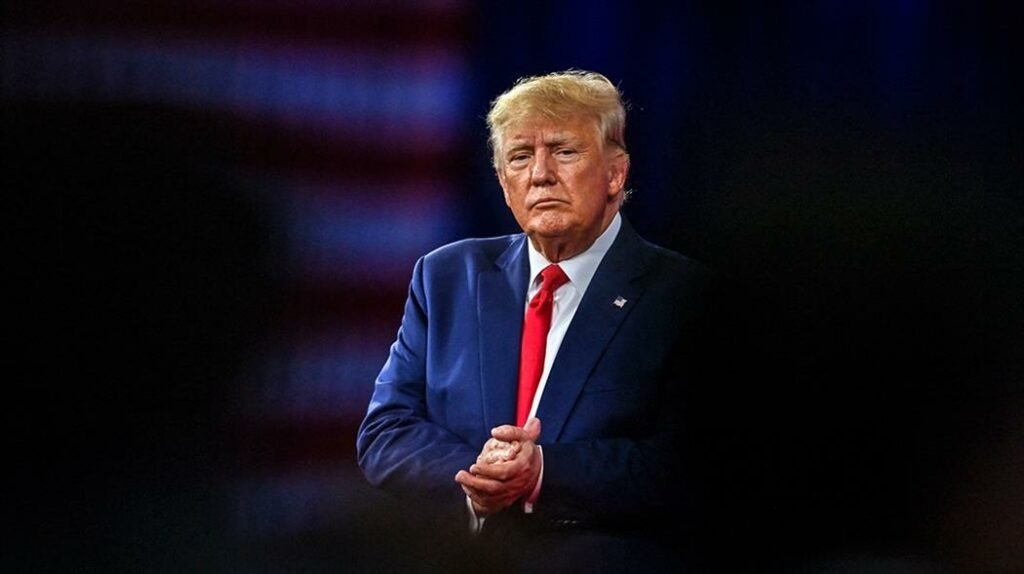
US President Donald Trump made good on his threat to impose 10 per cent tariffs on Chinese imports and 25 per cent on goods coming from Canada and Mexico, launching a potential trade war less than two weeks into his administration.
Trump signed three executive orders late Saturday afternoon at his Mar-a-Lago resort in Florida, launching the salvoes. Layered on top of those already in place, the tariffs will go into effect on Tuesday.
“President Trump is taking bold action to hold Mexico, Canada, and China accountable,” the White House said in a statement. “Chinese officials have failed to take the actions necessary to stem the flow of precursor chemicals to known criminal cartels and shut down money laundering by transnational criminal organizations.”
In announcing the unsettling moves, the White House added that the Trump administration was drawing on emergency powers to counter the influx of opioids and other drugs that “threatens the very fabric of our society”.
“This was done through the International Emergency Economic Powers Act because of the major threat of illegal aliens and deadly drugs killing our Citizens, including fentanyl,” Trump said in a post on X, formerly known as Twitter. “We need to protect Americans, and it is my duty as President to ensure the safety of all.
The levy on imports of Canadian oil would be reduced to 10 per cent under the new orders, seen as part of a bid to moderate politically explosive prices at US gas pumps.
The three nations are America’s biggest trading partners and together account for nearly half of all US imports.
While the announced import taxes are below levels of up to 60 per cent on Chinese imports that Trump said he would impose during his election campaign, they sow uncertainty across vast swathes of the global trading system, analysts said.
The White House also referenced China’s “intellectual property theft, forced technology transfer, and other unreasonable behaviour”, as well as illegal immigration “including a rising number of Chinese nationals and people on the terror watch list”.
Trump’s strategy aims to force major US trading partners to take more decisive action on the fentantyl crisis and escalating migration at US borders.
All three trading partners have threatened to impose retaliatory tariffs of their own, which the White House has addressed in Saturday’s order by including a mechanism to escalate the rates if the countries retaliate.
The hard-hitting executive order calls China out for “actively sustaining and expanding the business of poisoning our citizens”, adding that despite several attempts to resolve the crisis, Chinese officials have “failed to follow through with the decisive actions needed to stem the flow of precursor chemicals to known criminal cartels and shut down the money laundering”.
The order adds that China has the world’s most sophisticated surveillance network and domestic law enforcement system and “routinely exerts extraterritorial reach across the globe to threaten, harass, and suppress what it views as political dissent” yet is “simply unwilling” to blunt the fentanyl epidemic.
“I will not stand by and allow our citizens to be poisoned, our laws to be trampled, our communities to be ravaged, or our families to be destroyed,” Trump said in the executive order.
The order added that if the US Secretary of Homeland Security determines that China has taken “adequate steps” to alleviate the opioid crisis and the president agrees, the tariffs will be removed.
If China fails to act, however, the Trump administration will “recommend additional action” against China, it added, without providing specifics. The White House addded that its actions were “consistent with law”.
The orders also removes duty–free de minimis treatment, a system that exempts goods valued at US$800 or less from duties and stringent screening, for the three countries.
The moves against Canada and Mexico – two of US’ closest allies – could undercut a continent-wide free-trade agreement Trump negotiated and signed in 2018 and suggest that no one is exempt from Trump’s tariff threats.

Mexican President Claudia Sheinbaum speaks during her daily press conference at the National Palace in Mexico City in December. Sheinbaum signed a decree to increase tariffs on manufactured goods by 35 percent and on the import of textile goods by 15 percent, except for markets with which there is a free trade agreement.
They also leave many questions about timing and implementation and whether products services or industries other than Canadian oil would receive exemptions.
“The devil’s in the details,” said Nicole Bivens Collinson, managing principal with trade law firm Sandler, Travis & Rosenberg, formerly with the Office of the US Trade Representative (USTR).
The executive order specified that tariffs would be implemented on Tuesday, but goods on vessels by midnight Friday January 31 would not be subject to the import duties.
North America and the global economy are now in uncharted waters,” said Abishur Prakash, founder of The Geopolitical Business, a Toronto-based advisory firm. “There is no precedent or playbook for what is happening. Even Trump’s first term and trade actions pale in comparison to what is taking place today.”
Speaking with reporters in the White House on Friday, Trump said Washington would target computer chips, steel, aluminium, copper, pharmaceuticals, oil and gas imports as early as mid-February without clarifying how that dovetailed with Saturday’s announcement.
The barrage against America’s closest neighbours underscored that no nations are exempt. Trump added Friday that he “absolutely” wants to hike tariffs on the European Union as well, which has “treated us so horribly”.
“That’ll happen fairly soon,” Trump said, speaking with reporters in the Oval Office.
Among retaliatory tariffs that Canada has threatened to impose, including an export tax on oil aimed at undercutting Trump’s bid to avoid higher prices. Claudia Sheinbaum, Mexico’s president, has suggested her country could impose its own retaliatory tariffs without providing specifics.
Trump, 78, has long seen tariffs as something of a cure-all. Recently he has teased an across-the-board global tariff, claiming they could raise US$1 trillion in additional annual revenue.
Most mainstream economists say tariffs are paid by US importers and largely shouldered by consumers but Trump sees them as a way to revitalise American industry and return to a “golden age”.
“Tariffs are going to make us very rich and very strong,” he said.
Reaction to the move, both positive and negative, was swift.
The US Chamber of Commerce said Saturday that fighting fentanyl addiction and “broken borders” was valid, but using emergency trade powers was “unprecedented, won’t solve these problems, and will only raise prices for American families and upend supply chains”.
Others expressed similar concerns.
Bob Hemesath, an Iowa farmer and chairman of non-profit group Farmers for Free Trade, said the agriculture industry was already struggling. “Placing tariffs on the three largest export markets for American farmers and ranchers, particularly for an extended period of time, would have severe consequences,” he added in a statement.
And Greta Peisch, a partner at law firm Wiley Rein and former general counsel at the USTR, termed it “an aggressive assertion” of presidential power that is “testing the boundaries of trade authorities delegated by Congress”.
Saturday’s tariffs could be the first salvo in a potential global trade war leading to mounting costs, disordered supply chains and lost jobs, analysts cautioned.
Trump acknowledged the potential for unwelcome consequences on US consumers, but indicated that it was worth the cost. “There could be some temporary, short-term disruption, and people will understand that,” he said.
MSN REPORT

