


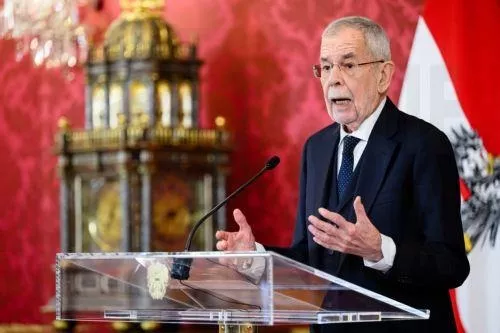
In a historic move, Austrian President Alexander Van der Bellen on Monday tasked far-right leader Herbert Kickl with forming a government after coalition talks excluding the Freedom Party of Austria (FPÖ) collapsed.
The FPÖ emerged as the top party in Austria’s September elections for the first time, securing nearly 29% of the vote. However, the party had struggled to find partners to form a national government until now.
Speaking after a one-hour meeting with Kickl, Van der Bellen said he entrusted the far-right leader with forming a government alongside the conservative People’s Party (ÖVP) due to the “new situation.”
Coalition negotiations between the conservatives, Social Democrats, and Liberals broke down over the weekend.
“Mr. Kickl believes he can find viable solutions… and wants to take on this responsibility,” Van der Bellen stated. “Therefore, I have asked him to begin discussions with the [conservative] ÖVP to form a federal government,” adding that the decision was “not an easy one.”
Far-Right Leadership Sparks Protests
While the FPÖ has joined Austrian governments in the past—most notably since 2000—this marks the first time the party will lead coalition talks.
Analysts told AFP that a far-right-led coalition with the conservatives as junior partners is now “highly likely.”
Hundreds of protesters gathered outside the presidential palace in Vienna’s Hofburg, chanting “Nazis out” and holding signs that read, “We don’t want Austria ruled by far-right extremists.”
Van der Bellen had initially requested that the long-ruling ÖVP, which placed second in the election with 26% of the vote, form a stable government that respects the “foundations of our liberal democracy.”
However, on Sunday, the President acknowledged the “new situation,” noting that “voices within the ÖVP that ruled out cooperation with… Kickl have significantly quieted.”
Controversial Leadership
Kickl, who took over the FPÖ in 2021 after it was mired in scandals, has drawn criticism for incendiary rhetoric, including referring to Van der Bellen as a “senile mummy.”
He has also used language reminiscent of Austria’s Nazi-era history, calling himself a future “Volkskanzler” (People’s Chancellor), a term associated with Adolf Hitler.
Political Shifts
Following the collapse of coalition talks on Saturday, conservative Chancellor Karl Nehammer announced his resignation as both Chancellor and ÖVP leader, citing the need for a “smooth transition.” Nehammer had held both roles since late 2021.
In a significant reversal, the ÖVP, now led on an interim basis by Christian Stocker, stated Sunday that it would enter coalition talks with the far-right FPÖ if invited.
“This country needs a stable government right now, and we cannot keep wasting time with election campaigns,” Stocker said.
Nehammer had previously declared himself the “force of the political center” working to build a “bulwark against radicals.”
Meanwhile, Kickl dismissed the failed coalition parties as “losers” on Saturday, blaming them for “three wasted months” and accusing them of creating “chaos instead of stability.”
The FPÖ, while never leading Austria’s national government, has governed at the regional level, heading one provincial administration and participating in four others across the EU nation of nine million people.

