


In March, when Cyprus President Nikos Christodoulides and European Commission President Ursula von der Leyen traveled together from Bucharest to Cyprus, few noticed that behind this significant development for Nicosia was once again Washington. The European Union’s failure to exercise a substantial foreign policy as a unified entity was once again evident to those closely monitoring developments not only within Brussels’ sphere but also beyond.
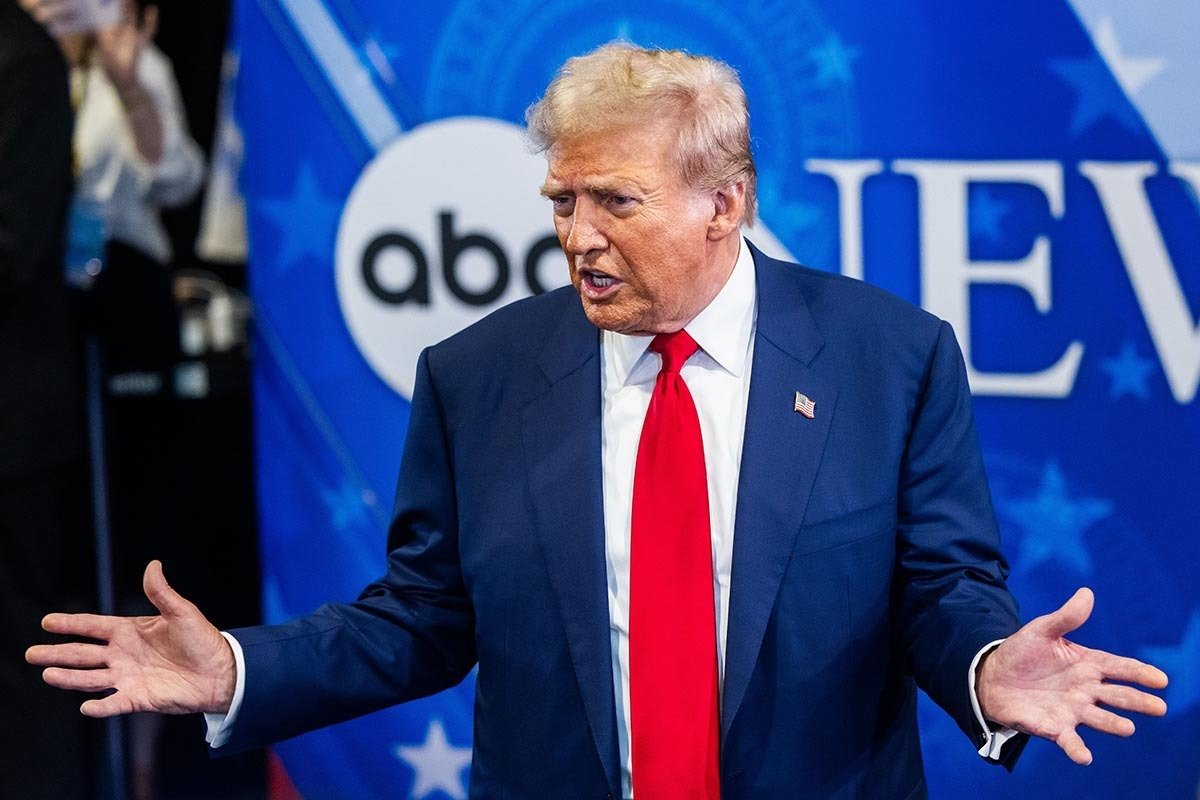
The return of Donald Trump to the White House is causing alarm and concern within the European Union over a range of issues, from the economy to energy and trade. The EU’s major test as a political entity lies in its ability to formulate an independent foreign policy. This is an area where the EU has struggled since its inception, often opting to keep a distance—an approach that diminishes its standing as an entity in front of its interlocutors, with subsequent implications in other areas as well.
The March event demonstrated that the EU, instead of playing its own leading role, chose to follow in the footsteps of the United States. These moves are not about NATO-related alliances, but about the fact that the EU has yet to establish an independent foreign policy. Even on issues that negatively affect the EU itself, it allows matters to unfold according to Washington’s agenda.
For many years, it appeared that the EU’s inability to pursue a cohesive foreign policy stemmed from the stance of its member states—particularly the powerful ones—who wished to retain control over foreign policy matters. These nations were reluctant to leave foreign policy in the hands of the bureaucrats in Brussels. Some also believed that the United States, through NATO, was undermining a unified European foreign policy in one way or another.
Indeed, these factors may have been true, but it is equally true that the EU itself never sought to play a significant role on the international stage. Even the presence of senior EU officials at international meetings was often more ceremonial than substantive. Despite efforts in recent years to give the EU a stronger voice on foreign policy issues, it remains far from achieving this goal. The EU still appears unable to act independently without Washington’s assistance, raising fears about the future, particularly with Donald Trump’s return to the international stage.
For years, Cyprus has been voicing its concerns about the European Union’s inadequate engagement in addressing complex issues. Since joining the EU in 2004, one constant point of reference for all Cypriot governments has been urging Brussels to play a more active role in resolving such problems. Because this call was often linked to the Cyprus issue, EU bureaucrats in Brussels and elsewhere tended to interpret it as an attempt by Nicosia to sidestep the issue from the United Nations, among other bodies.
The EU’s approach, as understood by its bureaucracy, was that the Cyprus issue was a matter for the United Nations. Regardless of the fact that the problem involved an EU member state, the EU’s primary goal was to keep the issue at arm’s length from itself, due to the absence of a unified foreign policy.
While the EU had the mechanisms to implement numerous decisions it made, it struggled when it came to foreign policy. Although it could impose punitive measures on plastic bottle caps, it failed to enforce compliance with decisions related to foreign policy issues, like the Cyprus problem. The Russian invasion of Ukraine was a turning point, prompting the EU to reconsider its stance and recognize that it could no longer remain detached from major global issues.
However, it soon became evident that this shift in approach was narrow and focused solely on the Ukrainian case and Russian aggression, as it had a direct impact on several EU member states that had not forgotten Soviet occupation during the Cold War. In contrast, the EU was largely absent from other issues like the conflict in Gaza (the most recent example), Syria, and Libya.
President Christodoulides, speaking at the Economist conference in Nicosia on Thursday, highlighted the contribution of European Commission President Ursula von der Leyen in facilitating humanitarian aid to the Gaza Strip. However, he also pointed out that the European Union “woke up” too late, despite his own efforts and initiatives to support Cyprus’ humanitarian initiative.
When did von der Leyen board the plane to Cyprus to be briefed on the “Amalthea” initiative? It was only after Washington had suggested that there was a proposal in Cyprus that could be implemented and that the EU could play a significant role. Prior to this, the EU had been entirely absent from any efforts to address the humanitarian crisis unfolding in Gaza.
In his speech, Christodoulides further stated that “the EU, now more than ever, especially in the current context, is called upon and must play a significant role in the region, thereby enhancing its strategic autonomy.” He emphasized that “our message to Brussels regarding the region is clear: the EU must play a substantive role. It cannot be content with a passive observer role if it wants to achieve its strategic autonomy.”
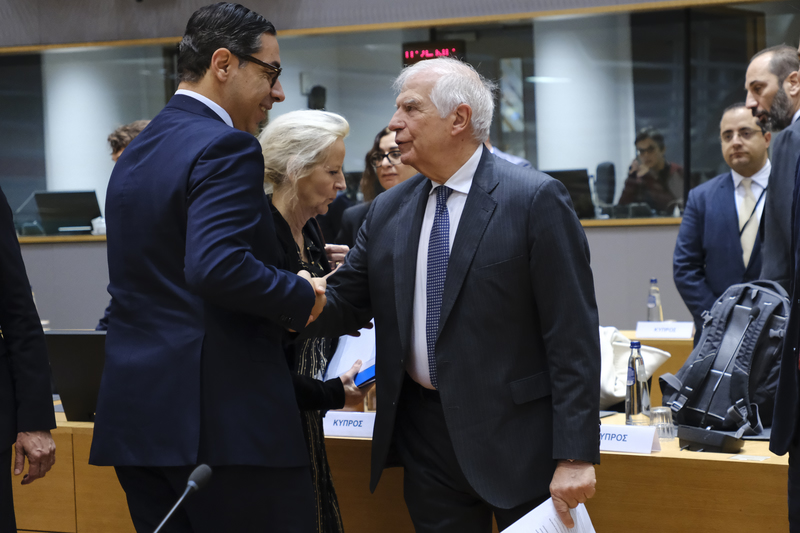
Constantinos Kombos, perhaps in the best position to highlight the ongoing gaps in the European Union’s foreign policy, took the stage and, effectively picking up where President Christodoulides left off, noted that the EU “is potentially a huge player that has chosen to act as an observer.” He added, “In my opinion, the EU has failed. We have become irrelevant in the discussion. The bloc is fragmented and largely acts as an observer of events.”
One point widely recognized both within and outside Brussels is that the EU must now chart its own foreign policy. This does not mean it will find itself in opposition to, or conflict with, Washington. On the contrary, by strengthening its role in its own neighborhood, the EU may force the U.S. to adopt a different approach to decision-making. The cost of these decisions will be borne by Europe due to its proximity, while the U.S. may face little to no cost, or, in the end, may even benefit.
Restarting the Effort
Earlier this week, in an interview with Euronews, Foreign Minister Kombos emphasized that efforts to send humanitarian aid to the Palestinians in Gaza are ongoing.
According to Kombos, “All necessary arrangements have been made for the resumption of the effort through an alternative point of entry for aid, while still following the same model and cooperation protocols.” He added, “Ultimately, one must look at the cold numbers.”
He pointed out that “over 20,000 tons of humanitarian aid have arrived in Gaza” and, responding to critics who argue that this is insufficient, he noted that the alternative would have been “having 20,000 tons less in shipments.”
Power Comes Through the Union of Forces
Just before stepping down from his position as High Representative of the EU, Josep Borrell acknowledged that European foreign policy faces challenges due to the inability to make quick decisions. “At the beginning of my mandate, I said that we need to learn how to use the language of power,” Borrell stated, adding, “This is even more true today than it was five years ago.” However, he emphasized, “To use the language of power, to show you have strength, you need to be united.” “Too often, we were not united. Too often, discussions took too long. You cannot pretend to be a geopolitical power if it takes days, weeks, or months to reach an agreement to act,” he stressed. He also acknowledged that he himself bears some responsibility for the delays in decision-making, as there were many instances where he acted in a “traditional manner,” with notable slowness. Delays in decision-making have been a long-standing issue for the EU.
Trump’s Election Presents an Opportunity
According to Borrell, Donald Trump’s election presents a significant opportunity for the European Union. Speaking on Monday, he noted, “Trump represents an opportunity for Europeans. Not just for us to wake up—we already woke up five years ago—but for us to use our capabilities and our working system to have a clear voice on the global stage. We need to invest more in security and defense. I’ve been saying this from the beginning. [Remember] when I said, ‘Is Europe in danger?’ in 2022. Remember when I said, ‘Europe is in danger,’ and presented the Strategic Compass? Increased defense capabilities, ammunition production, and a stronger Europe. Europe must develop its security and defense. This is the job of the High Representative – I want to remind you – the High Representative is not (only) the chief diplomat, he is also responsible for diplomacy, security, and defense.”

