


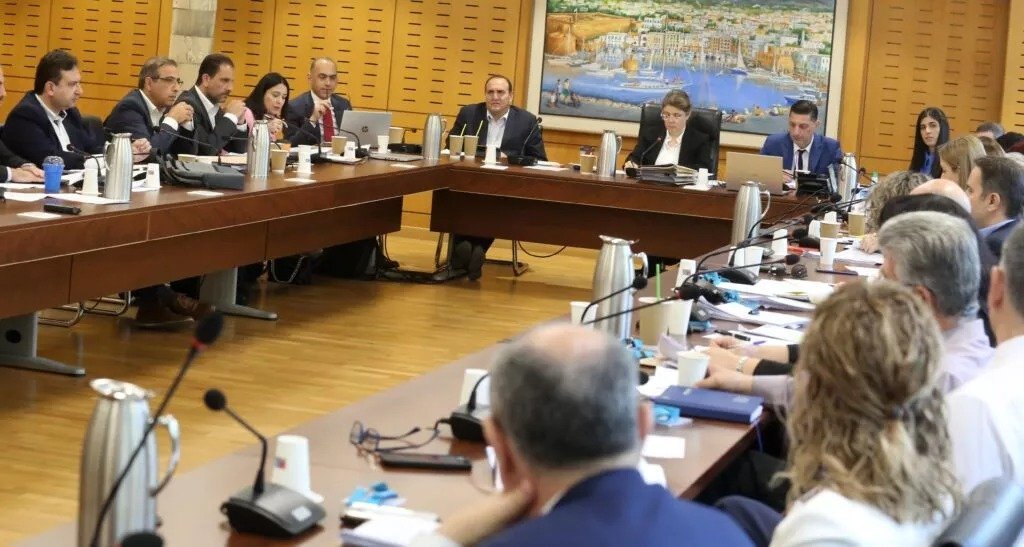
Professional associations are unanimously calling for amendments to the foreign investment screening bill, despite the Finance Ministry’s apparent reluctance to accept all proposed changes.
During discussions at the Parliamentary Finance Committee, business groups presented their shared request to modify provisions regarding the 25% minimum threshold that defines control of a business or legal entity.
Stakeholders suggest raising this to 25% plus one share to align with anti-money laundering legislation.
The associations are also seeking exemptions for ship investments (both newbuilds and acquisitions) from the law’s scope.
They note that investments in LNG carriers can reach between $250-300 million in today’s market, pointing out that such investments through Special Purpose Vehicles (SPVs) typically involve multiple investors.
Additionally, they are requesting the introduction of an investment threshold below which notification to the Competent Authority would not be mandatory.
In their parliamentary submission, they argue that completely eliminating the minimum threshold for notification and approval requirements across all sectors is misguided.
“A different approach based on categorising ‘critical infrastructure’ and ‘sensitive facilities’ for each ‘particularly sensitive sector’ would ensure a more flexible yet targeted control mechanism, with separate investment thresholds based on current market conditions”, they stated.
CIBA representative Pantelis Christofides emphasised the importance of implementing the screening mechanism, citing examples from other EU countries.
He referenced Germany’s use of the mechanism to block an Italian bank’s majority stake acquisition, and Spain’s intervention to prevent the purchase of railways partially owned by the Hungarian government.
Ministry of Finance representative Michael Iakovides said the bill attempts to strike a balance, noting that the 25% provision is not applied in other countries and that the legislation relates to critical infrastructure rather than anti-money laundering.
The committee will begin article-by-article discussion of the bill next week to expedite its presentation to parliament.
If the ministry does not agree to the requested changes, political parties are considering introducing them through amendments.

