


By Christos Kalli*
After almost a decade of abstaining from Cypriot weddings because of my expatriation, I was invited to a personal friend’s nuptials. During the awkward dance between the bride and the groom, I turned to the friend who accompanied me that evening and asked, ‘What are we doing here?’
The question was prompted by the chatter between the guests, the orchestration of reactions, the keen eyes on the wedding dress, the organisation of the big round tables, the spectacle of the lights, the epic scale of the high-ceiling venue. The ‘we’ of my question constituted something larger, not in the room, an ambient system. I was not necessarily attempting to find the reasons for attending this or any other wedding, but the consequences and implications of doing so. Taking my question as generously as possible, my interlocutor responded: ‘We are celebrating the love of our friends.’
Although a fitting response to a wedding taking place on the Island of Love, I could not reconcile my friend’s Romantic answer with how public, decorated and calculated (in every sense of the word) love became for the period of a single day. During the wedding, as expected, I was directing time, attention, money, and emotions to something that felt bigger than the married couple and in fact unrelated to them, packaged as love yet regardless of it. In that sense, it felt like an initiation, an investment, and a promotion.
Religion and economy have calcified marriage in the centre of the island’s identity, providing the foundational coordinates for its historical persistence. But to understand what continues to shape this cultural superstructure today, we need to turn to the mores that have changed over time and those that have remained surprisingly unchanged.
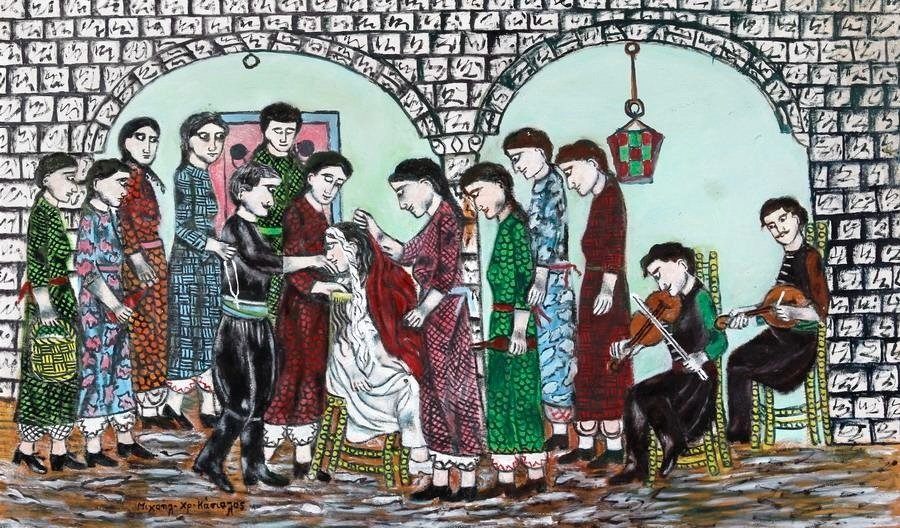
In the early 20th century, traditional Cypriot weddings—visualised by artists such as Michael Kashalos and more recently George Mavros—were characterised by their expansiveness, as socio-religious events that centred the community. Word of mouth travelled through each village and the surrounding communities, resulting in an event of considerable scope and a near open-door policy. Wedding celebrations before and after the church ceremony occurred entirely in the fields to accommodate the large number of “guests” and utilise the agricultural wealth.
The Turkish occupation of 1974 and the subsequent mass migration to the South produced long-standing effects on the Cypriot wedding. Noticeable changes manifested progressively because of or alongside a complex set of national processes: rapid infrastructural development and urbanisation, the growth of the tourism industry, an increase in international tertiary education, a diversification of culture, and the simultaneity of a fracture in community living yet an accumulation of more social ties in an occupied and now even smaller island.
The end of the 1990s signals the industrialisation of the Cypriot wedding, first with the rise of wedding venues, such as Panorio Palace and Cosmyria. As the names of these two venues suggest—with connotations to aristocracy and the cosmos respectively—weddings were embellished as epic affairs. This embellishment was compounded in the early 2010s with the popularisation of hotels as wedding venues, such as Golden Bay Hotel. The rise of the hotel in this industry, and later the rise of other smaller venues like wineries and wellness resorts, either necessitated or coincided with a time in which the unvarying scale of the traditional Cypriot wedding was being reconsidered.
With this reconsideration came the pressure to develop a more sophisticated invitational strategy to accommodate the close-knit community, maintain the financial character of weddings, yet adjust qualitatively the openness of the celebration. These wedding venues did not merely introduce a physical space for wedding celebrations that were previously held in the fields. They physicalised a social class system that was becoming increasingly more prominent during this time on the island. They also provided a structure for “civilising” and aestheticising a process that was marked by the lifestyle of previous generations.
Despite these developments, the Cypriot wedding has maintained an incredibly stable affective and linguistic character. The Cypriot wedding day is punctuated by a series of salutations, greetings, and blessings that accomplish a lot more than well-wishing. Single guests, unmarried couples, or people whose relationship status on Facebook may simply be ‘It’s complicated’ will hear the phrase ‘και στα δικά σου’ repeatedly during a Cypriot wedding. Meaning ‘and to yours,’ it is an expression of hope that you or your children will also be getting married soon. As it turns the attention away from the couple’s present wedding to direct social pressure into future weddings, a phrase as ordinary as this is infused with the high ambition of continuing this tradition.
Unmarried guests will also likely hear ‘εισαι επομενος,’ which translates to the almost threatening ‘you are next.’ As with the previous wish, the underlining aspiration of this rhetorical artefact is the expansion of this tradition, by establishing a wedding order based primarily on age. Turning the wedding into a form of relay (a la catching the bouquet), these linguistic cues move beyond the marrying couple and the temporal limits of their wedding day to reemphasise marriage as an ideal. In the context of an industry that depends on numbers rather than people, everything from the invitation as a recruitment tool to the venue becomes a self-promotional advertisement for the benefits of marriage itself.
But this is symbiotically about the forced placement of marriage within a larger seemingly organic structure. It is difficult to see marriage as a choice when law, society, culture, and the dominant religion are designed to leave unrecognised those who remain unmarried. Yet, marriage is not only seen to be a choice but also an achievement, in the same way, that weddings are treated as an epic celebration in Cyprus—an achievement and a celebration that, in their hypervisibility, others are inspired to pursue. If marriage in Cyprus is an achievement, what exactly is it an achievement of? Escaping the dread of the dating scene, being able to split the bill, moving out of the family house? And, if it is an achievement, why is it an achievement that so many people, in the LGBTQ+ community or alternative romantic formations, are occluded from, either legally or socio-culturally?
This multifaceted national recognition shows that marriage has not only been aligned with human rights but integrated within the very idea of the human, the well-roundedness of living and belonging in the networked social space of the island. It is an endless well-roundness, or at least the pursuit of it is. One of the most common wishes directed at the married couple during a wedding is ‘καλούς απογόνους,’ which means ‘good offspring.’ The cycle continues and collapses into the very cycle of life.
*Christos Kalli reads and writes about poetry at the University of Pennsylvania. Visit him at www.christoskalli.com.

