


“The Green Line is not a border, and we do not want it to become one,” Deputy Minister of Migration and International Protection, Nicholas Ioannides said Wednesday.
He emphasised that the Republic of Cyprus does not accept ‘migrant flows’ through the Green Line and aims to prevent it from becoming a migrant route.
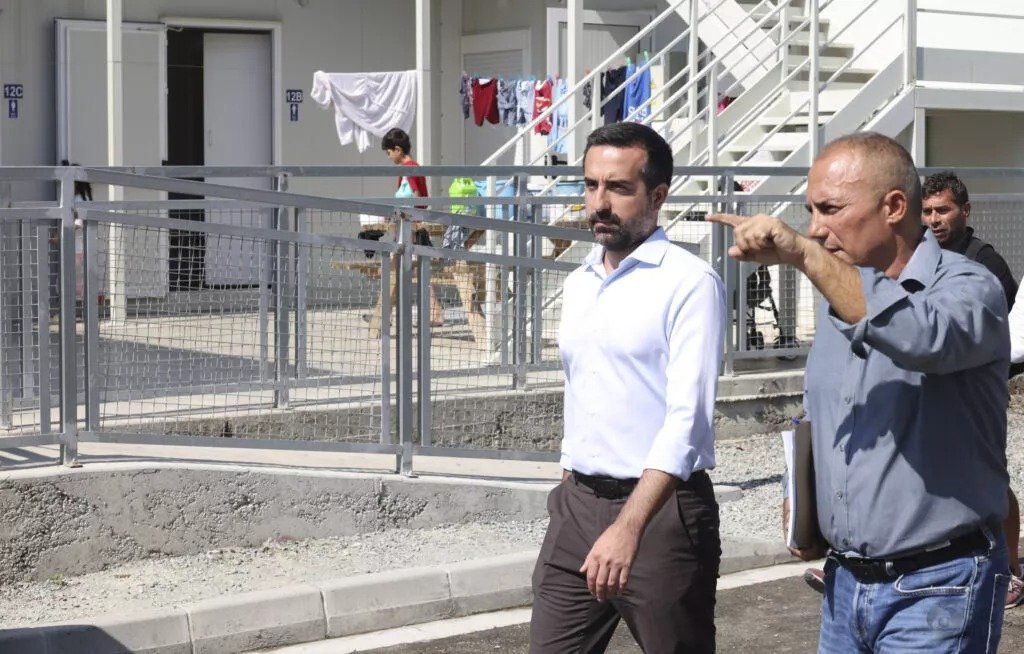
During a visit to the Kofinou Reception and Accommodation Center for Applicants for International Protection and the ‘Limnes’ Hospitality Centre, Ioannides addressed arrivals of people migrating through the buffer zone and Cyprus’s refusal to process the asylum applications of some, leaving many stranded.
“We must clarify that we do not want a conflict with the Peacekeeping Force or the UN High Commissioner for Refugees, which is why we are in dialogue with them to resolve this problem,” he said.
He added that the issue extends beyond those stranded in the buffer zone, highlighting concerns about migrant flows from Turkey through the occupied areas into government-controlled regions. “The Republic of Cyprus has decided that it will not accept flows through the Green Line, at a time when we have managed to have zero sea crossings. We do not want to create a new route,” Ioannides asserted.
The Deputy Minister reaffirmed that the government’s strategy is to prevent migrant flows through the Green Line. “That is why we are in dialogue with the UN High Commissioner for Refugees to resolve the problem of the people already there and to regulate the situation in general so that the Green Line does not become a migrant route,” he added.
When asked if the situation at the Green Line would persist indefinitely, given the numerous crossing points, Ioannides responded, “It is not a route, precisely because the Republic’s authorities do not allow the passage of these individuals. We have the Green Line Regulation, which allows us to effectively monitor the Green Line regarding illegal immigration.”
He emphasised a need to keep a balance between policy and humanitarian concerns, stating, “We do not ignore the humanitarian aspect, which is why we provide assistance and whatever these people need. However, on the other hand, we must balance between our policy, our position that we will not allow migrant crossings, and at the same time, taking into account the humanitarian factor.”
Regarding EU involvement, Ioannides clarified, “The EU is currently not involved, and there is no need for it to be. What is important is that there is no intervention from the EU, i.e., no pressures have been exerted on the Republic of Cyprus because they understand the situation.”
He reiterated, “The Green Line is not a border, and we do not want it to ever become one. It is a peculiar case; we have a military occupation, and we must take this fact into account. It is not what happens in other European states where migrants cross borders with other countries; we have a military occupation, and we must consider these different rules in addressing the situation.”
Reflecting on his visit to the Kofinou Hospitality Centre, Ioannides noted, “I wanted to personally assess the situation at the Kofinou Hospitality Centre and also see the progress of the works at ‘Limnes.'”
He reported decent living conditions at Kofinou, with asylum seekers receiving necessary amenities, including air conditioning, food, and education for children.
Regarding ‘Limnes,’ Ioannides described it as a significant project under construction, with a capacity for a thousand people and an additional 800-bed pre-departure centre.
He emphasised that these centres are temporary accommodations for asylum seekers awaiting the processing of their applications.
International organisations have accused Cyprus of failing to uphold international law by denying migrants access to asylum procedures.
Both the United Nations High Commissioner for Refugees (UNHCR) and the United Nations Peacekeeping Force in Cyprus (UNFICYP) claim that the Republic of Cyprus is pushing back asylum seekers to the buffer zone.
Activists said that police are even rounding up people who arrive in Pournara to apply for asylum, put them inside vans and transfer them to the buffer zone.
The Cyprus Mail yesterday reported that 46 migrants are suing the government over the alleged pushbacks.
Read more:

