


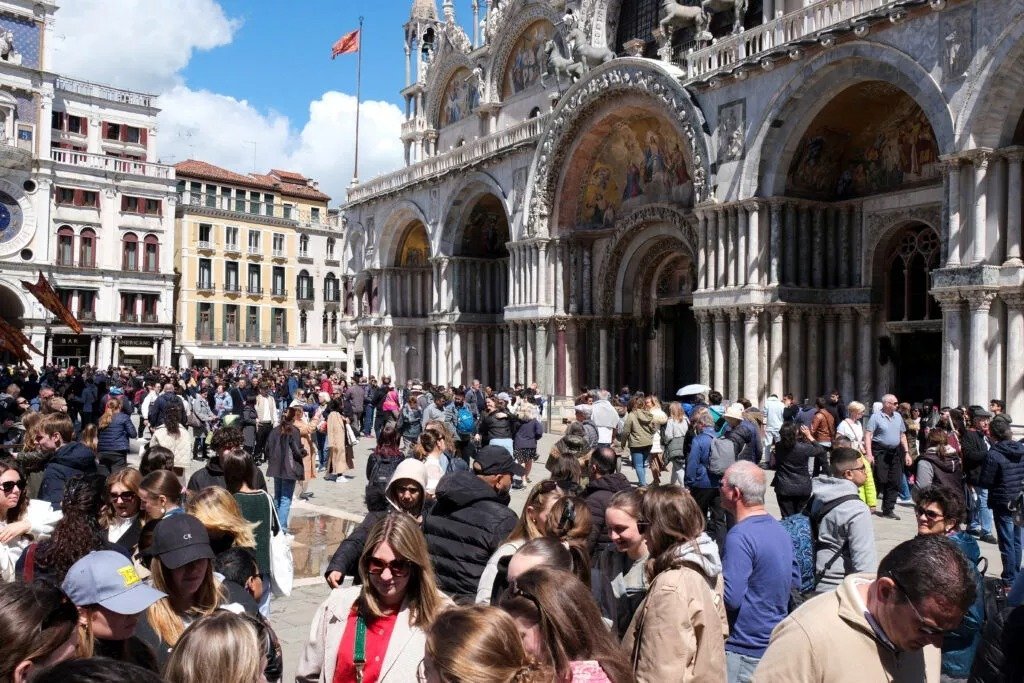
Governments invest in expensive advertising campaigns to attract tourists, while at the same time, residents have organised movements against the influx of holidaymakers and the disruption of their own lives.
In an interview with Phileleftheros, marketing and tourism expert, Professor Antonios Giannopoulos analyses the phenomenon of over-tourism and the backlash by local communities.
Doors, walls, bus stops, and columns in Malaga have been plastered with stickers and slogans against tourists! In the Canary Islands, walls are being graffitied in English with the message, “Tourists go home.”
Authorities in Venice have imposed entry fees on visitors, while Japan has decided to build a large black fence blocking the view of Mount Fuji from certain angles.
The reason behind these reactions is the hordes of tourists in places where they are no longer wanted by a large section of the local population. Mass tourism, they say, is destroying our cities. And this chorus of discontent is being heard in historic cities across Europe, from Prague to Barcelona, Athens to Amsterdam.
This should come as no surprise, given that many popular city destinations now host 20 or more visitors annually, per resident.
What’s more ominous for these cities is that official tourism figures are likely underestimates as they rarely capture visitors staying with friends or relatives, those exchanging homes, using short-term rental platforms, or day-trippers who don’t stay overnight.
The result is strangers coming and going in apartment buildings, crowds of visitors squeezing through narrow alleys, parties in neighbourhoods of working-class residents, and small and large-scale quarrels, with locals trying to go about their daily lives amidst the chaos.
Initially, the rise in tourist numbers was applauded by local tourism industries and state-funded tourism marketing campaigns. Most residents stood by and watched, attracted by the revenue flowing into local economies. Now, they can no longer bear the burden and have decided to take matters into their own hands, hence the increasing number of reactions.
The solution is not to stop tourist flows, as this seems impractical and contradictory. On the one hand, states are promoting their tourist attractions, and on the other hand, local communities are protesting against more tourists. A delicate balance must be found between the much-needed revenue and job creation from tourism and the quality of life for residents. In other words, a balance between tourism management and discouragement or containment.
Dr Antonios Giannopoulos, Assistant Professor at the Department of Organisation Management, Marketing and Tourism at the International Hellenic University discusses the phenomenon of over-tourism and ways to manage tourist destinations.

It’s a question of proper management
What is over-tourism? Are there specific numbers or accepted ratios regarding the relationship between the local population and visitors?
First of all, let me disagree with the use of the term ‘over-tourism.’ Not because the issue it refers to doesn’t exist, but because the term itself is misleading and distracts us from finding solutions to the problem. The phenomenon of over-concentration, mass arrivals, or tourism flow saturation certainly has a lot to teach us. The problems created are enormous, and they stem primarily from the mismanagement of tourist destinations, not from ‘over-tourism,’ as it is commonly labelled.
Let’s not be blind to the issue by attributing the notion of excess to tourism. It is a question of problematic destination management in Greece, Cyprus, and worldwide. If we want to address this issue effectively, we must look beyond simple indicators of visitor numbers relative to the local population and consider other factors. For example, the number of overnight stays or available rooms compared to the local population, the operating season of hotels, the existing human resources employed in tourism relative to the population, the area/destination size in square kilometres, and the available resources for tourists and locals, such as water supply, telecommunications, and other infrastructure. Therefore, we are dealing with a multi-faceted issue concerning supply and demand, stemming from inadequate destination management.
What are the environmental, social, and economic impacts of over-saturation by masses of tourists in certain destinations?
The World Tourism Organisation (UNWTO) has been addressing the concept of ‘carrying capacity’ for over 30 years. This refers to the ‘how far and how much’ question—the limit that we must study for each tourist destination to avoid negative impacts on the natural, social, and economic environment.
Research and scientific knowledge contribute to this, not as an end in itself, but to find ways to tackle the phenomenon of over-concentration or destination saturation. As strange as it may seem, almost half a century has passed since scientific research categorised carrying capacity into physical, economic, perceptual, social, ecological, and even political aspects, including residential development in a destination.
How can popular destinations cope with this saturation of tourists while also ensuring revenue from their tourism products?
The answer lies in the words ‘Destination Management and Marketing Organisations.’ If we genuinely want to address the negative consequences of destination saturation, we must focus on their management and marketing rather than blaming ‘over-tourism.’
Let me give you an example. In the past, I had the opportunity to teach in classrooms overlooking the Panathenaic Stadium and the Acropolis, with students from some of the best universities in the USA. In the Tourism Management and Sustainable Development course, a unique ‘laboratory’ unfolded before our eyes daily during peak hours when tourist buses crowded in front of the Panathenaic Stadium, unloading hordes of tourists, creating unimaginable traffic, and leaving unpleasant images and sounds.
Everything, therefore, begins and ends with destination management, with a particular emphasis on marketing. And here, there is a serious misunderstanding. I am not just referring to promotion, advertising, or communication, but to the marketing strategy, which we fail to understand in terms of both significance and substance for destinations. In simple terms, how many and what kind of tourists do we want? Do we want to genuinely differentiate ourselves from other destinations in the international tourism market? If so, how can we provide a unique tourist experience? These are questions that require thoughtful consideration, drawing on knowledge, scientific research, and applied research in marketing and tourism.
We invited them to come
How effective are measures such as imposing special taxes, entry fees, or charges in certain cities and regions to address over-tourism?
As we conduct this interview, we are about to witness the implementation of such a measure in Venice, which has already introduced a fee for day-trippers entering the city.
This refers to the announcement to ban tourist groups of more than 25 people from June 2024. While such measures can have short-term effects on managing tourist flows, they do not exhaust the management and marketing of a destination by merely imposing penalties on those who have already chosen to visit an area.
Let’s not forget that it is our actions that brought these people to the destination through mass promotion and collaborations with agents, tour operators, and airlines, creating the conditions to ‘invite’ them to visit us.
We cannot utilise all available distribution and promotion channels to attract tourists and then, when they arrive by charter, put up a ‘prohibitive’ sign, suddenly telling them to turn back because ‘…there’s no room!’
We cannot seek the arrivals of daily cruise visitors while simultaneously blaming them for the harm they cause to our place by disembarking in large numbers. We must decide where we want to go as a destination; otherwise, we may end up somewhere else entirely.
Does overtourism threaten the industry’s prospects in the long run?
When there is a lack of moderation, we risk ending up somewhere we might not want to be. I often discuss this with tourism professionals and students, and the concern is so intense that the lecture could be titled, ‘Where are we going? Will we lose our jobs, and then what?’
Similarly, a few years ago, at an international conference, I had a conversation with an American academic colleague who pointed out that destinations following this path (referring to Santorini) exist in their country too, and they only decide to address destination management and marketing after experiencing disastrous consequences due to mismanagement.
Scientific knowledge exists, and gradually, a critical mass of young people is being equipped with the necessary skills to staff positions in Destination Management and Marketing Organisations when they are finally established to coordinate all forces in the destination ecosystem for sustainable development.
This will be the most significant reward for all of us academics and researchers who study the field and prepare the ground for the next generation, co-creating with the new ambassadors in the tourism and hospitality sector. Yes, we have indeed done a lot as a country to reach this level, and it is time to do more and give space and time for scientific knowledge to flourish in every destination!
Travel will not stop
Will travel continue at this high rate in the coming years, or have we already seen the biggest increases, with some stabilisation ahead?
The COVID-19 pandemic has left a lasting impact on the recovery of tourism to pre-pandemic levels, especially in Asian and Pacific destinations, according to the latest UNWTO data (specifically, tourist arrivals in 2023 reached 88% of pre-pandemic volumes).
However, the rapid growth in travel numbers is expected to continue globally, in line with forecasts projecting approximately two billion tourist arrivals by 2030. We are at a turning point, as Europe may soon relinquish its leading position in international arrivals to new and emerging destinations, mainly in Asia.
It’s important to note that the burden of mass arrivals will not affect all destinations worldwide equally. Even within Greece or Cyprus, different destinations are in different life cycle stages.
We are perhaps the last generation to experience a planet that is not as crowded with travel and tourism from country to country and destination to destination. Today’s reality is ‘click, book & go.’ People will continue to travel, and new trends such as digital nomads, the blend of work and leisure (bleisure), solo trips, and silver tourism create a highly competitive environment for tourist destinations. Destinations, in turn, will increasingly compete to claim a share of tourists’ wallets. What they must not forget is to also claim a share of voice to build an identity that ensures their sustainable development. Armed with knowledge in marketing, hospitality management, and destination management and marketing, we should not be concerned that travel will stop. Just as the journey of knowledge never ends, neither will the world’s desire to explore and discover.

