


Read the first part of the interview here:
IWW Cyprus: Only recourse is collective action – workers must be organised
The landscape surrounding workers’ rights is undergoing significant transformations, influenced by evolving labour laws, new technologies, rising precarity and ever-changing economic dynamics.
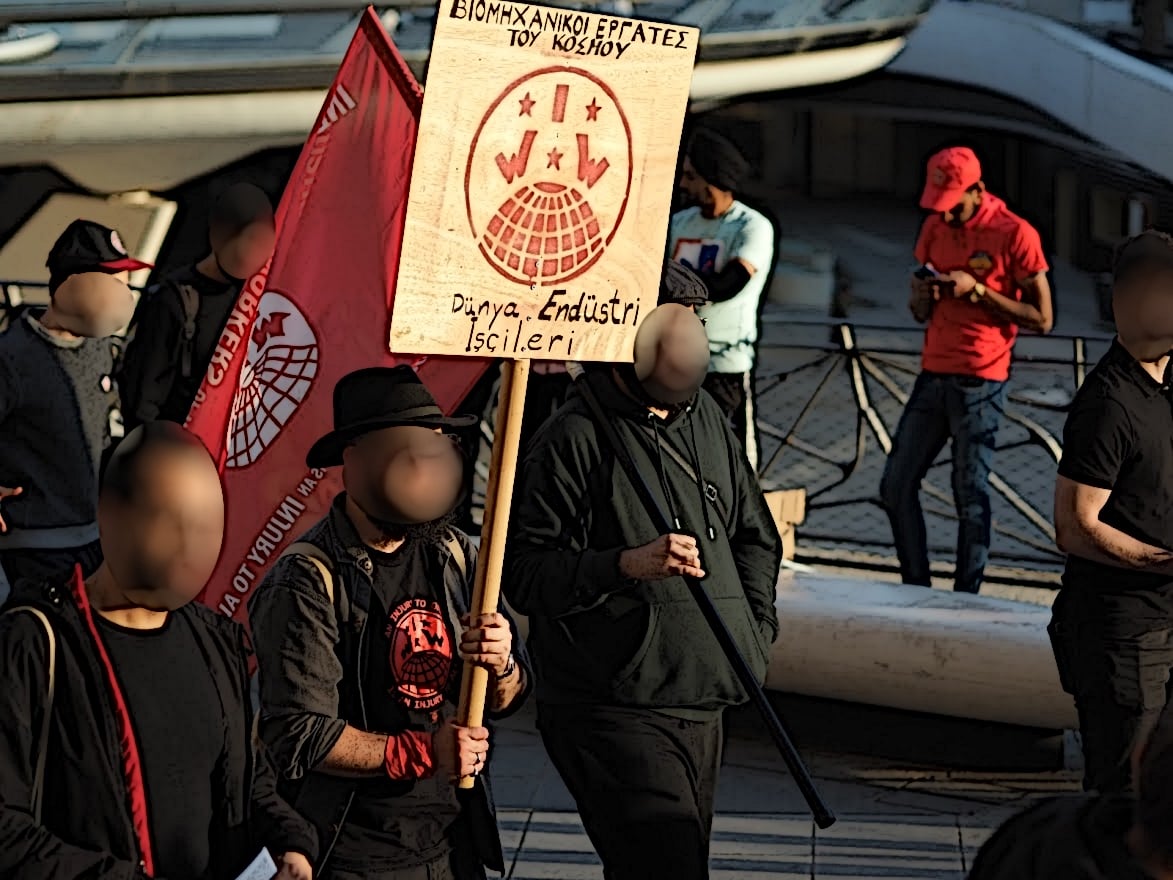
Amidst these changes, the Industrial Workers of the World (IWW), a global labour union first formed in Chicago in 1905, has been organizing in Cyprus since 2020, aiming to empower local workers, facilitate and support collective action, and challenge systemic inequalities in the workplace.
In an interview with in-cyprus, Alex P., the Secretary and Treasurer of the Cyprus Regional Organising Committee of IWW, speaks about the need for labour rights, collective action, and the role of grassroots organizing in safeguarding workers’ interests.
What makes your union stand out from more traditional trade unions?
It is important to keep in mind that the IWW was originally formed in 1905, and was from the beginning an alternative to the traditional trade unions of that era.
It was, and still is, a union for all those deemed unorganisable by trade unions (minorities, migrants, members of the LGBTQA+ community, and even women back then), including, to this day, entire professions, like sex workers.
It was from the start, and still remains, an international organisation, perfectly suited for workers who move around countries (whether by choice or by force) and want to find a group of supporters everywhere they land.
It was the first, and one of the few still, to organise prisoners as full members, which is the reason why prison guards are not allowed in our union; in fact, the Incarcerated Workers Organising Committee of the IWW was a lead organiser of the two largest prison strikes in the US (in 2016 and 2018), and they are currently working towards a third one this December.
Perhaps the most important difference between the IWW and traditional trade unions in Cyprus and abroad, a difference that played a major role in the formation of the IWW almost 119 ago, is considering that workers and employers have nothing in common; this statement is, in fact, the first sentence of our Constitution.
We understand that the conflicts between these two groups are fundamental and inherent in the capitalist social system, a system which must be uprooted if true human emancipation and balance with the environment are to be achieved.
As a result of this realisation, the IWW is not trying to be buddy-buddy with employers and government, and as such, despite being around for more than a century, it has not grown to resemble them; this is unlike the major traditional unions, whose close ties with employers, political parties and governments force them to adapt and function similarly to them, not to mention that their model of business unionism with paid officers makes them employers themselves.
This realisation is one of the reasons why the IWW is not organising police officers, in addition to the more pragmatic reason; the sad fact that the aim of police trade unions is to defend their members against accusations of brutality, excess force etc., and generally they prioritise advocating for the “liberty” of police officers to act uncontrollably and without consequences, over the improvement of their working conditions.
What about the way the IWW are organised?
Another major difference stemming from the above relates to the internal structure of our organisation.
Most traditional trade unions are not the temples of Democracy and membership control they claim to be. They are in fact bureaucratic, hierarchical organisations, led by paid officials usually elected unopposed in conventions that happen every few years.
The IWW is a horizontal organisation, which does not exist above and beyond its members. Branches and Regional Organising Committees (ROCs) hold monthly assemblies where all members have full participation rights, while general electoral conventions both local and international occur yearly, with limits to the re-electability of officers.
As workers, we spend the majority of our daily life in undemocratic workplaces, and the obligation to work oppresses and defines the entirety of our lives; trade unions are supposed to be tools to give us back some control in our lives, and this must be reflected in the way they function, internally and externally.
Contrary to traditional trade unions’ making decisions and even negotiating with employers behind closed doors and away from the eyes of their membership, the IWW is a fully transparent organisation, with the membership having the ability to monitor all the discussions and decision-making processes of the elected bodies, as well as receive an update about everything and anything the local and international bodies are up to in monthly newsletters.
It is important to note at this point that, for the past few decades, the vast majority of traditional trade unions have shifted away from the organisational model that the IWW is implementing, which means that they are not actively and efficiently trying to form a strong, tightly-knit membership base, able to perform consequential direct action when necessary.
Instead, they are pushing for the extension of labour rights and legal protections based merely on the number of their members, which they are trying to enlarge by providing certain services, like, for a Cypriot example, cheaper holiday homes for the summer.
These methods of unionising are called the lobbying and servicing models respectively, often complimented with the mobilising model; organising isolated protests and work stoppages which are more shows of force than actually damaging collective action.
Prioritising organising over mere mobilising, providing services and lobbying does not mean that the IWW is against protests and limited work stoppages, or that we do not advocate or provide for our members; mobilising can be a very useful supplementary tool to collective organising, and everything our union provides is not a service that is offered from the top to the bottom, but something we build together as new experience is acquired and developed.
What is your relationship to traditional trade unions?
One important example of such a “service” provided to members is the following: as we do recognise that there are some benefits to joining traditional trade unions, we encourage all workers, regardless of whether they are our members or not, to join (or form their own) officially recognised trade unions; in fact, many of our members are dual-carders, members of both the IWW and traditional trade unions.
By implementing this in Cyprus (although it is a phenomenon occurring all around the world), we were confronted with the fact that trade unions expect applicants from companies that they do not have a presence to do all the organising work and provide them with the majority of the workforce, before signing them as members and representing them in bargaining for a collective agreement.
But how can an isolated worker get the tools and skills needed to organise their co-workers, while avoiding the hostile reaction of management? That is where we come in; the IWW provides the necessary knowledge, experience and guidance on how to organise workplaces, regardless of the end goal being to form a new trade union or to sign up with an existing one.
One final difference, specifically for Cyprus, is the fact that the IWW organises all workers under one single big union, instead of being a federation of unions divided by profession, industry or whether they belong in the private or the public sector. It should be noted that this is not unprecedented in Cyprus.
The relatively new trade union Isotita recently became the first to organise both public and private employees.
Isotita is a militant union, initially formed in 2017 due to the dissatisfaction of non-permanent public employees with the largest traditional trade union of the public sector, the Pancyprian Public Servants’ Trade Union (PASYDY).
Isotita managed to organise the “unorganisable” and the disregarded in the public sector, is not afraid to implement industrial action to achieve its goals, and its organising methods are quite the elevation from the rest of the trade unions, and close to our model in many respects; Isotita’s example provides great proof that what the IWW is trying to do can actually be done.
However, we cannot disregard some major problematic aspects of Isotita, their lack of a radical approach to industrial relations aside.
Police officers and prison guards became a huge part of its membership in recent years; the former becoming members en masse after the horrific police assault against the Os Dame protest in February 2021 and the backlash that the police faced.
How can you organise workers doing undeclared work, or those who lack documents, under the same organisation as police officers?
Moreover, certain Isotita officers are candidates in elections supported by the far-right ELAM party. How can you claim that you are independent from political parties and how can you hope to organise migrants when something like this is allowed?
Furthermore, by striving and lobbying for recognition and a seat at the collective bargaining table, spending vast amounts of its membership’s money taking this matter to court (one of Isotita’s main complaints is not receiving any government funding, unlike the major trade unions in both the private and public sectors), shows that, in many respects, they are trying to become the very thing they were formed against, a clear case of gazing into the abyss long enough.
Isotita is indeed proof that what we are trying to do can be done, we the IWW strive to become proof that not only it can be done, but it can be done right.
What are some notable strikes and actions surrounding workers’ rights that have taken place in Cyprus in the past few years?
Anyone who studies industrial relations in Cyprus knows that strikes and work stoppages happen every month on the island, not to mention those which are cancelled at the last minute for having achieved their goals without actually having to take place.
If you ask a trade unionist or a labour journalist this question, you will most probably get an answer that will include the general work stoppage for COLA in early 2023 (the first general work stoppage in the history of the Republic), the numerous strikes in the so-called essential services (airports, ports, hospitals, Cyprus Telecommunication Authority, Electricity Authority of Cyprus etc.), and the strikes of the low-paid public employees in late 2023.
These are all very important examples. However, we are far more interested in examples which received, arguably, less public coverage.
One such example is the successful strikes at Eurogate (at the port of Limassol) in 2020, when workers labelled their 24-hour strikes as “work stoppages”, in order to circumvent the legal limits to the right of strike.
Another example is the numerous strikes at hotels all over Cyprus, and especially in Paphos, for the enforcement of the legally binding collectively bargained agreement for COLA, which proved that no laws or agreements can replace the necessity for direct action.
The ten-day strike of Wolt delivery drivers in December 2022 which spread all over Cyprus, a strike that proved migrant workers from third countries, most of them asylum seekers and students, can self-organise and fight against a multinational company and contractors associated with organised crime and ELAM; additionally, the fact that negotiations for a relevant collective agreement are still ongoing with most of those strikers having moved to other jobs, shows how inefficient the current approach to collective bargaining is when faced with the more modern forms of employment.
For a final example, last year’s strike at Anytime, which occurred after more than three years of organising work by one of our members resulted in their firing, despite the employees deciding to join up with the largest trade union in Cyprus during the last months of the campaign; her fellow workers walked out immediately after the dismissal, and began a strike that lasted a month, supported by actions of solidarity all over Cyprus, as well as in Greece, the UK, the Netherlands and Germany.
After one month of striking for the reinstatement of their fired co-worker, all strikers were fired for striking, which was unprecedented in Cyprus; as it is also illegal, the Ministry of Labour sued the company, but more than a year later the trial has not even begun yet.
The trade union they are affiliated with was quick to consider the effort a failure, however, the strikers themselves celebrated the fact that they kept their dignity intact, and, acknowledging the value of the IWW, some of them became members and eventually officers of the IWW-CYROC.
What is the situation surrounding collective agreements?
Currently, many collective agreements in Cyprus have expired, including those covering the most salient of sectors, like the hotels, the ports, the airports, the construction and the banking sector.
Furthermore, negotiations regarding those agreements are at an impasse.
In addition, recent developments in the public sector have caused massive upheaval among the employees, and the hospital employees hired after the State Health Services Organisation took over the public hospitals are still fighting for a collective agreement.
This is a situation for which trade unions in some other countries are begging for, and are currently actively trying to achieve.
This is due to the fact that in these countries, the most important of which is the US, a situation like this would make organising a continuous general strike possible.
This raises the question, why do trade unions in Cyprus, faced with the uncompromising stance of employers (despite record profits and low unemployment) and having expressed goals including COLA for everyone, truly universal and hourly-based minimum wage, and making collective agreements legally binding for entire sectors, not utter a word about the prospect of a general strike?
We realise that a strike, let alone a general one, cannot materialise from thin air, by mere wishful thinking.
It means moving away from the lobbying and servicing model, even from the mere mobilising model, and stopping prioritising collective bargaining and labour peace over collective direct action.
It needs the difficult, grinding, time-consuming, soul-rentering work of slowly and meticulously forming strong relations with our fellow workers.
And regardless if those relations are tested in the battle that is a strike or any form of industrial action, and especially regardless whether we actually emerge victorious, whether we get COLA for everyone, or compensation for overtime, or an extra bathroom break, or we do not lose our paid sick days or get that manager who is harassing us fired, or we get the company to go green and de-invest from Israel etc., those relations are a victory in itself.
For what is more important in this hostile alienating jungle that we live in, than to have people around you who you can depend on to fight together and support each other?
That is what the IWW stand for.

