


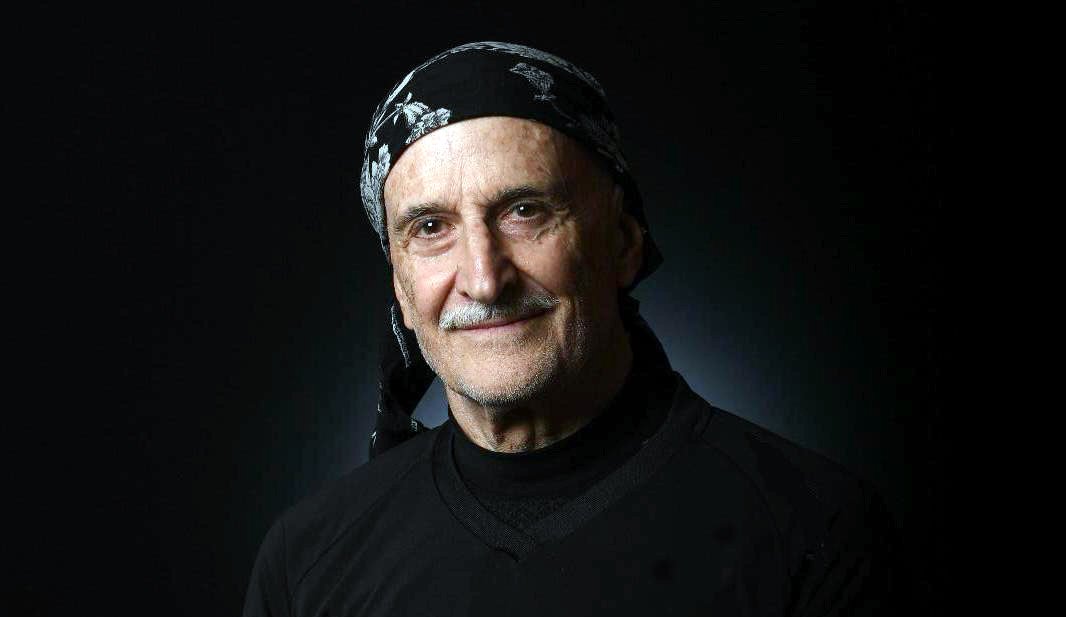
Lorca Massine is among the world’s most celebrated living choreographers, son of Russian ballet legend Leonid Massine (1896-1979), himself considered one of the greatest choreographers of all time. Born Leonid the Younger, he adopted his distinctive name at age 14 as a tribute to the Massine family’s beloved poet, Federico García Lorca. Since then, he has built a brilliant international career, first as a dancer, then as a choreographer, working alongside 20th-century giants Maurice Béjart, George Balanchine and his father.
His crowning achievement remains the ballet “Zorba the Greek,” which has left an indelible mark on world stages and forever linked the language of movement with the Greek spirit. The production returns to Cyprus for the first time since 2001, presented at Paphos Medieval Castle in a spectacular staging by Slovenia’s National Theatre of Maribor that merges dance with Mikis Theodorakis’s immortal score against the timeless backdrop of the Mediterranean sky.
Born in New York in 1944, Massine conceived this masterwork in an extraordinary setting: the studio of a Saracen tower his father had converted on the family’s private island of Gallo Lungo, Italy. The elder Massine purchased this rocky outcrop in the Li Galli archipelago off the Sorrento Peninsula in the early 1920s, where he built an exquisite villa with Le Corbusier’s architectural guidance, commanding panoramic views opposite Positano.
The island’s sale to Rudolf Nureyev in 1989, a decade after his father’s death, marked a profound transition in Massine’s life. “I left the island, but I found Zorba,” he later reflected. In conversation with Phileleftheros, he explores the challenge of embodying Kazantzakis’s vision—choreographing a mythical figure who embodies freedom, authenticity and unbridled joy. How, he asks, does one create an immortal experience that speaks the language of life lived fully in the present moment?
What is your personal relationship with Zorba after all these years?
It hasn’t changed. Zorba has been with me for decades, not only as a role I’ve shaped for the stage, but as a living spirit that walks beside me. His dance hasn’t aged- nor has my inspiration for him.
What does Zorba mean to you today, at this stage of your life and career?
It is the happiness the public gives back to me. When I see people rise to their feet, clapping to the rhythm of the sirtaki, smiling with tears in their eyes, I understand that Zorba is more than choreography- he is a shared heartbeat. That return of energy, of joy, is the greatest gift this work gives me.
Theodorakis’ music is deeply rooted in the Greek soul. How do you translate this “Greekness” into the language of dance for an international audience?
The Greek soul springs from its ancestral roots, nourished by literature, art and philosophy- forces that have shaped not only Theodorakis, but the world at large. His music listens to the heartbeat of the world and answers with the harmony that humanity instinctively seeks. The language of dance, like life itself, is the purest expression of movement.
How does the open-air setting of the Paphos Medieval Castle influence storytelling and direction?
Open-air theatres enchant with a cosmic dimension, the sky their only roof. At Paphos, the sea’s breath drifts across the stage, the ancient stones hold the memory of centuries, and the night wraps the dancers in its vast embrace. In such a place, the castle does not merely frame the story- it becomes part of its pulse, sustaining every gesture as if it were born there.
Zorba is a larger-than-life, almost mythical character. What is his most deeply human quality?
A love of faith, a celebration of life embracing both suffering and loss, yet rising through them toward the triumph of the human spirit. Zorba’s greatness is not in ignoring pain, but in dancing through it. He teaches us that joy is not the absence of hardship — it is the courage to live fully despite it.
You have said that Zorba “dances life.” What have modern societies forgotten about this way of being?
Within each of us lies the untamed heart of Zorba- a pulse that knows how to seize the wind, to laugh in the face of sorrow, to drink life without measure. Modern existence smothers it beneath calendars, anxieties, and the dull hum of routine. We have unlearned the art of being present, of holding another’s gaze without haste, of honoring the small, luminous moments. Zorba’s dance is not nostalgia; it is a summons to awaken that sleeping fire.
How do you select the dancer to play Zorba? What must he carry beyond technical mastery?
He must translate body into soul. Technique alone is not enough — Zorba demands a man who can be vulnerable and fierce in the same breath. He must carry the weight of life on his shoulders and still be able to throw his arms wide open to the wind. The audience must see not only the dancer’s steps, but his spirit.
You have created dozens of works, yet Zorba remains your signature. Has that ever weighed on you?
Not at all — the music of Theodorakis and the novel of Kazantzakis fill my soul and draw forth the finest within me. Zorba is not a burden, but a home I can return to. Every revival, every new cast brings something unexpected, so the work continues to surprise me.
You grew up in the shadow- or light- of a legendary father. When did you realise you had your own voice?
I felt free, although I cherished my father’s work. His legacy was a towering presence, but it did not cast a shadow — it offered a horizon. I understood early that my steps would trace a different path, and that knowledge was not a rebellion, but a liberation.
How do you remember yourself as a child?
Hyperactive, with a dreamlike obsession. I was always in motion — running, imagining, inventing. And although discipline was imposed on me, I could not help but break the rules.
Do you believe people are predisposed to a particular direction in life?
No — directions are the offspring of knowledge and spirituality. Life shapes us through what we learn and what we believe. Destiny is a path we pave, step by step.
What was your first rupture with tradition?
Though tradition is the spine of civilisation, I have most often followed my instinct, guided by a deep and steadfast intuition. I respect heritage, but I believe art must breathe, must be free to move in unexpected directions.
You worked with Balanchine, Béjart, your father. What did you take from each?
I watched, watched, and watched. From Balanchine, the architecture of movement. From Béjart, the theatre of the body. From my father, the composition of gesture.
Have you ever truly felt a country as your own? Is there such a thing as “homeland” for a traveling artist?
I have many homelands and feel at home in most, yet as a Russian immigrant, a quiet emptiness will always linger within me. The stage is my true country — it belongs to everyone.
What does “freedom” mean to you in art and in life?
Judgment rooted in education and culture. Freedom is not doing whatever we want — it is choosing wisely, with understanding and respect.
Do you believe fear is what drives us in life?
Fear is man’s greatest enemy, though caution remains an inescapable companion. Fear can paralyse; caution can guide.
Have you ever choreographed death? Or imagined how you would like to dance it?
Yes- Richard Strauss’s Four Last Songs: a valediction suffused with light, the consummate gesture of a life wholly given to dance. And in the stillness of reflection, Heine’s Totentanz emerges- not as a macabre vision, but as the ultimate pas de deux, wherein time relinquishes its hold and the self dissolves into the infinite.
What would you like to remain of you, when you are no longer here?
I believe in living in the present- but if Zorba keeps being performed, I’ll gladly take off and fly away grinning. If the dance continues, so do I.
The ballet “Zorba the Greek” featuring 150 artists will be take place at Medieval Castle Square in Paphos on Friday, September 26 and Saturday, September 27, at 8 p.m. Tickets: Sold Out Tickets.
Media sponsors: Phileleftheros and Active 107.4

