


Brussels is staging a landmark simulation exercise this week to test how EU member states would respond if one of their number came under attack, with Cyprus directly implicated in one of three scenarios being examined.
The exercise focuses on Article 42.7 of the Treaty on European Union — the bloc’s mutual assistance clause — and will model three distinct attack scenarios. Its findings are intended to serve as a roadmap for future EU decisions on collective defence.
The first scenario involves an attack on an island EU member state that is not a NATO ally. Three countries fall into this category: Cyprus, Malta and Ireland. It is considered the most demanding test of the clause, as it strips away the NATO safety net entirely.
The second scenario examines an attack on a country that is both an EU and NATO member, probing how Article 42.7 and NATO’s Article 5 interact — where they overlap, where they complement each other, and where they may conflict.
The third scenario moves into different territory: a cyberattack rather than a conventional military strike. The central legal question is whether Article 42.7 — which refers to “armed aggression against the territory” of a member state — extends to hybrid threats. This is widely regarded as one of the clause’s most significant legal gaps.
A difficult opening
Cyprus played a role in getting the issue onto the table at all. “Many member states did not want this,” diplomatic sources who spoke to Phileleftheros said. “In the Council there was hesitation, in the Commission there were reservations.” That the discussion opened at all was itself significant, the sources indicated.
Why the simulation matters
Article 42.7 has been invoked only once in its history. On 17 November 2015, four days after the Paris terror attacks, French Defence Minister Jean-Yves Le Drian formally called on EU partners to invoke the clause. All 28 member states at the time expressed unanimous support.
What that support meant in practice, however, was limited. France chose Article 42.7 over NATO’s far stronger Article 5 precisely because of the flexibility it offered: bilateral negotiations with each member state separately, with no mandatory institutional involvement. Assistance was the product of political negotiation, not legal obligation.
A subsequent report by the European Parliament Research Service found that the first activation of Article 42.7 exposed a complete absence of practical planning at EU level, and that the article risked becoming a dead letter in a crisis — particularly if the next target were a smaller state without the resources to coordinate incoming assistance on its own.
A legal opinion issued by the Council Legal Service in the wake of the 2015 events added weight to the clause: it concluded that the obligation to apply Article 42.7 is binding on all member states, and that assistance to a member state under attack cannot be symbolic — it must be substantive.
Christodoulides active on two fronts this week
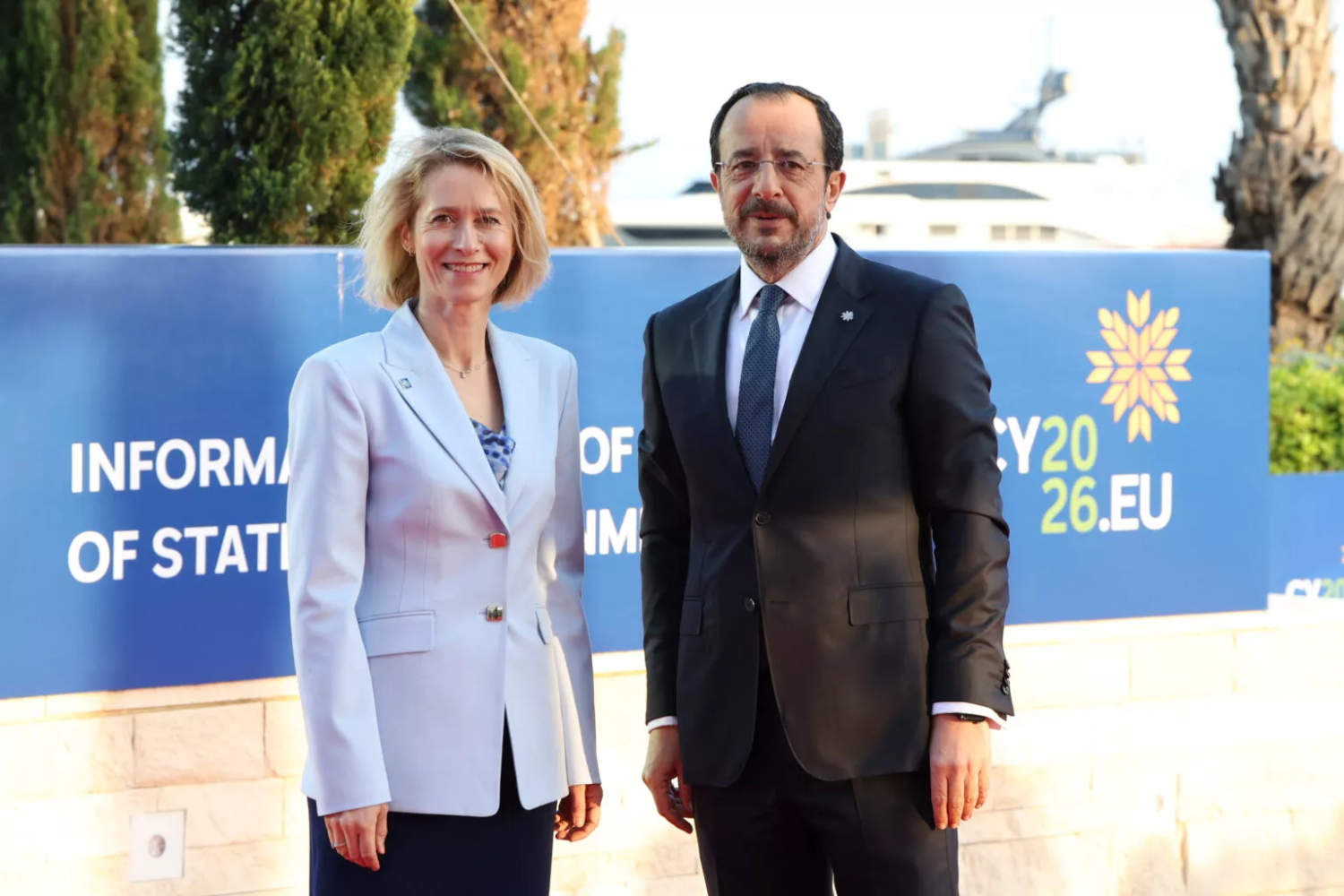
President Nikos Christodoulides has two significant engagements this week with the mutual assistance issue high on the agenda.
On Monday, he is attending the European Political Community summit in Yerevan, Armenia, where Cyprus is taking on a special role for the first time: Christodoulides will deliver the opening remarks and closing comments at a plenary session, and will chair the discussion on European security — a session that includes the leaders of Britain, France and Italy, as well as the President of the European Commission.
On Tuesday, he meets European Commissioner for Defence and Space Andrius Kubilius in Athens. The Commissioner’s visit is part of a broader push to strengthen the European defence industry and also includes meetings with Greek Defence Minister Nikos Dendias and Prime Minister Kyriakos Mitsotakis, as well as a visit to the GOVSATCOM secure satellite communications facility.
The meeting with Christodoulides reflects the strategic alignment between Cyprus and Greece on defence matters, according to the source.
Read more:

