


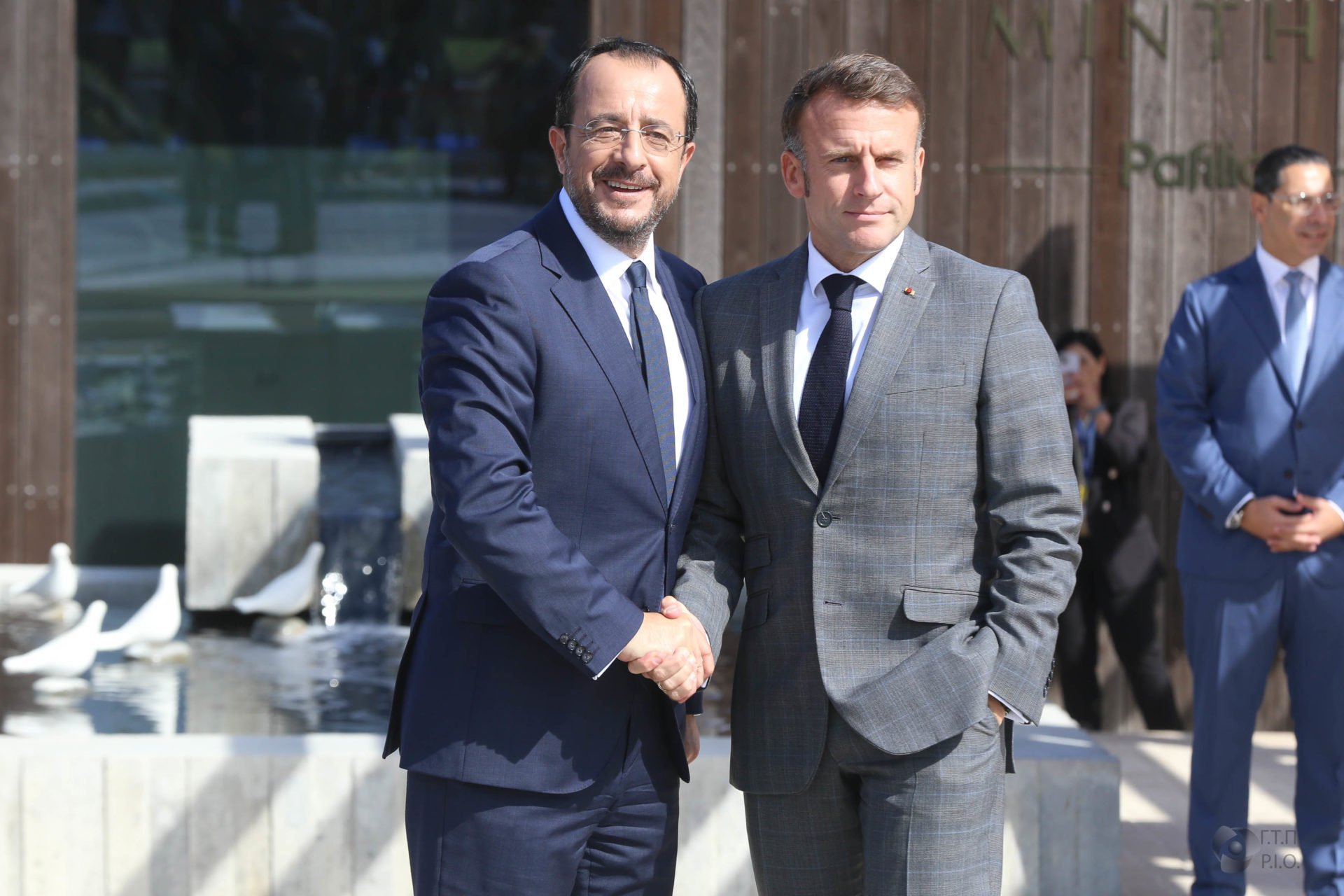
Cyprus and France are due to sign a significant defence agreement in June, following a meeting between President Nikos Christodoulides and French President Emmanuel Macron in Nicosia.
The deal has been welcomed by the Cypriot government as a milestone in bilateral relations and condemned by the Turkish Cypriot administration in the occupied north as null and void. Here is what you need to know.
What is a SOFA?
A Status of Forces Agreement, known as a SOFA, is a treaty that sets out the legal framework governing the presence of one country’s military personnel on another’s territory. It covers practical matters such as jurisdiction over personnel, customs procedures, tax arrangements, logistical access and transit rights. SOFAs are common between allied nations and do not in themselves constitute a military alliance.
What does this agreement cover?
Government sources told Phileleftheros that the SOFA defines the terms under which French forces can be stationed, train or operate in Cyprus while respecting national sovereignty. In practice, it covers four main areas: military coordination and interoperability; defence technology, procurement and industry links; joint exercises, strategic dialogue and personnel exchanges; and administrative and legal arrangements for forces operating on each other’s territory.
The agreement is reciprocal. It also provides a legal framework for Cypriot personnel already training in France or serving on French naval vessels, which are considered French territory. French naval expertise is already contributing to the planning and design of Cyprus’s Mari naval base, and that cooperation is expected to deepen as the base undergoes upgrades.
How did the two countries get here?
The SOFA builds on a strategic partnership signed in Paris in December last year, which established a framework for cooperation across defence, energy, security, innovation and education, with an action plan running from 2026 to 2030. Macron’s visit to Nicosia, the first by a French head of state to Cyprus, came at a time of peak bilateral relations.
The partnership already has practical results. France deployed its Charles de Gaulle carrier strike group to the region following a drone strike on Cyprus last month, which Macron described as an attack on Europe. Cyprus is also in talks to procure Griffon armoured personnel carriers and Serval light tactical vehicles from French defence companies. The agreement is expected to be signed at ministerial level in June.
Beyond strictly military matters, the SOFA also allows for coordinated responses to regional crises, including evacuations. Cyprus has previously served as a hub for such operations, facilitating the evacuation of foreign nationals from nearby conflict zones.
Why is it controversial?
The Turkish Cypriot administration in the occupied north declared the agreement null and void, arguing it alters the balance of power on the island, disregards the rights of the Turkish Cypriot people and creates grounds for regional tension. They also argued that Cyprus lacks the authority to conclude such an agreement on behalf of the island as a whole.
Turkish Cypriot leader Tufan Erhurman questioned whether a solution to the Cyprus problem could be achieved while Turkish Cypriots are excluded from key decisions. The north’s “prime minister” Unal Ustel called the arrangement extremely dangerous, provocative and an unacceptable step that could damage peace on the island.
What is the background?
Cyprus has been divided since 1974, when Turkish forces invaded the island and occupied its north part following a Greek-backed coup. The Republic of Cyprus, recognised internationally, governs the south. The north is governed by a Turkish Cypriot administration recognised only by Turkey. Agreements signed by the Republic of Cyprus are routinely rejected by the Turkish Cypriot side as illegitimate.
Read more:

