


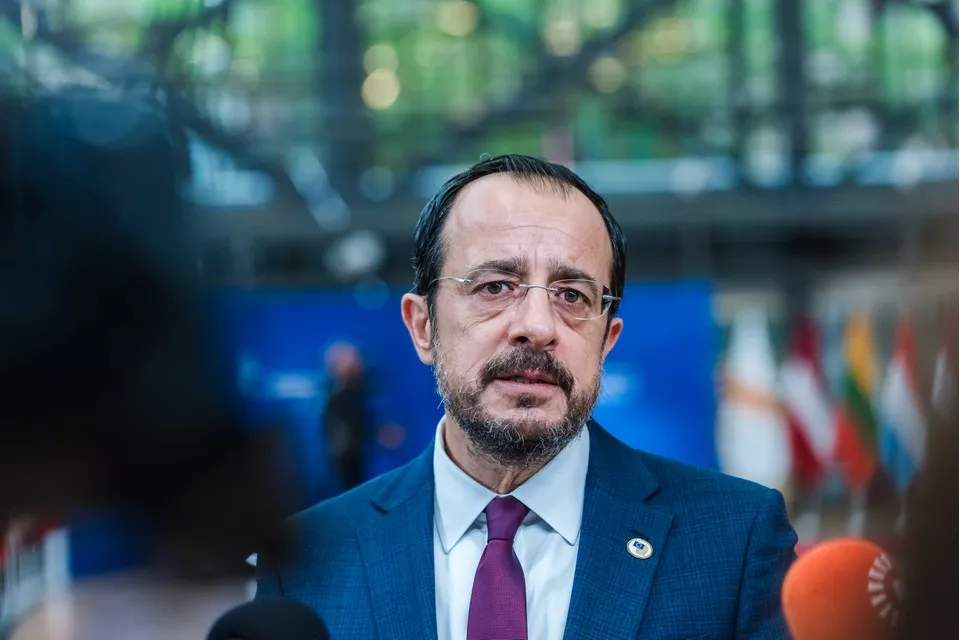
President Nikos Christodoulides said today he is going into his afternoon meeting with Turkish Cypriot leader Tufan Erhurman with “clear political will” for a positive result.
He rejected suggestions in both Greek Cypriot and Turkish Cypriot media that the meeting is expected to produce nothing.
Speaking to journalists at KEN Limassol, Christodoulides said the meeting follows discussions he held with the UN Secretary General in Brussels on the substance of the Cyprus problem. Turkey, Greece, and Britain are also aware of the topics under discussion. “I disagree entirely with that approach,” he said of the suggestion that nothing is expected. “It is not ceremonial, it is not formal, it is not for photographs. I go with the absolute political will for something positive and I genuinely hope there will be.”
Asked whether a result depends on Erhurman, Christodoulides said it depends on both Erhurman and on Turkey’s disposition.
On the broader question of optimism, Christodoulides was measured. “We are not at the desired goal — I want to be completely honest, I do not want to paint a rosy picture of the situation,” he said. Two enlarged conferences have taken place and the UN Secretary General is “absolutely committed” and has the political will to reach a solution, he said. “We must not only be optimistic but act on everything possible so that this optimism is translated into something concrete.”
Christodoulides also addressed Article 42.7 of the EU Treaty — the bloc’s mutual defence clause, which obliges member states to provide aid and assistance to a fellow member facing armed aggression on its territory. The clause is often compared to NATO’s Article 5 but is weaker in one important respect: it does not create an automatic EU military response mechanism and does not specify what form assistance should take, who coordinates it or at what scale.
The question of what the EU actually does when a member state activates Article 42.7 will be discussed at an Informal European Council in Nicosia on 23–24 April — a debate Cyprus pushed to secure on the agenda. Christodoulides said that without formally activating the article, he briefed all 27 EU leaders at the last European Council, along with the Council President and the Commission President, and that agreement was reached that a mechanism must be established for EU action when and if a member state activates it. “It was not only the strong first reaction on the part of Greece, we also saw France, Italy, Spain, the Netherlands. In essence, without having activated Article 42.7 of the EU Treaty, we saw it activated,” he said. The Commission has been instructed to prepare a draft outlining specific stages for activation, to be discussed at the April summit. Cyprus has specific proposals on the matter, he added.
Christodoulides said the push aligns with the goal of an autonomous EU — a priority of the Cyprus EU Council Presidency.
Read more:

