


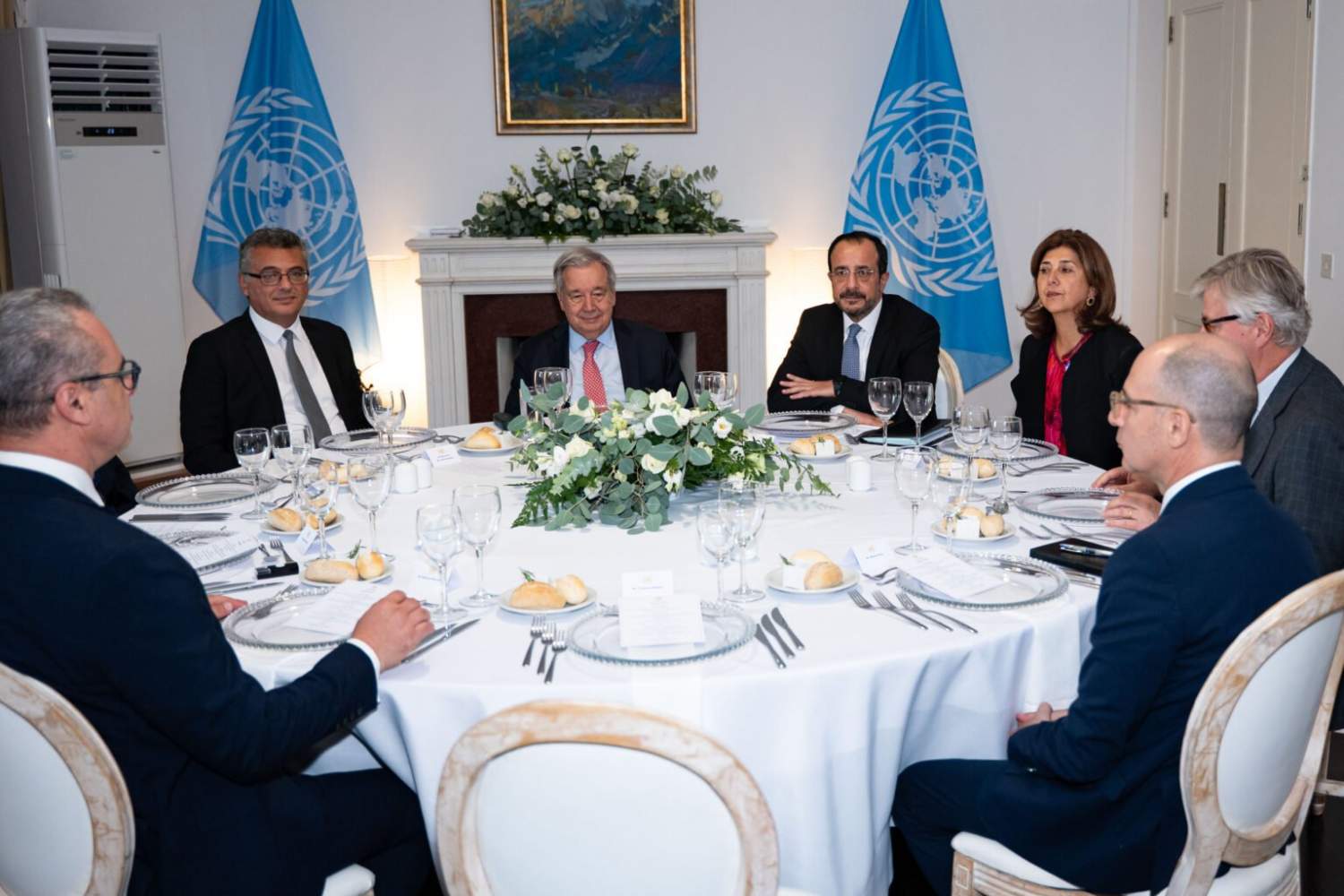
President Nikos Christodoulides and Turkish Cypriot leader Tufan Erhürman will hold their first one-on-one meeting later today, their first since UN Secretary-General António Guterres visited Cyprus in July. Expectations for the meeting are low, with the onus on Erhürman to show whether he can move beyond the limits Ankara places on him.
Almost a month after Guterres’s visit, no development has been recorded showing improvement or progress on what the Secretary-General had requested.
The United Nations’ recording of convergences between the two sides has not yet been completed, according to information so far. Presenting such a document could give momentum to the process and to a more substantive dialogue between the two sides.
The exercise would also surface the outstanding gaps or divergences that remain, providing a basis for discussion. Although the recording reportedly began even before Guterres’s visit, it remains incomplete, including on matters concerning internal aspects.
On confidence-building measures (CBMs), only those the Turkish Cypriot side raised no obstacles to, or did not attempt to use for benefits beyond their original goal, have been advanced and implemented. Under the previous Turkish Cypriot leadership, some projects were attempted along “two-state” lines, leading the effort into deadlock. Despite the change in Turkish Cypriot leadership since last October, no substantive development has taken place so far.
On opening new crossing points, the effort is hampered mainly by the obstacles Turkey, as an occupying power, continues to raise, and by Erhürman’s inability to overcome them. As became clear in the meetings Christodoulides and Erhürman held with the UN Secretary-General, the Turkish Cypriot leader shifted his positions and introduced new conditions, showing an inability to decide while serving Ankara’s interests by obstructing any agreement.
During his visit, Guterres spoke of a methodology, which Erhürman was quick to present as vindication of his Cyprus problem policy. However, what the UN Secretary-General had asked was for the two sides in Cyprus, along with the guarantor powers, to agree on a method that would lead to a new 5+1 meeting, a meeting Guterres made clear would be convened to announce the resumption of talks.
Erhürman’s position
This differs significantly from the methodology proposed by the occupying leader, which is divided into four parts: terms and framework, avoidance of formal procedures, confidence-building measures, and participation of the guarantor powers.
Erhürman insists that issues such as political equality should not be subject to negotiation, and that the process should not be “negotiation for negotiation’s sake.” He also seeks the convening of the five-party meeting only after proper preparation and clear rules, including a guarantee that Turkish Cypriots would not return to the current status quo if talks collapse due to Greek Cypriot fault. On CBMs, Erhürman prioritises the issue of the barricades, without taking steps to have them opened, while maintaining that any solution must be approved by the parties involved and by Turkey.
Christodoulides’s position
Christodoulides’s position is divided into three parts: linking the process to the convergences already recorded, preparing for an enlarged conference, and continuous consultations.
For the Greek Cypriot side, as set out in talks with the UN Secretary-General, the methodology is seen as interlinked with the convergences recorded so far and the open substantive issues. Regarding preparation for an enlarged conference, Nicosia’s aim is to record and clarify the terrain, including the relevant convergences document, to ensure that any future enlarged meeting or conference has a solid basis and a genuine prospect of success, rather than becoming a process without substance. Christodoulides has repeatedly stated that the methodology should serve the resumption of negotiations from the point where they were interrupted, while also making use of confidence-building measures.

