


By Panayiotis Papademetris
In September 1977, the UN Security Council adopted Resolution 414 on the Cyprus problem, expressing concern over the issue of Varosha. It was an initial, small battle for the occupied city fought by Spyros Kyprianou, as Rauf Denktaş and Ankara continued casting covetous eyes on Varosha. To achieve their goal, they applied a salami-slicing tactic, eroding the city’s core through colonization on a small or large scale, secretly creating fait accompli while the ghost town continued to crumble over time.
Appealing to the United Nations or the Security Council during those years was an indispensable political action steadily pursued by Cyprus, which stood almost alone and unprotected. It relied essentially on the support of the Non-Aligned Movement, which held votes but lacked executive power, as a veto from the major powers could neutralize thousands of votes. Nonetheless, Cyprus hoped that continuous condemnations of Turkey would at least ensure its survival until better days dawned, if not the return of occupied territories.
During this period, Denktaş made a tactical move regarding Famagusta to thwart a recourse to the UN—a standard tactic of governments at the time—and to bolster Turkey’s efforts to lift the arms embargo. In July 1978, he proposed resuming talks to solve the Cyprus problem alongside the simultaneous return of Famagusta’s residents. Spyros Kyprianou countered by proposing the return of residents to a free Famagusta under UNFICYP security control in exchange for dialogue toward a solution. Kyprianou believed accepting his proposal on Varosha would serve as a starting point toward a solution, though he clarified to UN Secretary-General’s special representative Galindo Pohl that he wanted the return of the entire city of Varosha, including hotels, orange groves, and industries, rather than just a small section.
Denktaş, however, was unwilling to accommodate Kyprianou’s demands, which had been enthusiastically pursued following Makarios’s initial steps with a map in 1977. Denktaş wanted to appear to make a gesture without provoking reactions in Ankara, intending to return areas south of Demokratias Avenue extending eastward to Deryneia Avenue.
Meanwhile, US President Jimmy Carter, seeking to lift the arms embargo on Turkey while playing a dual role according to the New York Times, targeted lifting the embargo in combination with the return of Famagusta or part of it to Greek Cypriots. Carter succeeded in lifting the embargo in late July 1978, declaring that the door to a Cyprus solution would open through Famagusta. Maintaining momentum, Carter dispatched State Department official Matthew Nimetz to Cyprus to explore the landscape.
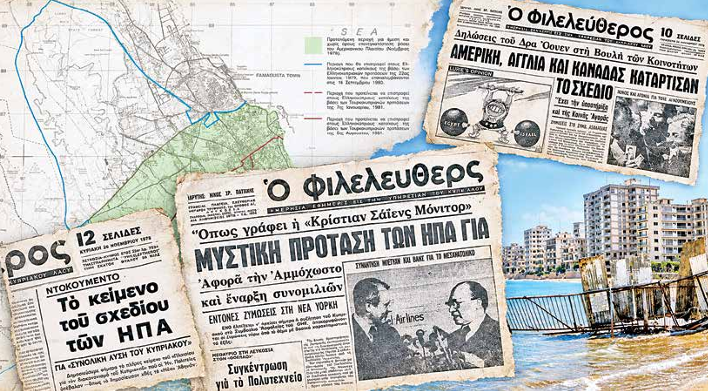
Ahead of the 1978 UN General Assembly and Security Council recourse, President Kyprianou met with Jimmy Carter and Secretary of State Cyrus Vance. Recognizing the positions of both sides from the Nimetz mission, the US, Britain, and Canada prepared a joint proposal known as the American-Canadian-English plan, or simply the Western Plan, submitted on November 10, 1978. The drafters knew that securing Greek Cypriot support required offering something significant in return: Varosha.
The plan stipulated that the resettlement area would include territory east of Agios Nikolaos and south of the old Nicosia-Famagusta road, administered under UN supervision as an extension of the buffer zone. There would be no predetermined numerical limit on returning residents, and they would not face forced displacement again. The plan also proposed a bi-zonal, bicommunal federal state guaranteeing the island’s independence, sovereignty, and territorial integrity, alongside the demilitarization of the republic and the withdrawal of non-Cypriot armed forces.
Although characterized as the best solution proposal since 1974, Spyros Kyprianou’s government rejected it. Opposition was heavily influenced by Moscow and its domestic reflection, AKEL. General Secretary Ezekias Papaioannou, following Soviet directives, initially viewed the plan favorably before Moscow intervened, with Pravda criticizing the US-led plan as an imperialist attempt to divert the Cyprus issue outside the UN framework and into NATO backchannels. Soviet Ambassador Astavin hosted AKEL leadership for a meal, steering them toward rejection, after which AKEL reversed its position. Joined by Archbishop Chrysostomos I and EDEK leader Vassos Lyssarides—who argued the plan served Turkish interests and disguised partition—the domestic front sealed the plan’s rejection.
Although government officials later revealed a willingness to discuss the plan under specific conditions, the convergence of opposition from AKEL and DIKO led to the plan being shelved, leaving the future of Varosha subject to increasingly harsh historical outcomes.

