


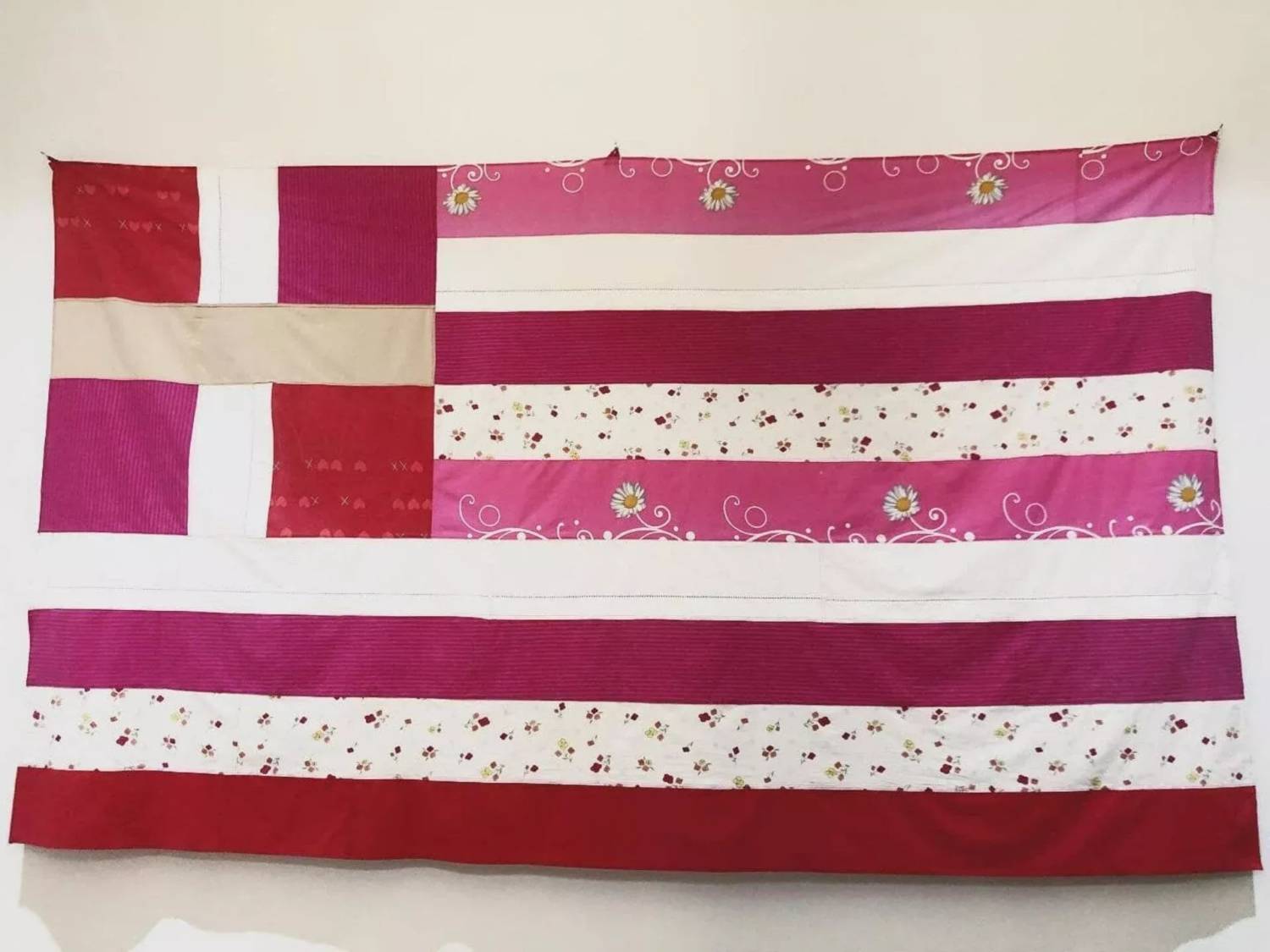
“In my homeland, the flag is blue with a pure white cross engraved in the middle. It proudly waves, unafraid of the enemy”, as we learned in our early childhood years. Yet today, the defenders of racial purity trembled at a pink flag. They feared a young artist as an enemy. “At the Consulate General of New York, this ‘monstrosity’ was presented as our flag! Our flag, made of bed sheets and painted pink. Our flag is blue and white, dyed red only with the blood of our heroes,” exclaimed one of the far-right leaders. The government rushed to save the nation’s pride, a pride unaffected when men murder women, whose blood does not stain the flag. However, nations are not only threatened by external enemies but also by internal ones. In a society where women are murdered so easily, the danger is not the pink in the flag for a temporary art project.
The pink flag, made from sheets of femicide victims, was created by the artist Georgia Lale as part of an exhibition titled ‘Neighborhood Guilt,’ inaugurated last Friday at the Consulate General of Greece in New York. The goal was to raise awareness about the escalating issue of domestic violence and the murder of women in Greece. “Most femicide victims are killed in their homes and on their beds. Their lives end in the beds they make every morning. Their sheets absorb their blood,'” said the organizers of the exhibition. However, the country’s Foreign Minister quickly satisfied the far-right demands by instructing the removal of the artwork from the exhibition.
“Apparently, he hasn’t seen similar ‘partisan’ flags for decades, where blue and white have been replaced by red and white, yellow and black, green and white, or black and white, without any ‘anti-national’ propaganda intent,” writes Dimitris Politakis. Kyriakos Athanasiadis, paraphrasing the childhood song and interpreting Lale’s work, writes: “In my homeland, the flag is rosy red, like the blood of girls who lift the cross. It waves wounded, still trembling from the enemy, who breaks their bodies and pushes them into the abyss.”
P.S. This is not the first time that a flag has been used in art for symbolism. In the ’90s, David Hammons replaced the colors of the American flag with those of the African flag, and his work ended up in a museum in Amsterdam, earning him recognition for his contribution.

