


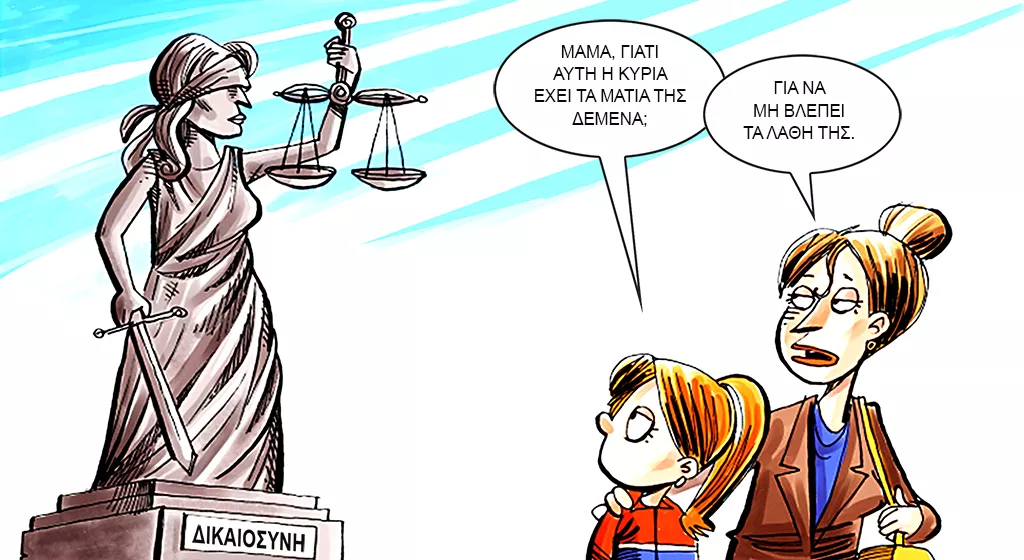
Justice—to paraphrase the well-known saying—is a dish best served cold. So when this vindication, which I had waited for patiently for 18 years (lies, I was impatient, hopeful, doubtful…), finally came, I decided to let it… cool down a bit so I could serve my comments dispassionately wherever appropriate.
Ten days ago, on 3 July, the European Court of Human Rights (ECHR), to which “Phileleftheros” and I jointly appealed in 2022, ruled definitively that Cypriot courts violated Article 10 of the European Convention on Human Rights regarding freedom of expression, overturning the Supreme Court decision which had characterised my disputed text as defamatory—an opinion piece in “Phileleftheros” dated 1/7/2007 titled “Property – Dignity 1-0”.
I was commenting on an article by lawyer Constantis Cantounas that had been published in the newspaper “To Vima” a few days earlier. In short, I criticised his action of paying money to “buy back” a painting by G. Pol. Georgiou that had been stolen from his family’s home in the occupied areas, considered it undignified and likened it to paying ransom to thieves.
Contrary to the Cypriot courts, the ECHR decided that what I wrote unquestionably formed part of public discourse and not an attack on Mr Cantounas personally. It ruled that I expressed value judgements based on his own article, even if I used excessive or provocative expressions. I consider particularly significant the point in the judgement where the judges are criticised, both for their excessively restrictive decision and for their insistence on dictating to journalists how and with what expressions they should write their texts. This tendency of some judges to decide according to subjective criteria, based on their personal ideas and prejudices, particularly in a case of public interest as the European Court characterised it, deviates from the essence of a fair trial.
In reality, the Cypriot courts had to judge a very simple case, which they nevertheless managed to completely misinterpret: The issue was not to decide who was right. Just as Mr Cantounas in his own article described his actions thinking how well he had done, I had the same right to disagree with him. Every publication is a priori subject to public dialogue and criticism of it must be considered expected, observes the ECHR. If therefore in such a simple case the judges fail to distinguish the subject under consideration and decide subjectively, they themselves place the justice system they serve in dangerous disrepute. Even if we assume that the first-instance judge was relatively inexperienced, what can we say about the display of deficient judgement by the very experienced judges of the Supreme Court (among them its president Mr Antonis Liatsos), who unanimously upheld the erroneous first-instance decision?
The handling of this case, which essentially should never have reached the courtrooms, proved harmful in multiple ways: For 18 years, economic and human resources were wasted, lawyers, judges, clerks, support staff worked, precious time was lost by all involved. Moreover, as the ECHR observes, such excessive decisions contribute to the increase of intimidating lawsuits against journalists which, if the disproportionate amount of compensation awarded is also taken into account, may bring about unwanted silencing (chilling effect) on matters of public interest—the so-called SLAPP (Strategic Lawsuits Against Public Participation) which do not only concern those working in the press. The UN calls on states to take “anti-SLAPP” legislative measures so that such lawsuits are rejected at an early stage, but laws criminalising defamation continue to exist in Europe.
Judges—and not only them—must finally learn to distinguish the “invention of insult” from real insult, that which endangers defenceless people or sensitive social groups. The same must be done by the heads of the Law Office, who defended the erroneous decisions of Cypriot judges at the ECHR. “Judges are not expendable,” said Mr Angelides, but if they don’t do their job properly, what use are they? Let’s go directly to the ECHR—it will cost us less and be quicker. Judges who make gross errors don’t need to resign, but there should be consequences. Justice cannot only judge but must also be judged—and possibly those who prove harmfully inadequate should be tried.
In the case of “Phileleftheros” alone, every citizen will pay for their mistake, through indirect and direct taxes, around two-plus euros, approximately 7 to 10 per family. The greater damage, however, is that public opinion, even if it isn’t always right, increasingly devalues institutions. I would expect a public apology from the president of the Supreme Court on behalf of all judges, as well as from the heads of the Legal Service, not so much to me and the newspaper as to the citizens. Admitting mistakes is not an expression of weakness but the opposite. In any case, it would be a good start for everyone.
(Incidentally, the leadership of the Cyprus Journalists’ Union appears to be having a… siesta. Such an important decision for all European journalists didn’t merit even one announcement from them?)

