


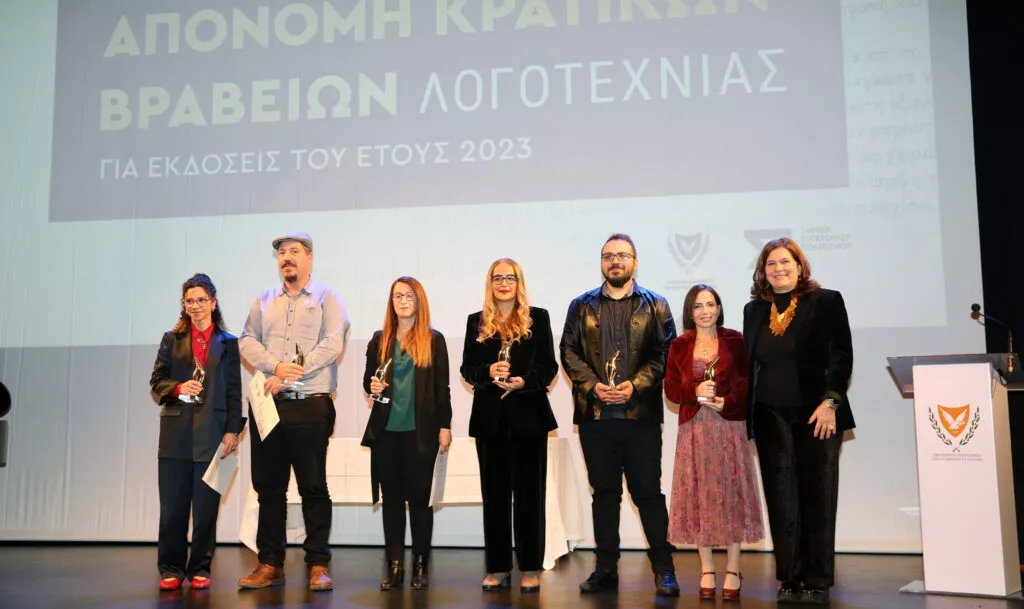
Let’s start with an admission: awards have never impressed us, least of all state ones. We’ve always had reservations about how winners are selected, even about the so-called “shortlists” that precede the final announcement.
Generally speaking, we’ve never believed a work can be judged (definitively) through an annual awards process, especially here in Cyprus. Especially because our local (so-called) intelligentsia—or the overwhelming majority of it—still hasn’t worked out what’s national, what’s authentic, what’s Greek, what’s Cypriot, what’s vernacular, what’s patriotic, what’s satire, what’s literature, what’s poetry, and so on and so forth.
This, after all, is proven by the racket kicked up by the chairman of the 2024 State Literature Awards jury, Kyriacos Ioannou, over one particular prize, but also more generally—as we understand it—over the evaluation process and the composition of the committee, which had also decided on the 2023 works. Last year Mr Ioannou had no objections, not even about the “adequacy” of the jury members, but this year he unleashed his arrows—not at the selection process, but at the winner of the Young Writer category.
Mr Ioannou chose to publish scattered excerpts from Alexandros Chronides’s prize-winning book “By the Rivers of Babylon” (Almyra Publications, 2024) rather than offer literary criticism. Excerpts he knew would provoke, even though those who condemned the book had no idea it had been published—a year and a half ago—and put forward for the prize. Even though those who denounced it, as if we’re living somewhere in interwar Germany, would never have heard it existed if Kyriacos Ioannou hadn’t “promoted” the excerpts and his opinion.
The issue, however, isn’t whether the chairman of the jury likes the book or not, and whether this prompted him to give a bollocking to both the Deputy Minister of Culture and the committee itself.
The issue arises, in our humble and artless opinion, from one specific, arbitrary statement by Mr Ioannou: “The collection that has been awarded has—and I write this with a heavy heart—nothing whatsoever to do with poetry. In short, it is not poetry,” he claims, before adding some excerpts. Scattered excerpts from Chronides’s poems, whom he accuses of… anti-Hellenism, with a (glaring) example being a single verse.
The point of this piece isn’t to turn the State Literature Awards into a football match, nor to show solidarity with Chronides, who has the guts to express himself through his poetry when his peers prefer TikTok, Phidias, and other daft distractions. The point is to note that poetry, even though we often don’t understand its contemporary incarnation, cannot be left on the shelf to freeze whilst waiting for a new Vasilis Michaelides, a new Seferis, a new Elytis. And therefore it’s not as easy as Kyriacos Ioannou made it seem for someone to judge what is poetry and what isn’t.
In short, “whatever can be explained is not poetry,” as the great Irish poet William Butler Yeats said. More colloquially, “poetry is poetry if nobody understands it. If everyone understands it, it’s not poetry, it’s a belly dance,” as Dinos Iliopoulos said in “The Bait”. Bottom line: we need at some point to reach a collective realisation—that the right to art, to practise it and express it, also belongs to those whose works we can’t stomach, even if they grate against our national, religious, or other sensibilities.
Because even Michalis the Mechanic, who was referenced in Ioannou’s piece and whose poetry none of today’s poets can touch, would be accused by many using excerpts from his “controversial” poems. For Onesilos’s curses, the cowards whose women were raped and who didn’t draw their knives, the murdered little Turk, and more.

