


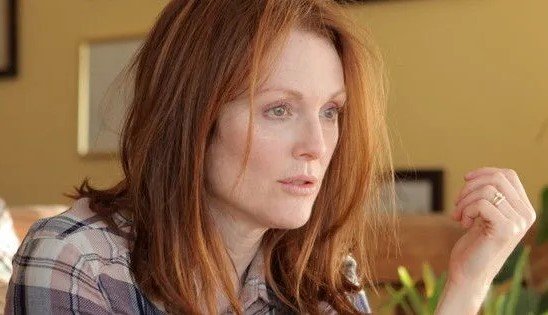
Yesterday (21/9) was World Alzheimer’s Day, as 21 September has been marked every year, and I decided to watch the acclaimed American film “Still Alice” again. It tells the story of a patient with early-onset Alzheimer’s. The film is based on the novel by Lisa Genova, centred on Alice Howland, a professor of Psychology at Harvard University. She is played by Julianne Moore, who won the Best Actress Oscar for the role in 2015.
At 50, Alice is diagnosed with Alzheimer’s. She begins, gradually, to lose her sense of direction and her memory. She gets lost in her own city, in her own neighbourhood. In the end, she can’t even recognise her own children. The book and the film show, unflinchingly, the devastating effect the disease has on her family: her husband and her three children, as they face the changes in her and the need to care for her, now that she can no longer care for herself.
The film’s message is this: the patient remains themselves. They don’t lose their identity, their worth, their uniqueness as a human being, even when they no longer recognise anyone else. I spoke about the importance of solidarity, love and care from patients’ relatives and friends with neurologist and psychiatrist Dr Kyriakos Veresies, one of the founders, thirty years ago, of the Alzheimer’s Support Association. “A person’s worth,” he told me, “is determined neither by their age, nor by their physical or mental condition. An Alzheimer’s patient loses their bearings in space, time and among people, because all the relevant information their brain once held has faded away. They might, for instance, believe their daughter is their mother.
“In these cases, one or even two people are needed to care for the patient, day and night. That happens through the self-sacrifice of children and other relatives, because there’s very little help from the state.”
That last remark brought to mind a public intervention I heard at an event in Nicosia, from the son of a 92-year-old patient: “It is unthinkable that Cyprus, a member state of the European Union, does not have a single state structure for people with dementia. And it is unacceptable that the state leaves this problem to volunteers and to local authorities, and refuses to take up its own responsibilities.”

