


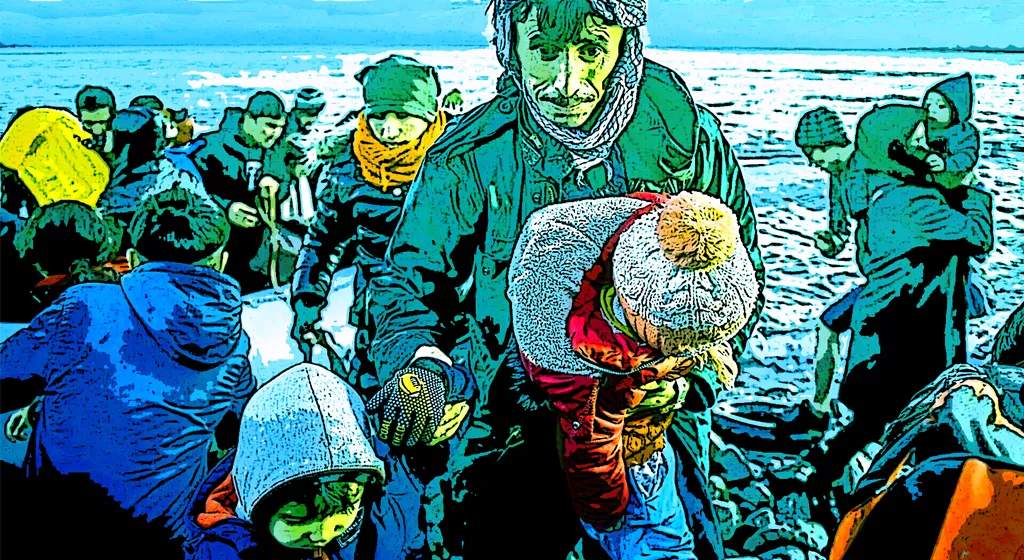
We’re all refugees, more or less. We came from somewhere—us or our forebears. Europe itself is a continent of migrants.
There’s a glaring question I haven’t seen anyone even ask, let alone answer, after the latest migrant disaster in the Aegean—off Chios this time: What exactly is the Coast Guard doing out there with its patrol boats? What are their orders when they spot boats packed with people trying to land on Greek soil? I imagine they try to stop them, yes, but how? Do they cut across their path to block them? Do they literally shove them backwards—what’s called a pushback—forcing them to return to wherever they came from? And if they don’t comply? Do they sink them, “accidentally” as in this case, if not deliberately? They need to reveal what orders they’ve received from their superiors, and what orders those superiors have received from their government, because there are specific rules in international law that ban pushbacks.
Someone will ask, rather naively: Doesn’t a state have the right to protect its borders, land or sea, from illegal entry? Of course it does. But it’s not allowed to forcibly send migrants or refugees back—especially en masse through summary procedures—without giving them the chance to apply for asylum, without examining each case individually according to the proper legal procedures. Pushbacks are illegal under International Refugee Law (the principle of non-refoulement), the European Convention on Human Rights, and EU law.
According to the Geneva Convention (1951), “No Contracting State shall expel or return (‘refouler’) a refugee in any manner whatsoever to the frontiers of territories where his life or freedom would be threatened” (Article 33.1). According to the European Convention (ECHR), “Collective expulsion of aliens is prohibited” (Protocol 4, Article 4). EU Directive 2013/32 (Asylum Procedures) stipulates that every person has the right to submit an asylum application which must be examined individually, and the person must remain in the country until a decision is reached.
Obviously, none of these procedures were followed—and how could they be, with these naval confrontations in mid-sea that almost inevitably ended in collision and “tragedy”? (That desperately hackneyed euphemism used in such cases feels like a whitewash of bad decisions and practice before they’re even investigated: A tragedy is a bad thing, yes, but the many dead elevate it, somehow, to something else—something rather unavoidable.)
And we can guess what conclusion the administrative inquiry that’s been ordered will reach: It was an unlucky moment. The coast guards, performing their duty (which duty exactly?), tried blah-blah-blah, but the operator of the inflatable turned against the Coast Guard vessel (some idiot acronym!) intending to ram it (the fool), causing the dinghy to capsize, deflate and sink (proof: a little mark they showed us on the starboard side of the patrol boat). Result: 15 dead foreigners and 25 injured, one coast guard with concussion and one coast guard with a dislocated shoulder—which they popped back in (pushback).
There’s something perversely ironic about such cases: Instead of sinking them first and then spending all night scrambling to collect the dead and the living, with a wealth of resources and manpower, wouldn’t it be easier and simpler to act according to the regulations? Not that they have a choice, but I’m saying—wouldn’t it be simpler to transport them safely to shore, register them, and follow all the proper legal procedures? Mightn’t we, I’m saying, avoid all this—the dead and injured, the investigation into responsibilities, etc.—if everyone just did what they’re supposed to do, what the laws say, what the conventions and directives require? What exactly does the opposite serve, this moronic practice (we’re protecting the country and whatnot?), which not only protects no one and nothing, but on the contrary leaves everyone exposed, from the lowliest wretched coast guard right up to the irresponsibly responsible prime minister?
Yes, I know: There’s the fear that foreigners will drag their feet as long as possible, squat in the country which is forced to feed and care for them, etc. So what? Is the alternative preferable? It reminds me of that racist joke dripping with malice and inhumanity: “What do you call 15 foreign migrants on the surface of the sea? Pollution. And what do you call 15 migrants at the bottom of the sea? Solution.”
I say all this because society, in Greece and Cyprus, is largely callous to the plight of the uprooted—a paradox that isn’t justified by the many (or fewer) years that have passed since we became refugees. We’re all refugees, more or less—we came from somewhere, us or our forebears. Europe itself is a continent of migrants, far more so the whole of North and South America, Australia, Asia… When will we feel sympathy and empathy, some kinship—however distant—with those people drowning at sea searching for a better future?

