


The Middle East crisis is dominating the news cycle, and rightly so. Its most immediate shock to Cyprus has been the chaos rippling through the tourism sector — and if the fighting grinds on, that disruption will harden from turbulence into something far more damaging, given how comprehensively tourism underpins this economy.
But there’s another story, quieter and less dramatic, that slipped out recently — one that connects in revealing ways to some of Cyprus’s deeper structural realities.
Eurostat published figures showing that Cyprus recorded the highest proportion of residents who never use public transport anywhere in the European Union. In 2024, 85% of people over 16 said they simply don’t use it. At all. Ever.
The next-worst country trails by a full 20 percentage points. Italy comes second at 68%, followed by Portugal (67.8%), France (65.1%), Slovenia (61.6%) and Greece (61.3%). At the other end of the scale, Luxembourg — predictably — leads the way, with only 15.7% of residents reporting zero public transport use. Estonia (26.6%) and Sweden (26.7%) round out the top performers.
As for Cyprus: just 4.5% use public transport daily. Another 4.3% weekly. A further 2.9% once a month. And 3.3% less than once a month.
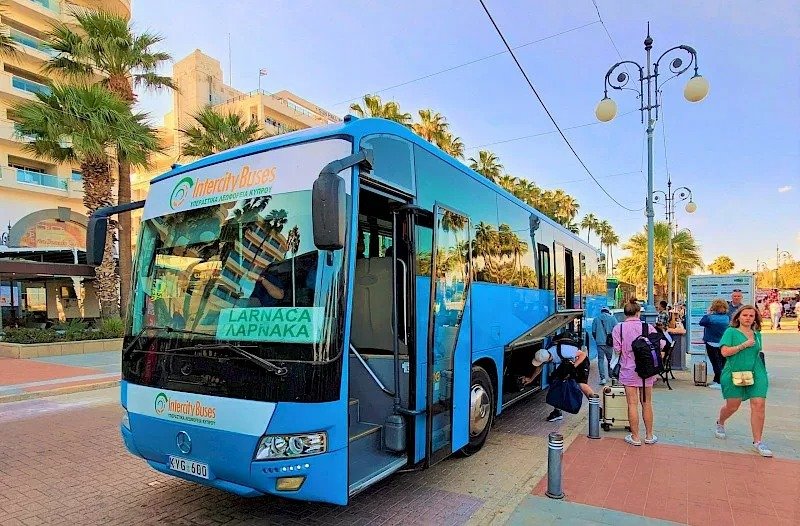
To anyone elsewhere in the EU, the startling figure is the 85% who never get on a bus. Here in Cyprus, we find the startling figure is the 15% who apparently do. Because — let’s be honest — public transport in Cyprus barely exists. When we use that phrase here, we mean buses. That’s it. Full stop. And who rides them? Overwhelmingly, migrant workers. Pensioners trying to get to their GP. The occasional student. That’s your ridership. The reasons are well-worn and endlessly rehearsed, so there’s no need to go over them again here.
The practical upshot is straightforward: everyone else drives. To work, to school, to after-school clubs, to the supermarket, to a night out — everything. Which explains, obviously, why traffic in Nicosia and Limassol has become an exercise in quiet, daily misery.
It also explains, rather neatly, a second set of figures published last week. According to Eurostat’s Energy in Europe 2026 report, Cyprus has one of the highest rates of energy dependence on petroleum products in the entire EU. In 2024, 86% of available energy in Cyprus came from crude oil and petroleum products. The country imported 96% of its energy in that form — the highest dependency ratio in the bloc. The biggest consumers? The Electricity Authority of Cyprus (EAC), road and air transport, and industry and residential heating. Hotels, hospitals, and construction also feature prominently.
The conclusion is not subtle: as a country and as an economy, we are utterly captive to oil.
We drive private cars almost exclusively, because no credible alternative exists. The EAC still cannot run on natural gas instead of heavy fuel oil. And we have yet to find a serious way to deploy solar photovoltaics at scale — in homes, in businesses, across the board.
The regional crisis, and the oil price spike that comes with it, shoves this dependency back into the spotlight once again. The case for breaking free from black gold — for energy diversification, for genuine solutions to fuel consumption in transport, in property, in heavy industry — is not new. It is simply, as ever, unfinished.

