


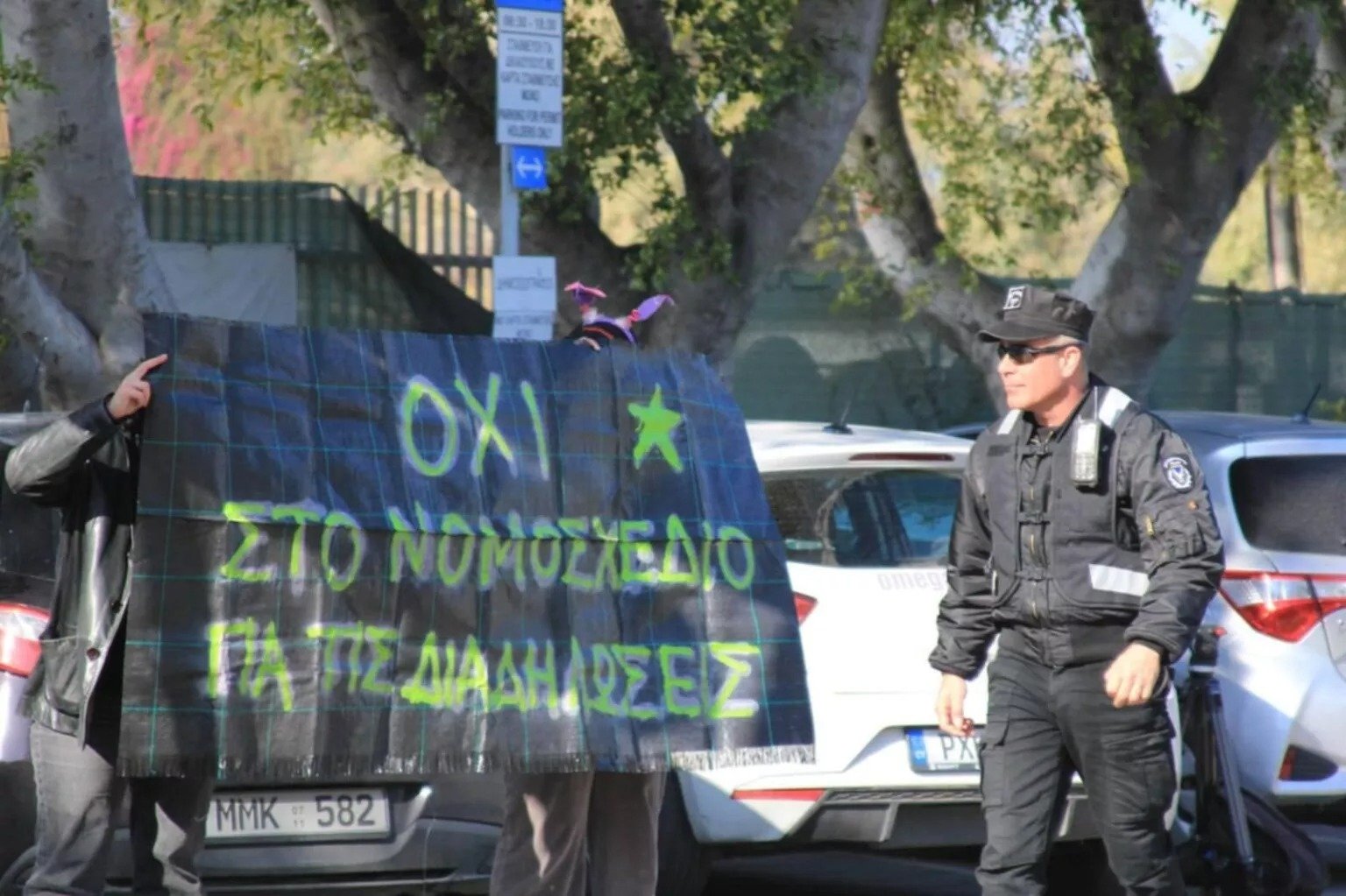
A bill of this nature, which seeks to impose restrictions on public gatherings based on the number of participants, inevitably raises serious questions about both its expediency and its constitutionality.
It’s true that the state has a responsibility to safeguard order and security. However, this cannot be done at the expense of fundamental rights, such as freedom of expression and assembly, which are explicitly and non-negotiably enshrined in the Constitution and in international human rights instruments.
The provision that procedures and obligations are imposed on the organiser from the point at which more than 20 people gather opens a dangerous loophole.
The organiser bears responsibility not only for his invited guests but also for any “unwanted” or “random” person who turns up and joins the gathering.
This creates an absurd situation where the citizen’s spontaneous participation becomes almost illegal, or at any rate a burden for the organiser.
In practice, who can control the passer-by who stops for a moment, the friend of a friend who drops by to see what’s happening, or the citizen who is moved by the issue and decides at that very moment to take a stand? Will all of these be deemed “illegal”?
And how can the organiser exclude them without being transformed into a guard or a police officer of the state?
The logic of the bill ultimately leads to a climate of fear. The citizen contemplating organising a small peaceful gathering to express a view will weigh up the possible consequences:
What happens if the number “gets out of hand”? If more people turn up spontaneously? If some provocateur exploits the situation and “inflates” the crowd so as to render the gathering illegal? Thus, the organiser becomes hostage to an arbitrary and exceedingly uncertain framework, whilst the right of assembly is fundamentally undermined.
Moreover, this regulation offers whichever authority happens to be in power an excessively flexible tool of suppression. By invoking the supposed “exceeding of 20 persons”, it can deem almost any gathering illegal.
On the other hand, the same authority can show leniency at will towards other “friendly” gatherings, proving that this law is nothing other than a mechanism of selective repression. Thus, rather than fortifying democracy, it undermines equality and intensifies suspicion towards the institutions.
Let us not forget that freedom of assembly, with all the uncertainty and spontaneity that characterise it, is the heart of democratic expression. It cannot be forced into the mould of numerical limits, nor burdened with disproportionate responsibilities that make organising the simplest protest practically prohibitive.
On the contrary, the state’s duty is to create security frameworks that protect peaceful expression, not throttle it.
This bill, as presented, resembles more an attempt to curtail rights than a regulation for social order. Under the guise of “control” and “predictability”, what is essentially being pursued is to make every expression by citizens a difficult, dangerous and criminally precarious affair.
In a democratic society, however, the voice of citizens cannot be measured in numbers. It may be one, it may be a hundred, it may be thousands. The right of expression is not subject to a numerical precondition.

