


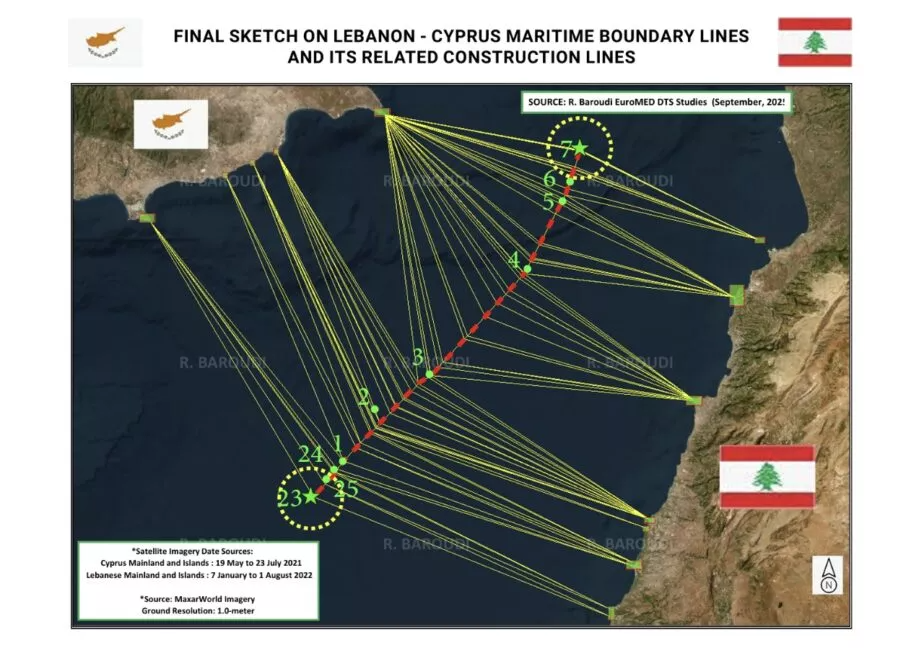
The maritime zones delimitation agreement with Lebanon represents an exceptionally significant development for the Republic of Cyprus. Following Egypt and Israel, Cyprus now has a maritime border agreement with Lebanon as well, creating the prospect of one with Syria at some point.
The importance of signing the agreement with Lebanon—expected to be ratified shortly in a ceremony likely to be held in the neighbouring country’s capital—is highlighted by Turkish opposition criticism of the government for failing to prevent these developments. A post titled: “The step-by-step loss of the ‘Blue Homeland'” by Fikret Bayır, deputy chairman of the Victory Party, which essentially criticises the AKP government, is indicative of the situation. Bayır argues that under AKP governance, Turkey’s losses in the Blue Homeland continue, and that this development constitutes a heavy blow to the country.
In his post, Bayır notes that the maritime zones agreement signed by Lebanon with the Greek Cypriot administration in southern Cyprus—as he characterises the Republic of Cyprus—highlights Turkey’s continuing losses in the Blue Homeland. Despite the AKP’s efforts since 2003, Turkey has failed to prevent the ratification of maritime zone agreements with Egypt, Israel, Lebanon, and one planned with Syria.
Bayır emphasises that Turkey’s ideological conflicts with neighbouring countries, particularly around Hamas and the Muslim Brotherhood, have resulted in significant losses for its maritime interests. By contrast, the Republic of Cyprus has proceeded with agreements that have yielded clear geopolitical advantage in the Eastern Mediterranean, strengthening its position vis-à-vis Turkey.
Bayır concludes that approval of the agreement with Lebanon constitutes yet another heavy blow to the Blue Homeland, whilst the AKP government remains inert, taking no measures to protect Turkish interests in the region.
“Since coming to power in 2003, the AKP, which has caused significant losses to the Blue Homeland, has remained silent about the occupation of the Aegean islands and has failed even to prevent Turkish republics from recognising the GCASC (meaning the Republic of Cyprus, which he calls the Greek Cypriot administration of southern Cyprus) instead of the TRNC. It will go down in history for the historic losses it has caused to security and foreign policy!
Every day of AKP governance causes significant losses for Turkey!” he notes characteristically in his post, amongst other things.
The signing of the maritime zones delimitation agreement with Lebanon marks a defining moment for the Republic of Cyprus, strengthening its position in the Eastern Mediterranean. This move not only consolidates Cyprus’s rights to its natural resources but also creates prospects for further cooperation with neighbouring countries such as Syria.
At the same time, the agreement highlights the geopolitical challenges facing Turkey in the so-called “Blue Homeland,” confirming that the region’s stability and alliances are determined by decisions that transcend narrow national interests. In any case, this development shows that the Republic of Cyprus is moving forward with strategy and determination, laying the foundation for a more secure and sustainable geopolitical map in the Eastern Mediterranean.

