


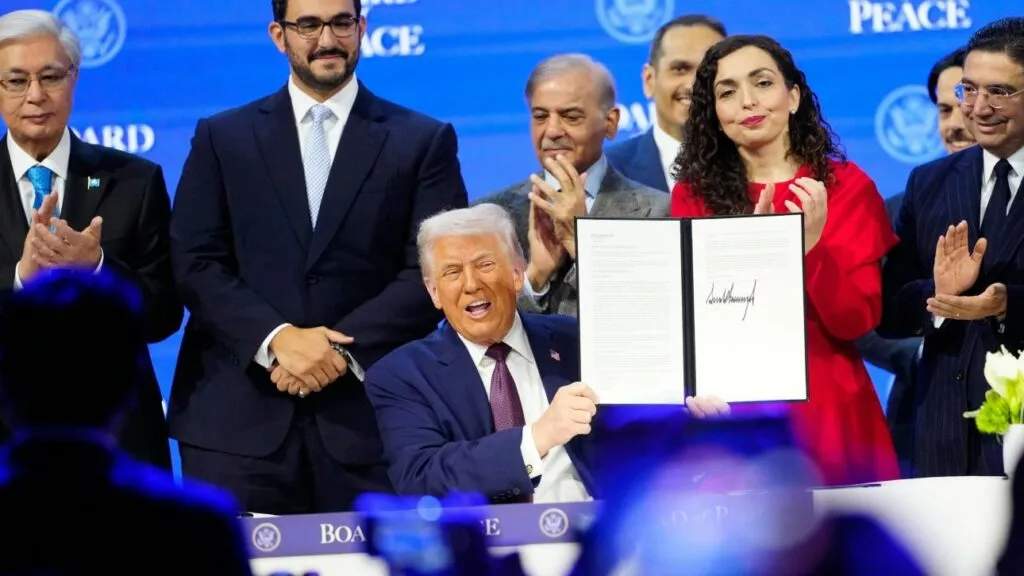
The proposal to create a new international body called the “Peace Council”, attributed to the President of the United States, is presented as an initiative to oversee peace processes in military conflicts. But behind the attractive title and the rhetoric about peace emerges a deeply problematic institutional design that threatens to replace the UN and, above all, to turn international mediation into a tool serving American interests.
The very structure of the proposed Council reveals its true character. The lifelong presidency of whichever US president happens to be in office, the exclusive authority to select members, and references to financial payment for permanent participation—all combine to create a mechanism where power, money and political submission replace collective legitimacy and international law. This is essentially an institution cut and tailored to fit American foreign policy, wrapped in the cloak of peace.
The most serious problem, however, isn’t simply the dubious morality of the proposal, but the direct undermining of the UN. The United Nations, despite its weaknesses and contradictions, remains the only internationally recognised institution with universal participation and institutional responsibility for maintaining international peace and security. Creating a parallel mechanism controlled by one superpower doesn’t come to complement the UN, but to bypass it and ultimately replace it.
The history of American interventions offers abundant examples of how the US understands the role of international law when it doesn’t serve their interests. The invasion of Iraq in 2003 is a classic case. Despite the negative stance of the Security Council and the absence of clear international legitimacy, the US proceeded with military intervention, constructing after the fact a “coalition of the willing” to avoid the charge of unilateral action. The result was the destabilisation of an entire region, hundreds of thousands dead, and a country plunged into chaos.
Similar examples can be found in Afghanistan, Libya, and in more indirect interventions in Latin America and the Middle East. In all these cases, the regulatory role of the US wasn’t dictated by principles of peace or protection of human rights, but by geopolitical, energy and economic interests. Peace functioned as a pretext, not as an objective.
In this light, the proposed “Peace Council” cannot be considered a neutral mediator. On the contrary, it portends a mechanism where every conflict will be assessed and “regulated” according to how closely it aligns with US interests. Friends will enjoy protection and tolerance, whilst adversaries will be treated as threats to be “neutralised”. Selective sensitivity isn’t peace—it’s political domination by another name.
The use of the term “Peace” in the Council’s title is therefore misleading. This isn’t peace founded on international law, collective security and respect for the sovereignty of peoples, but peace imposed by the powerful. A fragile, unjust and temporary peace, because it doesn’t address the causes of conflicts but simply manages their consequences for the benefit of the dominant player.
The international community must see behind the words and resist the institutionalisation of arbitrariness. If the UN is in crisis, the solution isn’t to replace it with unilateral mechanisms of power, but to strengthen it, democratise its structures and restore trust in international law. Otherwise, “peace” will remain the privilege of the powerful and peoples will continue to pay the price.
It’s worth noting that 23 countries have already accepted the invitation. Cyprus is amongst those invited. The dilemma focuses on the one hand on the need to leverage international alliances and, on the other, on participation in an organisation whose operation and objectives appear to be directed, at will, not in favour of but against peace and international law.

