


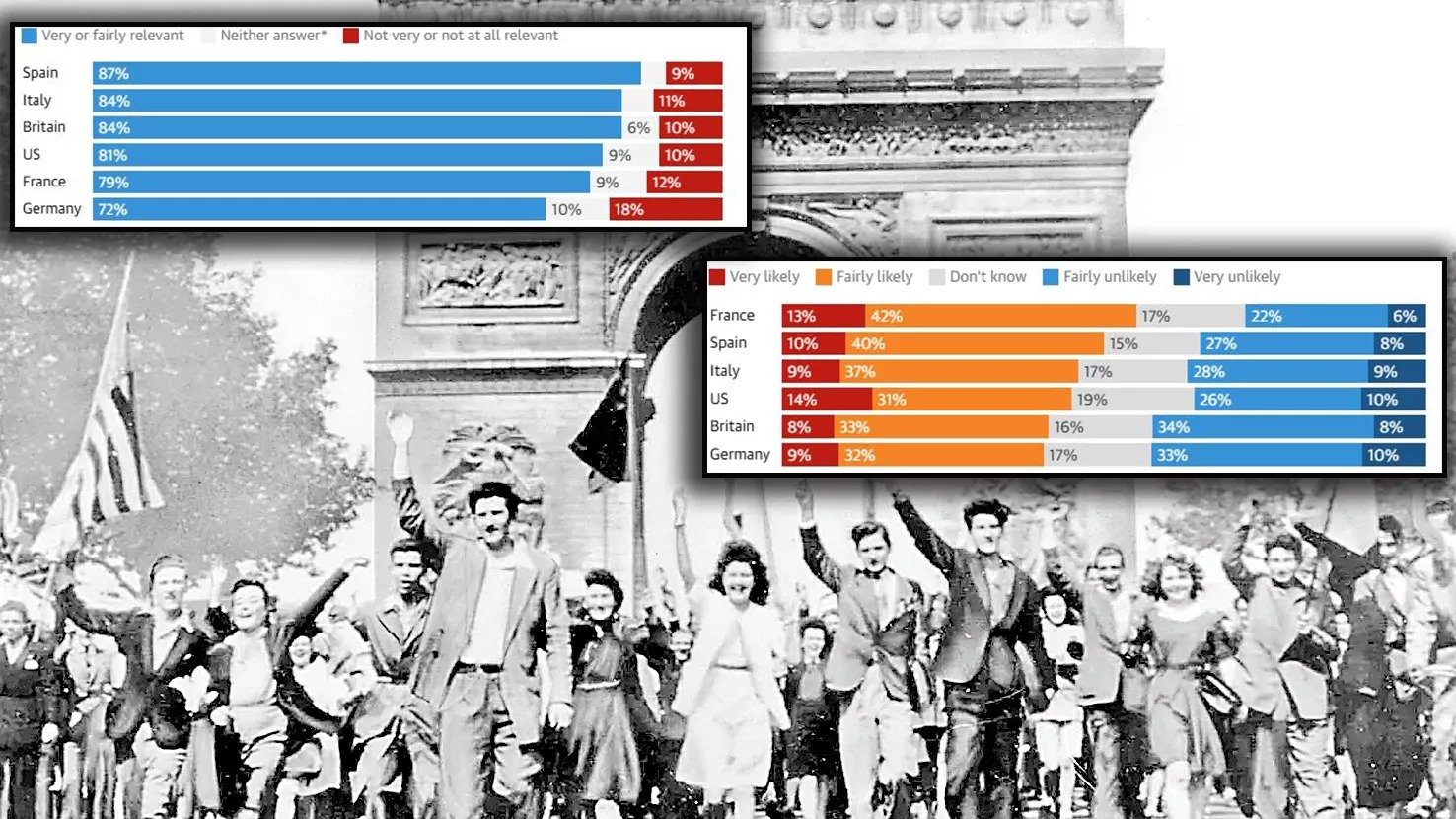
While Europe commemorated the 80th Victory Day anniversary on 8 May—marking the Third Reich’s surrender and Allied victory that ended World War II—the prospect of a third global conflict appears increasingly likely according to public opinion, at least based on data from a recent YouGov poll. The survey suggests such a conflict could emerge in the near future—within the next 5-10 years!
The poll also revealed that the vast majority believe events during and preceding World War II remain critically important today and should continue to be taught to younger generations.
This education serves to help us learn from past mistakes and prevent the devastation of wars, particularly a potential third world war, thus contradicting the notion of history repeating itself. As Albert Einstein is quoted as saying, “I do not know with what weapons World War III will be fought, but World War IV will be fought with sticks and stones”.
Between 41% and 55% of respondents across the five European countries surveyed—Britain, France, Germany, Italy and Spain—stated they consider a new global conflict very or fairly likely within the next five to ten years, a view shared by 45% of Americans.
Other findings include that 68%-76% of respondents expect any new conflict would involve nuclear weapons, while 57%-73% believe a third world war would result in greater loss of life than the second.
Russia was identified as the most likely cause of a new global conflict (72%-82% of Western Europeans and 69% of Americans), followed by Islamic terrorism.
Regarding terrorism, to be clear and avoid misunderstanding, we all seek its elimination. It strikes mercilessly at civilians who bear the brunt of such attacks. However, the question arises that often there are hidden agendas behind actions labelled as terrorism to justify them in the eyes of public opinion.
Moreover, retaliatory measures can be equally devastating, with civilians once again paying the price. And so the refrain about terrorism continues.
It’s worth noting that perceived causes vary depending on the sphere of influence where respondents were surveyed. For example, results would likely differ if the poll were conducted in Russia and countries within its sphere of influence.
Finally, an overwhelming majority (82%-90% of Western Europeans and Americans) stated they consider it important to teach World War II in schools, while 72%-87% said the events of the conflict and those leading to it remain significant today.
The inset tables in the photograph show the results to the questions: “How likely is a new world war within five to ten years?” and “How important are the events of World War II and the years preceding it to the world today?”.
All this serves as a reminder to avoid repeating history. Because, heaven help us if we do…

