


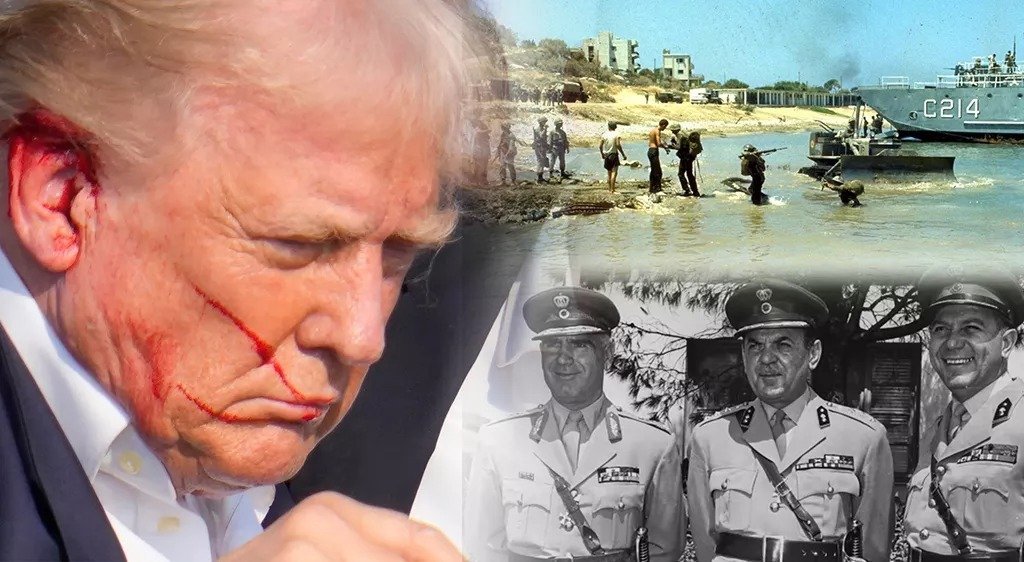
When a tacit agreement to forget leads to the normalisation of far-right rhetoric.
The title’s question comes from the play by Portuguese playwright Tiago Rodrigues, “Catarina And the Beauty Of Killing Fascists” (presented last winter in Athens). In the play, a mixture of true story and fiction, Catarina’s family kidnaps and kills a fascist every year—a day of beauty, they call it—until one descendant refuses to do it.
This “tradition” began in 1954 as retaliation for the murder of 26-year-old farmer Catarina Eufémia, a symbol of the Portuguese fight against Salazar’s dictatorship from 1933 to 1974.
Coincidentally, Greece’s dictatorship also fell in 1974, leaving behind the trauma of the Turkish invasion and occupation in Cyprus, which remains unresolved—50 years were completed yesterday, more than the 40 years of the Portuguese dictatorship and the 7 years of the Greek junta.
The difference is that in Cyprus, the crime remains unpunished—none of the perpetrators were imprisoned as in Greece, except for Sampson, nor did we have any kind of vendetta as in Portugal, although the latter had an tacit agreement to forget, which newer generations have begun to break, wanting to bring to light the ghosts of the dark past.
I don’t know if it’s a side effect of a similar tacit agreement to forget that seems to exist in Cyprus, but the rise of far-right formations accompanying the “normalisation” of far-right political rhetoric seems incomprehensible and offensive in a place with open wounds caused by fascism and intolerance towards the other—the “different one” due to religion, language, origin.
It’s the same political rhetoric that emerges everywhere, bringing with it violence and hatred.
We don’t know where the assassination attempt on Trump fits in—I’d like it to be a “beautiful” act of resistance to hubris, as in Rodrigues’s play, a response to the “political violence” openly promised by the vulgar clown if he doesn’t win the election.
However, in America, they say that if Trump had been killed or seriously injured, democracy and the entire planet would have been affected, although I personally believe that many (perhaps more outside the country) curse the would-be assassin’s failure.
So what is a political assassination, what are acts of political violence against fascist dictators—current or aspiring? Woody Guthrie “killed” them with his guitar—”This machine kills fascists,” he wrote on it.
What distinguishes a terrorist from a resistance fighter? What would have happened in Greece, and consequently in Cyprus, if Alekos Panagoulis had succeeded in assassinating dictator Papadopoulos on August 13, 1968? Would the junta, along with the local thugs, have organised the coup and the attempt on Makarios’ life, leading to Turkey’s invasion? Would Grivas with EOKA B have insisted on a senseless civil war for union with Greece (a Greece that didn’t want it)?
There are many “ifs,” and moreover, they are meaningless in hindsight, but the question of whether political violence is justified under certain circumstances remains. Let’s not forget that EOKA fighters were terrorists to the British colonisers. On the other hand, isn’t it paradoxical that Cyprus, with so many heroes and martyrs, is not free but under occupation?
The big problem, I reiterate, is the “normalisation” not of any violence, but of the violence brought by far-right, racist rhetoric.
To avoid reliving civil conflicts and divisions, but also to eventually come to an understanding with the Turkish Cypriots and live together in the same place, we must first bring to light the skeletons of the past.
This could be more easily achieved by younger generations on both sides if we allowed them to see, beyond fanaticism and grand words, that some people are responsible for what happened.
The path is not forgetfulness but knowledge. Not everyone is to blame, there is no collective responsibility, the Cypriot “original sin” does not concern the young. Besides the invader, however, there are guilty parties with names and surnames.
There will be no catharsis without punishment, so if we are looking for ways to communicate with the other side, this is the main one: I don’t know the answer to how beautiful it is to kill fascists, but I’m sure it is necessary to punish, as a society, the guilty—and fascists are guilty both by definition and inherently: Longing for that past and wanting to revive it is not patriotism, it is betrayal.
Ελεύθερα, 21.07.2024

