


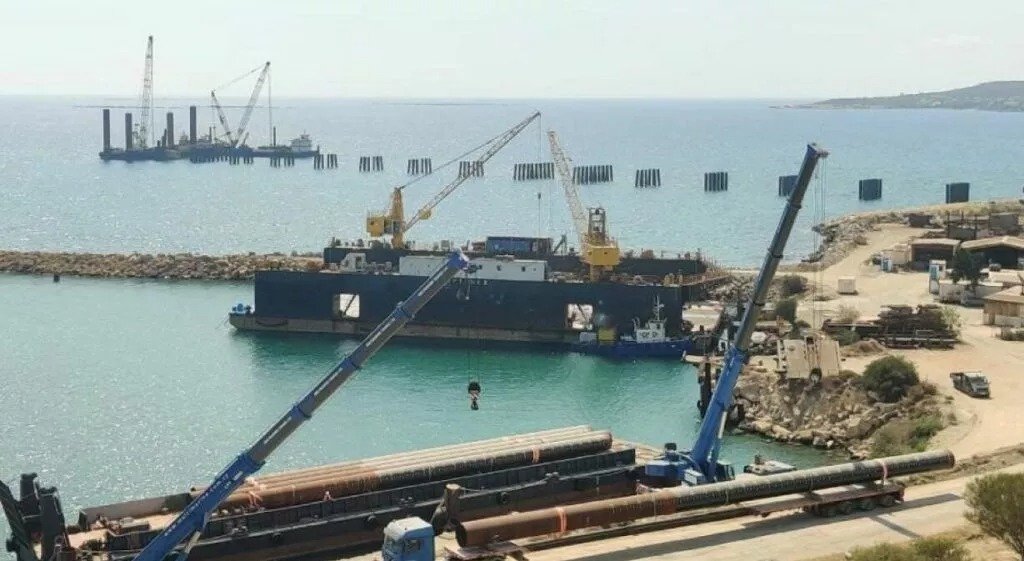
While a year has twelve months, technicians working on ETYFA’s natural gas terminal project at Vasilikos say they have far fewer useful months to work with.
For ETYFA and the terminal, 2025 effectively has at most 8 months. The same applies for 2026.
Despite Cyprus’s increasingly mild winters, the sea at Vasilikos, like elsewhere along Cyprus’s coastline, is hardly hospitable for complex technical operations. Sea turbulence is common from November through March.
Constructing a roughly 1,200-metre jetty of metal and concrete in Vasilikos’s waters is simply impossible from November through February. This was true when Chinese firm CPP coordinated the works, and will likely remain true for any future contractors.
Currently, there is no contractor at Vasilikos, meaning no work would be possible even if sea conditions were favourable.
When might jetty installation resume? Only after ETYFA decides to hire a new contractor. When will this happen?
There are two possibilities: either “whenever they choose, even in 10-15 days” or “after hiring a Project Manager to coordinate future works and prepare tender terms for selecting a new contractor”.
ETYFA’s intention was, and perhaps still is, to follow the second path, which better aligns with legislation, proper protocol, and “doing things by the book” – though this would take considerably longer.
Selecting a Project Manager seems unlikely to happen in February. Candidates will submit their final financial proposals around February 20th. Shouldn’t we factor in 2-4 weeks for ETYFA’s final decision, administrative procedures, signatures, etc.?
That brings us to March. If the Project Manager begins work then, won’t they need several months to handle the enormous mess left behind by CPP?
Won’t time be needed to take over materials, equipment, and contracts from the Chinese firm? Another complication entirely.
And won’t the tender process for a new contractor take time? It will. Then there’s evaluation, awarding the contract, etc. We’ll likely lose summer too.
If the new contractor starts in early autumn, they’ll have roughly two months of viable sea work time, assuming they’re completely ready with crews and equipment. Even state technocrats acknowledge this.
Even if everything goes smoothly, the contractor would need to suspend work in early November and resume in March 2026. They could work until early November ’26, then pause again until March ’27.
What’s the point of all this? ETYFA and the Government face a very difficult situation. If they decide on a new contractor in the next 10-15 days, work might resume in April, providing about 7 months in 2025 to progress with the jetty.
However, if ETYFA leaves initiative to the Project Manager (reportedly a major firm specialising in managing complex unfinished projects) to be selected in late February, allowing them to make crucial decisions through strict tender law procedures, the useful period in ’25 will be lost.
Works would then start in early 2026, pushing completion to 2027 – if we’re lucky.
ETYFA’s position is extremely difficult, as is the Energy Ministry’s. Can they award the contract to a contractor now without following public procurement laws?
Some say relevant state services indicated an express procedure might be possible, with direct negotiation with interested contractors and direct award, hoping works could start this spring without losing almost all of 2025.
Which contractors could respond so quickly and take over the Vasilikos mess immediately? Perhaps the subcontractors’ consortium previously used by CPP before they abandoned the project.
This consortium has the equipment ready, many required materials available to start work, and many concrete structures prepared for supporting the jetty in the sea.
This is where things get even trickier. How can ETYFA ensure a financially advantageous agreement if they rush to sign with contractors through an urgent – albeit legal – procedure, deviating from the usual time-consuming process required by law?
If they agree to, say, €60-70 million for the jetty and someone later claims they could have done it for half, what then? But if they follow the safe legal procedure and don’t have the natural gas terminal even by 2027 or ’28, who takes the blame?
Governments and state organisations/companies will always face difficult decisions under intense time pressure and sometimes amid suspicion and prejudice. Unfortunately, this recipe often leads to serious mistakes. Avoiding decisions at the right time can also prove a major error.
We note the above merely to inform public opinion. This column neither knows nor presumes to suggest what would be the right choice for ETYFA.

