


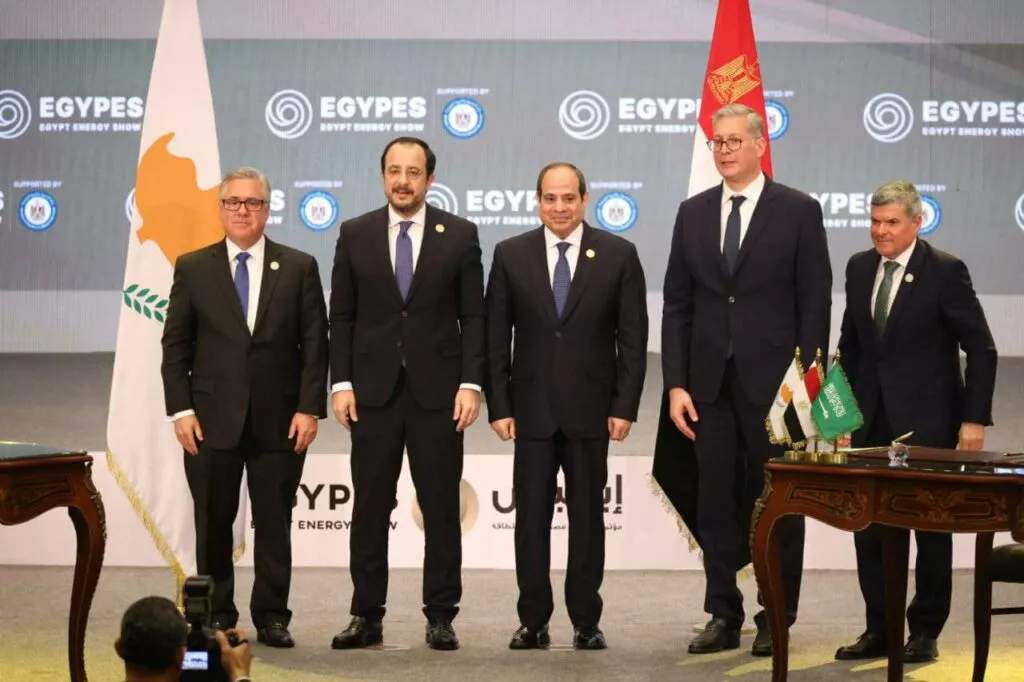
Some technocrat friends took issue yesterday with how we presented Egypt’s intention in Phileleftheros not to insist on the clause requiring 20% of gas extracted from Cyprus’s Kronos field in our EEZ to be sold on the Egyptian market.
We’d written that this intention amounted to a helping hand for Cyprus, so that the agreement with the ENI-TotalEnergies consortium could move forward and commercial exploitation of the field could begin by late 2027 or early 2028.
The technocrats told us that scrapping this clause and pushing the entire quantity of natural gas to the Damietta liquefaction terminal—and from there to European or international markets as LNG—isn’t actually the most profitable prospect for Cyprus’s economic interests.
They explained that if all the gas from Kronos is sent via the Egyptian Zohr field to reception facilities on the Egyptian coast, then piped to the liquefaction terminal to be converted into LNG, a significant sum will be needed for transport infrastructure and the liquefaction itself—money that will be deducted from what the Republic of Cyprus expects to collect from sales.
But to reach a conclusion about whether it “pays” for Cyprus to sell (in partnership with the consortium) all the gas as LNG, or whether it’s a better choice to allocate a fifth of the quantity to the Egyptian market without hefty infrastructure costs, you’d need to know the prices for each option as they’ll stand in 2028 when exploitation begins. And we don’t know them. Nor is it easy to know what price Egypt will be paying for imported natural gas, or what price LNG will fetch in Europe or Asia.
Charles Ellinas, who follows these matters closely and has years of experience in energy, told the column that current forecasts from specialist houses converge on a gradual fall in LNG prices after 2028 compared to today’s prices. And according to what’s happening in the market right now, Egypt—under pressure from foreign gas-selling giants—will gradually raise, if only modestly, the price at which it buys natural gas itself.
If both parameters of Ellinas’s estimates are confirmed in 2028 and beyond, then perhaps those who are pointing out today that Egypt’s intention to withdraw the 20% clause for Kronos gas (following Cyprus’s and the Kronos consortium’s wishes) burdens the field’s “maths” and makes the investment less profitable for Cyprus—compared to an investment that would continue to assume the sale of 20% to the Egyptian market—will be vindicated.
This worry is shared by former Energy Minister Giorgos Papanastasiou, during whose tenure—and within the framework of his negotiations with Egypt and the ENI and TotalEnergies companies—the 20% clause was included in the agreement.
But even if these worries prove accurate, it doesn’t mean Egypt isn’t helping today by removing the 20% clause to facilitate the formalisation of the agreement to exploit Kronos from 2028. Since all the information insists that if Egypt—and Cyprus—had stuck to the original 20% clause, ENI and TotalEnergies wouldn’t have proceeded with the investment to extract and sell natural gas, it follows that both Cyprus’s decision to back down (from the clause) and the Egyptian government’s decision not to insist on the 20% (for its own reasons, perhaps) do indeed facilitate pushing the project forward within timelines.
It genuinely is a helping hand for Cyprus, even if market conditions in two to three years confirm that the choice to liquefy the entire quantity will be less economically profitable for Cyprus compared to allocating only 80% as liquefied fuel.
And there’s something else: What does the government consider most important for Kronos today? If it considers the fastest possible exploitation—so that Cyprus gets on the map of natural gas producers even with modest economic benefit—then the development with Egypt serves that choice.

