


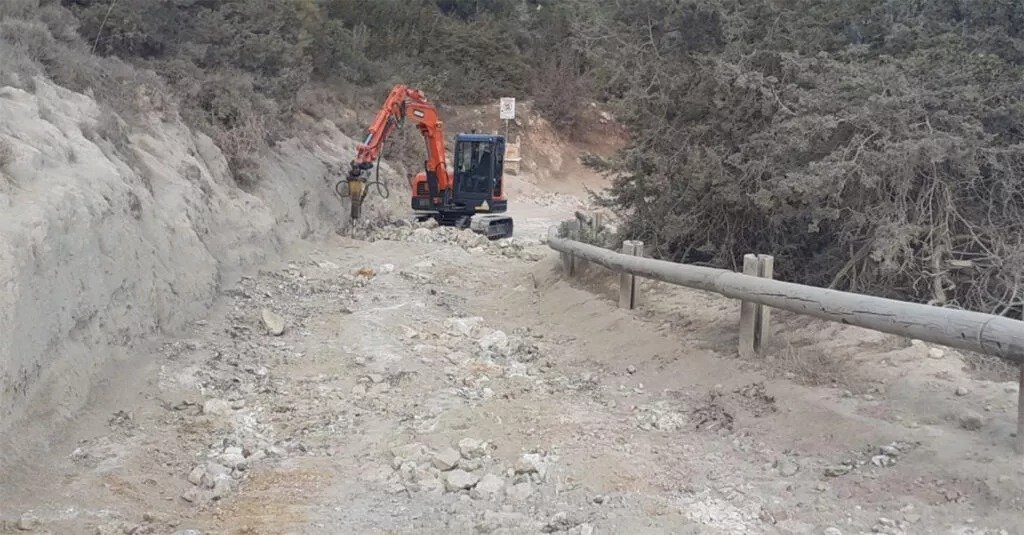
The Environmental Authority’s recent report (August 2025) on progress and compliance levels for Phase I road network improvement works in the Akamas National Forest Park leaves no room for misinterpretation: project management was problematic, environmental legislation was inadequately implemented, and the state bodies charged with protecting one of our most precious natural treasures proved, at the very least, inadequate.
The primary culprit is the Forestry Department, which violated legally binding and essential conditions of the environmental approval issued in 2021. Rather than implementing the stipulated conditions, the Department of Forests chose to execute works without meaningful regard for environmental protection, including unauthorised retaining walls and road over-excavations, causing degradation to protected areas and natural landscapes, such as at Toxeftra Beach.
Most concerning, however, is the Forestry Department’s persistent refusal to acknowledge these violations, despite all relevant authorities and members of the Ad-hoc Committee for Special Ecological Assessment unanimously recognising the breaches and the need to restore the natural environment and landscape. This position was also adopted by the Cyprus Scientific and Technical Chamber (ETEK), the Environment Commissioner, the Audit Office, the Parliamentary Environment Committee, the President of the Republic, and the Council of Ministers through related decisions.
The fact that complaints about these breaches were initially submitted by environmental organisations demonstrates the inaction of another competent authority, specifically the Environment Department, which effectively failed to fulfil its supervisory role, as the violations were identified by civil society organisations.
The recent Special Ecological Assessment Report, issued in August 2025 following a previous related report from March 2024, moves in the right direction by setting 19 conditions for Forestry Department compliance. The removal of the water supply pipeline, demolition of retaining walls, opening of wildlife corridors, and habitat restoration are all positive steps, but they come after serious damage has already been inflicted. In any case, these measures must be fully implemented and systematically monitored.
Nevertheless, significant outstanding issues remain, such as the reassessment of incompatible hydraulic works, and serious gaps persist, including the failure to issue necessary protection and management decrees for Natura 2000 network areas on the Akamas Peninsula. As a result, the Republic of Cyprus already faces proceedings before the European Court of Justice.
The Environmental Authority proposes appointing an environmental auditor and establishing a monitoring mechanism. Quite rightly. But the question remains: why was none of this done from the outset?
Akamas is neither a tourist product nor a field for experiments. It represents a unique ecosystem and a mirror of our ability (or inability) to manage our natural heritage with respect for existing environmental legislation. Recent developments have irreparably damaged the Forestry Department’s credibility, undermined the concept of environmental governance, and exposed weaknesses in environmental monitoring systems even for public works.
The opportunity for restoration exists, but it requires political will, transparency, accountability, and above all respect for such an important nature protection area. This appears lost on the Department of Forests, as evidenced by its related announcement, while the Ministry of Agriculture, Rural Development and Environment continues to display unjustifiable tolerance for unacceptable attitudes, actions, and behaviour.

