


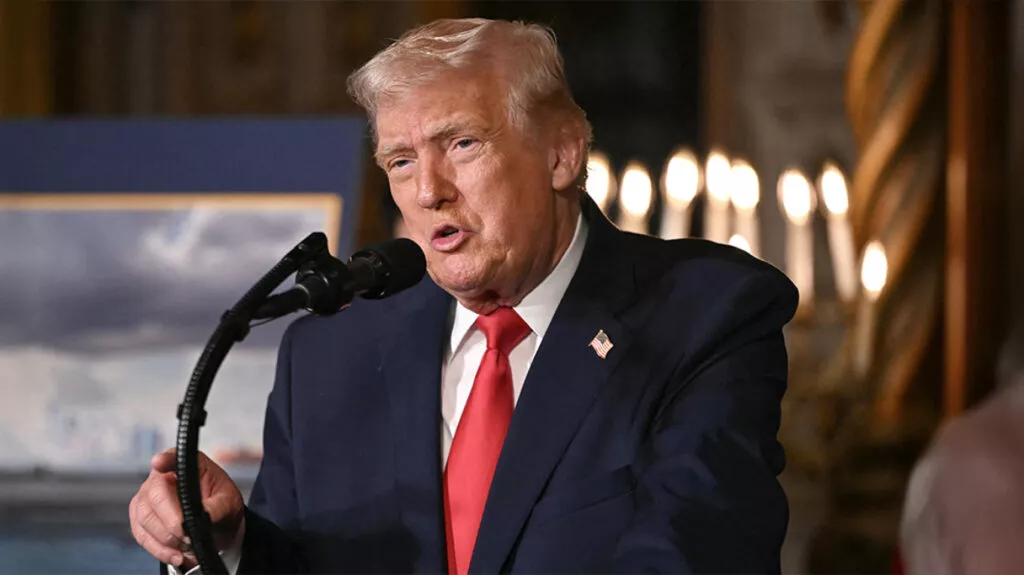
Donald Trump says he might bomb Kharg Island again — but only “for a laugh.” At the same time, he’s demanding that allies back a war he and Netanyahu started. He’s cracking jokes about bombing runs while being unable to sort out the Strait of Hormuz on his own. The self-styled master of the universe is cap in hand, begging for help.
He started a war and drove the global economy onto the rocks. He started a war without the faintest idea how to end it.
To be fair, this isn’t simply Trump and Netanyahu throwing their weight around on a whim. There are deeper forces at work — a scramble for power across the wider region, and American economic interests that go well beyond the headlines. The US economy is in serious trouble, and it’s hunting for a way out. According to analysts, the inflationary pressures the war generates actually suit Washington rather well — not least given a national debt that has ballooned to $39 trillion. This war has economic roots as much as geopolitical ones. What America and Netanyahu both want is to lock in their dominance in the region — whatever eventually becomes of Iran — and to hold their ground against the bigger players circling the board.
They went in wanting to topple the Tehran regime. That isn’t happening. They wanted to neutralise Iran’s nuclear programme. That isn’t happening either.
Trump isn’t a warmonger by nature — he doesn’t have some deep compulsion to launch conflicts. He’s simply clumsier than his predecessors, and he doesn’t answer to anyone. Not at home, not abroad. Then again, his predecessors were no different when it suited them — they launched wars too, all in the name of spreading democracy. Everyone remembers Iraq, which supposedly harboured weapons of mass destruction. How did that end? Recall that in February 2003, then-Secretary of State Colin Powell stood before the UN Security Council and presented his “evidence” that Saddam Hussein’s regime had active WMD programmes. When nothing was found, and the so-called intelligence turned out to be fabricated to mislead the international community, Powell himself later called it the darkest stain on his career.
And then what? Libya. Afghanistan. What next — Cuba? Venezuela all over again? Can America really invoke democracy as a licence to intervene wherever it pleases? The form a government takes, whether democracy functions or fails in any given country — that is a matter for its own people. Democracy is not restored at gunpoint by outsiders who then proceed to strip-mine the wealth of the countries they’ve just “liberated.” And let’s not forget another factor in the equation: Trump starts wars while his family hunts for business opportunities in the rubble. He sees investment potential everywhere beneath the flattened skylines. Gaza Riviera, anyone?
Cyprus is right to keep repeating that it has no part in this war and wants none. Nicosia has always said it stands on the right side of history — and the right side of history is the one defined by international law. Whatever one thinks of the Iranian regime, actions that violate international law cannot be dressed up as the right side of anything. Yet that is precisely what the United States and Israel are doing.
When Cyprus has needed support, it has turned to Greece and sheltered under the European umbrella. No one else. Those are the partners who stepped up — for their own reasons, but they stepped up. Meanwhile, Israel is pressing ahead with its invasion of Lebanon — a country with which the Republic of Cyprus not only maintains excellent relations but actively champions for greater EU support. It bears saying plainly: that invasion is no more justifiable than any of the others.
Lebanon is not Hezbollah.

