


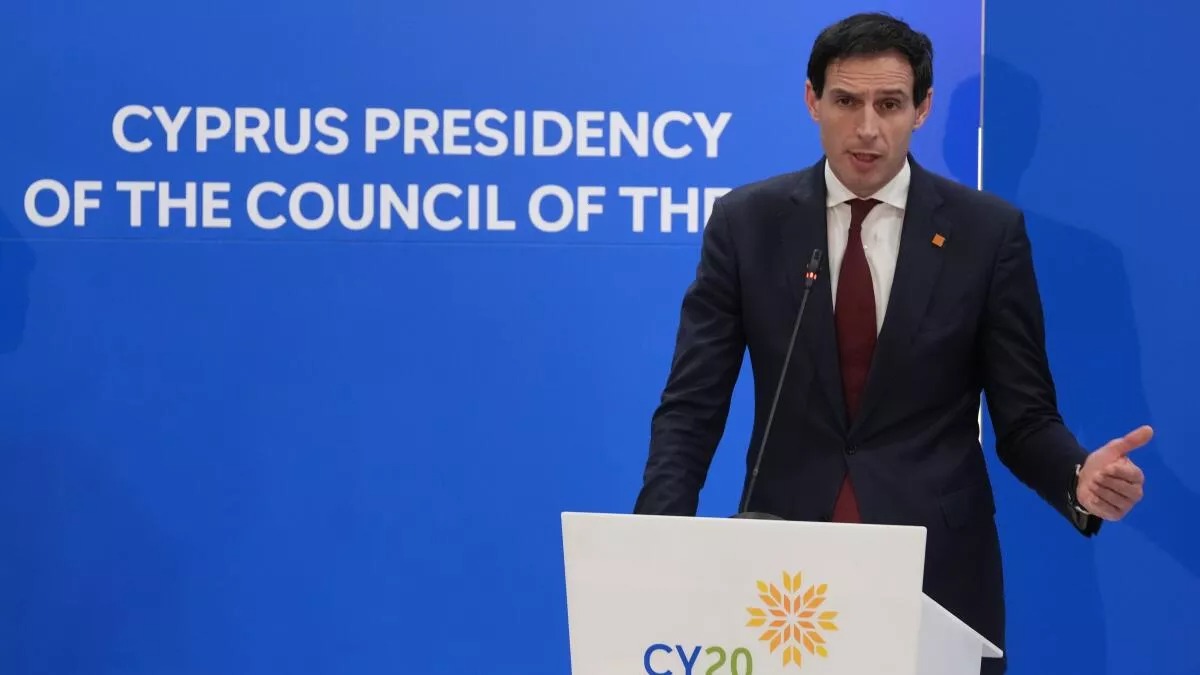
In an interview with Phileleftheros, European Commissioner for Climate Action, Net Zero Emissions, and Clean Growth, Wopke Hoekstra, referred to the role Cyprus can play in tackling the climate crisis.
He said that climate action is inextricably linked to the economy, innovation, and strengthening the competitiveness of European industry, while also helping to reduce dependence on fossil fuels and enhance security.
The European Commissioner, who was in Nicosia for the Informal Meeting, stressed that Cyprus is at the forefront of the effects of climate change, with serious problems such as forest fires and water shortages.
For this reason, the focus of the Cyprus Presidency of the Council of the EU on climate, and in particular on climate resilience and water, is particularly critical. This comes at a time when the EU itself recognises that it is not sufficiently prepared for climate disasters.
Despite its energy isolation, Cyprus can reduce its dependencies through energy efficiency, demand reduction, and the exploitation of its high solar potential.
Interconnection with the European electricity grid through the Great Sea Interconnector project is a strategic priority for energy security and the integration of renewable sources.
At the same time, as the European Commissioner said, strengthening regional cooperation in the Eastern Mediterranean can improve resilience, diversify risks, and support the gradual transition to cleaner forms of energy.
It seems that the European Commission priorities are now security, economy and competitiveness. Your portfolio focuses on climate. In this context, are these objectives compatible?
Of course, with everything going on, in my view, the only way forward for the EU is an agenda that manages to combine climate, competitiveness and independence, particularly from energy imports. All three at the same time, but not at the expense of the others. We’re very much committed to staying the course on climate, to ensuring predictability, but we are also making sure that we do that in a way that is feasible. It is ambition. It is clarity on the ‘why’, on the ‘what’, but on the ‘how’, when we learn new things, we need to take them into account. Addressing the climate change challenge means also to address its economics, investing in innovation and becoming more competitive.
Taken together, climate action strengthens our security by reducing fossil fuel dependence, supports the economy through stable energy prices and investment, and boosts Europe’s competitiveness by positioning European industry as a global leader in clean technologies.
How can Cyprus, which currently also holds the presidency of the Council of the EU, contribute to addressing climate change?
I’ve worked excellently with your Minister, Ms Maria Panayiotou. She is a strong advocate of climate action yet understands that this means working for our people and businesses. I would like to also stress the excellent cooperation I have with my colleague from Cyprus, Commissioner Costas Kadis, on all European Commission initiatives and decisions.
On climate, we managed to agree on our 2040 target in record time last year. I am looking forward to working together during her Presidency. Cyprus is one of the most impacted Member States, with a lot of the population in the front line. 2025 recorded the worst wildfire in recent history. Water scarcity is also a recurrent problem.
I’m glad to see that the Cyprus Presidency wants to focus on climate, and specifically on climate resilience. Because Cyprus can contribute to addressing climate change by using its agenda-setting and steer negotiations towards ambitious outcomes.
The EU and Member States are insufficiently prepared to deal with climate disasters. Economic losses are estimated at € 208 billion between 2021 and 2024, which is a huge number. This money could be better spent than on recovering from disasters.
Therefore, we are coming up with an important proposal this year, which sets out an Integrated Framework for Climate Resilience to address these challenges. Our main objective is to establish a more ambitious, comprehensive, and coherent EU approach to climate resilience and preparedness. We want to establish a common baseline for climate risk management, while putting emphasis on Member States’ specifics. The Framework will send a clear message about future climatic conditions Europe needs to prepare for.
At international level, the Presidency also plays a key role in preparing and coordinating the EU’s positions ahead of COP31 in Antalya, through its leadership in UNFCCC-related processes, including the Bonn climate conference, which is essential for shaping successful COP outcomes.
How does the European Commission view Cyprus’s role in regional energy developments in the Eastern Mediterranean?
Cyprus plays an important role in the regional energy developments, contributing to energy security, resilience and cooperation.
It is very important to end Cyprus’ electricity isolation. Cyprus is the last EU Member State not connected to the European grid. This limits its integration into the internal energy market and hampers the integration of renewables.
The progress on the Great Sea Interconnector project has been hampered by a complex geopolitical context, with implications for timelines and costs.
This interconnection is very strategic and needs full cooperation and coordination between the Member States involved to address the existing challenges. The Commission has been supporting this project for years, also financially through the Connecting Europe Facility, and has now included it among the 8 Energy Highways that it will prioritise for its timely implementation.
I can assure you that the Commission will continue to give strong political and technical support to it, in close cooperation with Cyprus and Greece, including through dedicated events and high-level discussions, and with additional engagement to addressing geopolitical aspects.
Water scarcity is now a permanent challenge for Cyprus. What long-term solutions are needed?
Cyprus is unfortunately facing a severe water shortage. So, it is very timely and essential that the country has made water its top sustainability priority for the Council Presidency.
And it is also a priority for the Commission, because clean water is the driving force of life. It is an essential resource for people and nature, and for regulating climate. Additionally, water is also important for the economy, agriculture, as well as energy production.
We presented the EU Water Resilience Strategy, which will help restore and protect water. This is essential to build a water-smart economy to boost competitiveness, attract investment, and promote the EU’s water industry. I am looking forward to the Presidency’s support here, bring all Member States together on how we will tackle water scarcity across the Union.
How can Cyprus reduce its dependence on fossil fuels given its geographic isolation?
Despite the geographical isolation, Cyprus can reduce its dependencies by prioritizing demand reduction and energy efficiency and scaling up domestic renewable energy – particularly solar.
Cyprus has a very high solar potential. Before my mission to Cyprus for the informal Council meeting, I was reading about several successful projects in this context. For example, that Cyprus’ largest hospital embraces solar energy and built a photovoltaic park. The project was also funded by the European Union’s Recovery and Resilience Plan, which aims to support the energy transition across Member States.
And at the same time, it is crucial to enhance regional energy cooperation in the Eastern Mediterranean. Because this can help diversify risks, improve resilience and support a gradual transition away from oil-based power generation.

