


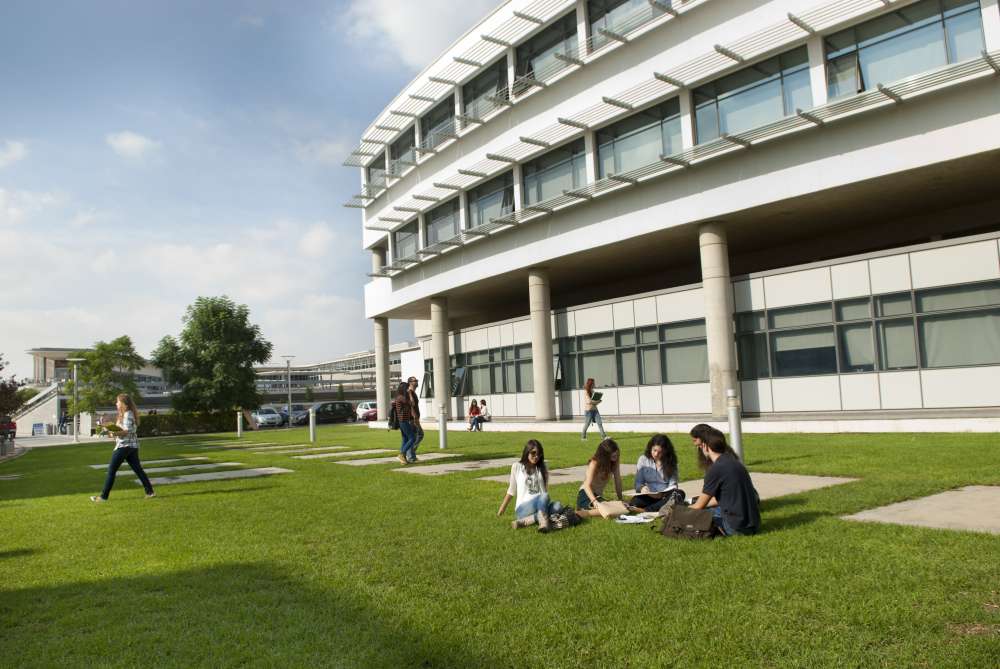
Four University of Cyprus schools are preparing to offer English-language undergraduate programmes, a move that has sparked debate in the House Education Committee.
The four schools involved are the Faculty of Engineering, School of Economics and Management, Faculty of Pure and Applied Sciences, and Faculty of Philosophy, according to an official briefing note from Education Ministry Director-General George Panteli.
The note, which addresses questions raised by MPs regarding legislation to allow public universities to offer English-language undergraduate programmes, indicates that initial discussions between departments have begun, focusing primarily on interdisciplinary undergraduate programmes.
Regarding tuition fees, the committee was informed that these would form an integral part of sustainability assessments. Fees will be determined based on operational costs and the minimum number of admissions required for the programme to function pedagogically.
The operational costs of each programme are affected by the pedagogical content and the particularities of the subject matter and tuition fees will be determined on a case-by-case basis for each specific programme of study, the Ministry of education stated.
The proposed fee structure would require approval from the university’s governing bodies and the responsible Minister, with final decisions made by the Cabinet.
Self-financing and sustainability
The financing and sustainability of these programmes has been extensively discussed in committee meetings. The briefing note emphasises that “the programmes will be entirely self-financing, meaning their expenses will be covered exclusively by their revenue.”
Revenue would include tuition fees and potential external funding from organisations or individuals, secured through special memoranda. “Under no circumstances will the University of Cyprus fund the operation of foreign-language programmes from any revenue related to the state grant,” the document clarifies.
To ensure sustainability, the programmes will undergo comprehensive analysis including:
- Internal and external environment assessment
- Market analysis with demand estimation at international and local levels
- Competition analysis to determine intensity of competing programmes
- Cost estimation including operational, administrative and capital expenditures
- Programme differentiation and target market selection
The Ministry has stated that programmes deemed unsustainable will not receive government funding. Instead, universities would be instructed to terminate admissions and discontinue such programmes.
Teaching staff and student admission
According to the briefing, these programmes will employ additional teaching staff, with significant contributions expected from partner academic institutions in inter-university programmes. Staffing needs will vary for each foreign-language programme.
A key concern, particularly among those opposing English-language undergraduate programmes at public universities, is whether these might threaten places offered to public school students through the Pancyprian Examinations.
The note addresses this: “The offering of places in Greek-language programmes is not connected in any way to foreign-language programmes. The number of places offered is determined by completely separate procedures and criteria.”
It further clarifies that admission to Greek-language programmes will continue through the Pancyprian Examinations, while admission to English-language undergraduate programmes will occur through international examinations such as GCE/International Baccalaureate or equivalent international examinations, as “the goal is to attract foreign students.”
All Cypriot secondary school graduates will have the right to apply for places in both categories of programmes (Greek and English), based on the admission criteria for each case.

