


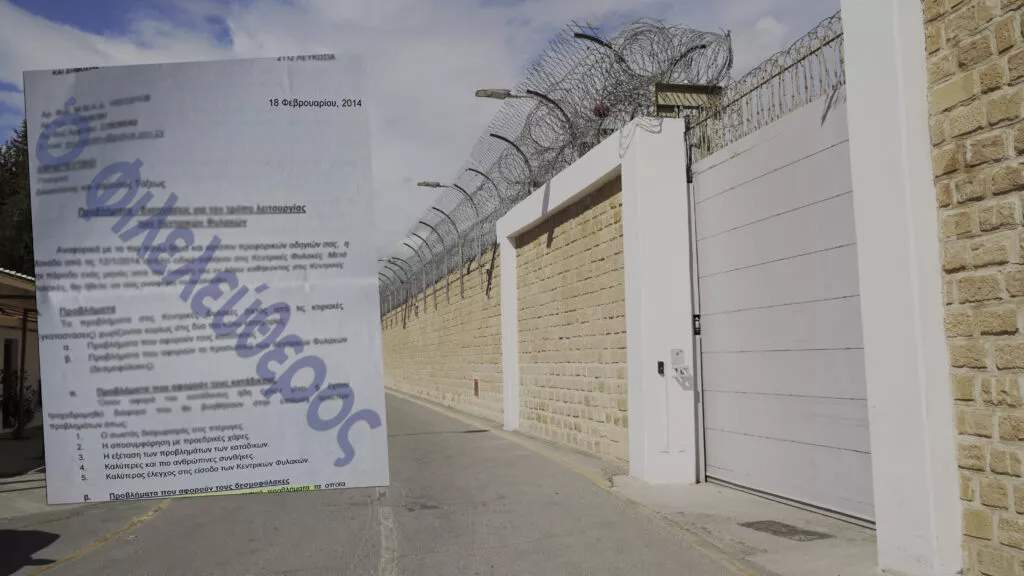
Two prisoners have died in the past 24 hours as a confidential letter warning of violence, understaffing and inadequate conditions at the Nicosia Central Prisons nearly 12 years ago has emerged as evidence in a criminal case, exposing a decade of unresolved problems.
Phileleftheros has obtained the contents of a four-page letter sent in February 2014 by then Mobile Immediate Action Unit (MMAD) commander Savvas Christou to Justice Minister Ionas Nicolaou after his unit spent a month at the prison following five prisoner suicides and the rape of a 22-year-old by four inmates.
The letter is one of several confidential documents found at the home of an accused chief warder now facing charges alongside seven others, including former prison director Anna Aristotelous and former senior prison official Athena Demetriou. The eight will appear before the Criminal Court on 30 January 2026, with committal proceedings for trial taking place last Monday.
Christou warned of critical failings that sources say remain largely unresolved today. He identified officer understaffing, with reduced supervision numbers making controls unsatisfactory, and noted no staff meetings were held to resolve problems. There was no cooperation, coordination or mutual information sharing amongst staff, whilst training for emergencies was reduced to non-existent.
The increased workload was causing tension and anxiety, with low morale and poor communication. Reduced staffing created difficulties granting leave, leading staff to take sick leave as an alternative or acquired right. For prisoners, he warned of failures in proper wing separation, decongestion, examining prisoners’ problems, inadequate conditions and poor entrance control.
Christou analysed the entry of illegal items into the prison, issues with CCTV handling and inadequate building facilities. He proposed specific measures including inspection mechanisms, psychiatric support counsellors for staff, actions to raise morale, recommendations on shifts, an independent service to inspect warders entering prison and crisis management measures.
A source familiar with current conditions told Phileleftheros that many issues raised in the letter remain unresolved. The source cited ongoing understaffing, chronic sick leave problems and lack of prisoner separation, with light and heavy offenders mixed in wings. Separation of young people is inadequate, with contact occurring in joint activities.
A recent report from the European Committee for the Prevention of Torture independently confirmed the warnings. The committee noted that physical security remains a concern, with violence between prisoners and staff neglect not only unchanged but worsened in some areas.
The committee found that lack of frontline staff created fertile ground for stronger prisoner groups to emerge, endangering prisoner safety when such groups develop and impose informal punishments. It said urgent measures are needed to review violence prevention policy at Central Prison and to recruit and train more frontline staff.
Serious indications of abuse of imprisoned persons have emerged alongside the two recent deaths. Entry of prohibited items remains a serious problem. In February 2024, Phileleftheros revealed that former police chief Stelios Papatheodorou had given instructions to address the entry of mobile phones and drugs into the prison.
Read more:

