


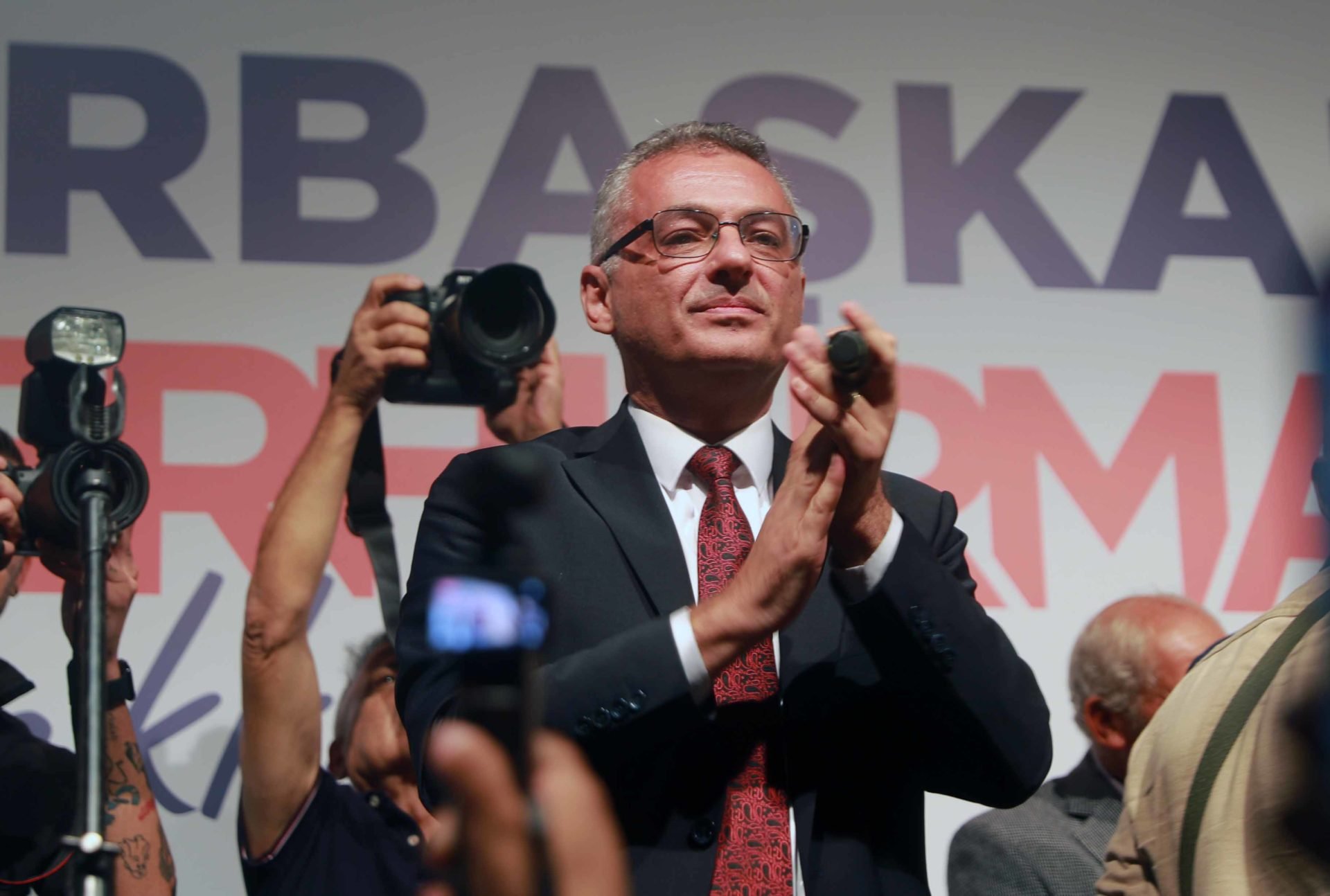
Turkish Cypriot leader Tufan Erhürman has called for new crossing points and a clear framework before formal Cyprus negotiations begin, saying confidence-building measures discussed at informal 5+1 talks were insufficient.
In a television interview on the illegal Bayrak channel on Monday morning, Erhürman said work on the Cyprus issue had begun since Saturday, but that the 5+1 format was not the right venue for discussing all issues.
“There is Nicosia. It doesn’t necessarily have to be New York or Geneva,” he said, adding that some issues, such as crossing points, did not need to be handled at the 5+1 level.
Erhürman said new crossing points should be opened to relieve pressure on existing ones, but stressed this would not be enough on its own. Additional steps were needed to ensure both sides viewed each other with trust, he said.
He called for a mechanism of continuous consultation at both leadership and negotiator level, saying crossing points affect daily life and could produce “win-win results for both sides.”
The Turkish Cypriot leader said he would make his first visit to Turkey later this week or early next week, and that his first meeting with President Nikos Christodoulides need not be social in nature. “I am open to every form of dialogue and diplomacy,” he said.
Erhürman rejected suggestions that four points raised by state broadcaster RIK about the Cyprus issue were preconditions, saying they were parameters consistent with UN resolutions.
“For example, I don’t understand why political equality is considered a precondition. Weren’t you the ones who said UN Security Council resolutions are the basis? Political equality is included in those resolutions. Therefore, we cannot make this a bargaining chip at the negotiating table,” he said.
He dismissed discussions through the press as pointless, saying these issues would be discussed in a personal meeting with the Greek Cypriot leader and the UN.
After so many years, there was no need for open-ended talks, Erhürman said. “My people don’t want negotiations for the sake of negotiations. They want negotiations for a solution.”
He stressed that the methodology followed until now should not be repeated, warning that revisiting progress on certain issues would lead to significant loss of time. These issues should be clarified before negotiations begin, he said.
“Pre-negotiations must be very well structured. We must have a clear picture of everything, so that when we start, we have a high probability of completion.”
Erhürman also addressed a European Parliament decision on missing persons, saying a reaction based solely on condemnation was pointless and that the diplomatic gap needed to be bridged. He said they would inform all groups within the European Parliament, starting with its president.
On the property issue, he noted that the assessment of the “immovable property commission” would take place in Strasbourg in early December, and the resulting decision should be analysed quickly before seeking the opinion of the international community.
“If we need to build trust, we must explain to both the UN and our interlocutors that this situation does not build trust, but, on the contrary, erodes it,” he said.
Confidence-building measures in no way replaced a comprehensive solution, Erhürman continued. “My approach is results-oriented. I want effective actions. To be able to say that we have taken at least these four or five steps in this five-year period. My wish is to solve everything, but if that doesn’t happen, I’m not going to simply say ‘nothing will be done’.”
He said he would meet with the committee already working on the property issue, adding: “There is a lot of work to be done, but we also have the energy to do it.”
Erhürman said his task now was to support what he said during the election campaign, stressing he would be “an impartial president” as representing “all citizens is a constitutional duty.”
The interpretation that the Turkish Cypriot “people” voted only on the Cyprus issue was wrong, he added, saying that contrary to prevailing belief, there was no serious division in society about Cyprus.
“There were attempts to highlight certain concepts. We chose to discuss the content, not the concepts. When we examined the content, I saw that everyone could agree,” he said.
Read more:

