Disinformation and fake news are phenomena that have long preceded social media, with experts in communication studies pointing out that, historically, the largest volume of false information is generated by governments in the form of state propaganda.
However, in our modern age, social media facilitate the spread of both false and valid information faster and further than ever before, creating cracks in the cohesion of belief and political systems.
While the world still grapples to understand and manage the effects that social media have had on seemingly every aspect of our lives, AI technologies become widespread, bringing with them more opportunities and possible dangers.
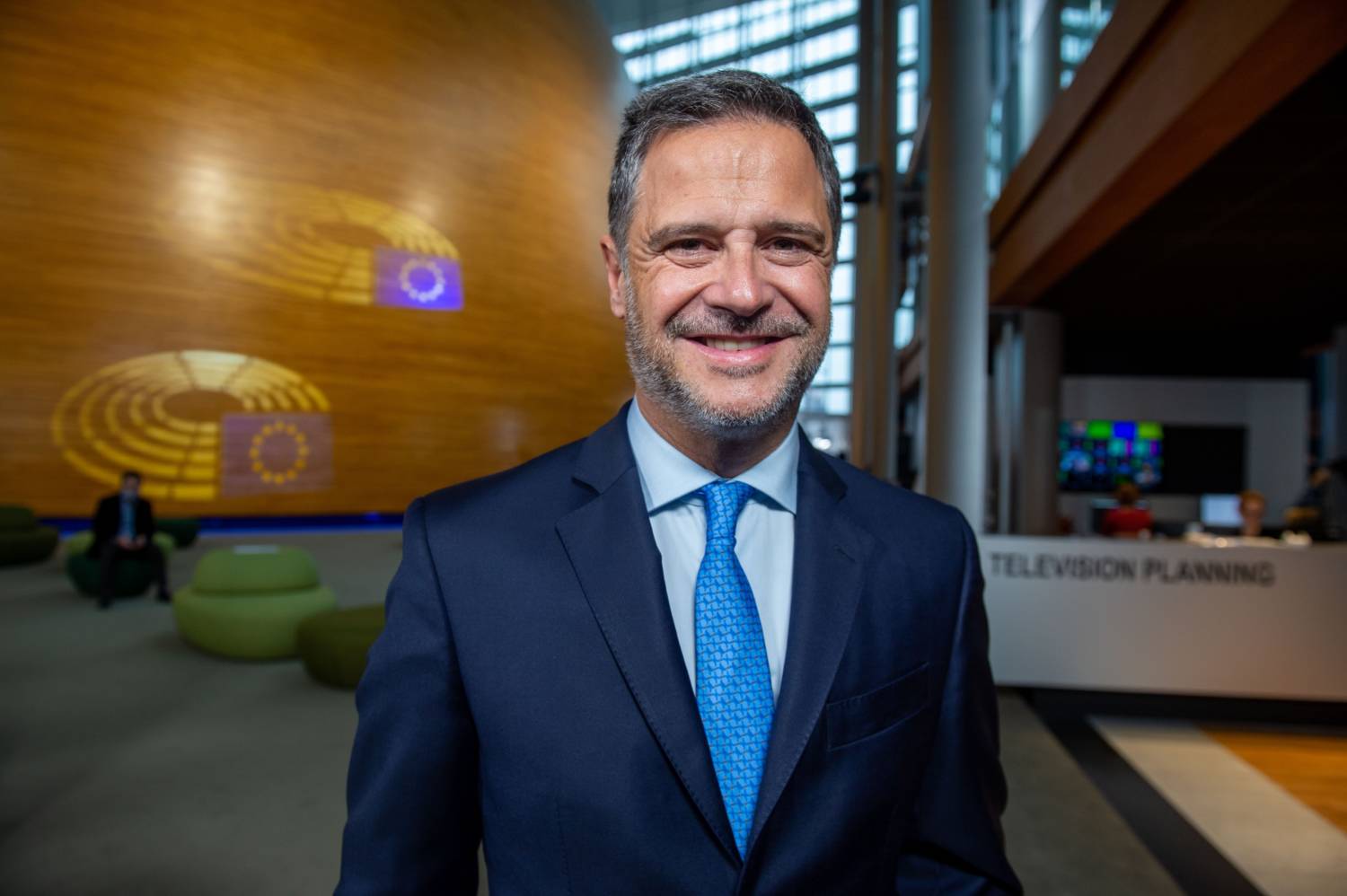
In an interview with in-Cyprus and philenews, Mr Jesus Carmona Nunez, Director for Media of the European Parliament, talks about the European Union’s strategy to regulate misinformation, social media platforms and artificial intelligence, while highlighting the importance of free press in democracy.
Interview with Stelios Marathovouniotis.
What does the Director for Media of the European Parliament do?
My main job is to liaise with media around Europe. Because we consider media as our major partners in spreading the message of what the European Union is doing. This is very important because we need the support of our citizens in the European project. Our citizens need to understand what we do, how we do it, and the impact the legislation we adopt in Brussels is having on their daily lives. I can give you some examples of this legislation we have passed: our Green Deal on the environment, which will affect the daily life of citizens, but also digital transformation. And there are more important legislations to be discussed in the future, on asylum, on migration, and all these different elements need to be understood by the citizens. And on top of that, is the sense of we are having a democracy in action in the European Parliament.
We work with the media to pass the message that the European Union project is not finished. Because we are suffering attacks from outside and from inside, we need the support of European citizens for this project. So from now on, and until the European elections, we are running with the media, to communicate what the European Union is doing and the importance of having a lively democratic government in Europe.
You mentioned attacks. Where are these kinds of attacks and how are they channeled through media and disinformation?
What we see is that for quite some years, the number of attacks we’re receiving in terms of misinformation has really increased. I see two reasons for that: One is that Europe has become a global actor, and is not the same European Union as it was 50 years ago when we focused mostly on economic issues. Now, particularly with the war in Ukraine, Europe has taken a strong stance against Russia and other powers. This has created some – I will say enemies – that didn’t exist before, and they are trying to attack our democratic system, they are trying to weaken the European Union from abroad. And at the same time, we have the question of social media, which has spread disinformation or fake news in a very, very fast manner. So now we have developed a strategy to combat this disinformation. But in fact, what we see is that the more the EU becomes an important actor, the more attacks it suffers.
We know about the troll farms in Russia, but many times misinformation comes from Euroskeptic actors inside Europe. Do these actors act independently or are they funded by regimes who want to see Europe decline?
Absolutely. So we have seen that there are some particular connections, and are not only external actors but also internal actors inside the European Union and populist movements from the extreme right to the extreme left as well, that take positions – I will say similar to those from these foreign interventions – because, well, they have some interest in seeing that the European project does not succeed.
What can do you to restrict this flow of false information, having in mind that freedom of speech must be protected as well?
The first or more important element is to combat this information with factual information, with real information. Every time we pass legislation, we are the first to make it known to the public. We have a very proactive communication policy to let people know that we are doing things, we are passing legislation before others come and can deny it.
The second element of our strategy is to work with independent media, who are trustable because they help us spread our message. They are the ones dismantling this fake news. Independent media are key in our strategy, because they are key for democracy, as well.
And finally, we are working with our external services in the European Commission to detect and counterattack this information when it comes from abroad. There is a special task force that has been created whose role is to monitor and give a deep look at different sites that can go against the interests of the European Union.
How is the EU’s relationship with social media companies and how do you work together to tackle false information?
Well, it’s a relation of love or hate at the same time, because on the one hand, they are there, so we need to work with them. And on the other hand, they need to take responsibility for everything that happens in their media. And we have detected that there is a lot of illegal content on the big platforms, there is a lot of information and they need to take responsibility for what is inside. We created a kind of Code of Conduct a few years ago, asking social media companies to take part of their responsibility. It works I will say not 100% as we wanted.
The next step we have taken is to pass legislation, which is one of the most important laws in the European Union, the Digital Markets Act and the Digital Services Act, which are there to frame their work, regarding content that could be illegal. So, our objective is to let them know that what is illegal offline, should be illegal online.
The second element is data privacy. So all the rules regarding our GDPR regulation should be obligatory for them, as well.
And the third element of these two important pieces of legislation is to create transparency in what they are doing, from where they are receiving money; whether a state is giving money to them, where is the advertising coming from; and these rules are now going to be implemented in a tough manner. I just would like to remind that recently, Meta was subject to the most important, fine that the European Commission has ever given to any company. We are talking about billions of euros. So the message for them is clear.
What we are doing in Europe, is highly important for other parts of the world. I was in South America, one year ago explaining what we’re doing against misinformation, because they are doing exactly the same, they are following us. Even Americans are not as advanced as we are in terms of protecting the rights of individuals and fighting against misinformation.
We are going to pass a law very soon to frame what we have seen as a worrying phenomenon these days, artificial intelligence. Artificial intelligence is on the table now of our legislators in the European Parliament and the Council. We have seen some key examples; such as pictures of Putin kneeling before Xi Jinping. We need to frame AI because people need to trust what we see in the public domain. They need to trust what the media are saying.
Besides, artificial intelligence is also good. It’s good for detecting fake news, and for doing things that previously we were unable to do, but obviously, there are some rules that need to be respected. Even the CEO of Open AI has come to Brussels, asking for legislation on AI, because he sees it could potentially be harmful to our democratic societies.
The issue of regulating social media has been under discussion for more than a decade in Europe and the US. Social media companies are unwilling to take responsibility for the content posted on them, because they see themselves as platforms, not publishers. How easy of a task is it to regulate them, also having in mind that AI is coming into play now?
It is not an easy task because, well, they have a lot of power. They have a lot of influence, particularly amongst young people. But what is clear is that there are limits to what they can do. In the European Union, we are strong defenders of freedom of the press and of freedom of speech. Without a free press, there is no democracy. But obviously, there are limits to what they can do. And if you post racist content, if you post xenophobic things, you cannot say, ‘I’m not responsible for that, because I’m just a platform.’ No, you’re responsible, because you are a platform, and you are allowing this kind of xenophobic or illegal content on your platform. And you have to take responsibility for that. So it’s not easy because the pressure and the lobby are huge for these platforms. They have a lot of money, they have very good lawyers working for them. At the same time, we have a set of principles, a set of values in the European Union, that we need to defend.
The view from inside the house is that the media industry is collapsing. The loss of revenue to digitalisation and social media is affecting the quality of the press. How does the EU view that and is there any plan to support media?
Well, it’s a key question for us because, without free media, there is no democracy. That’s our key principle. Now how we are supporting media: first of all, with legislation. We are going to pass an important piece of legislation, called SLAPP, which aims to stop lawsuits that seek to block the activity of journalists, because, big companies, or big enterprises, have the ability to censor a journalist when something they have written goes against their interests. The second is the European Media Freedom Act, which is going to run through the European Parliament in the next month. This is also a key piece of legislation, because through it we have tried to create a more transparent system for the media, in terms of the market, who are the owners of the media, and from where they are receiving money. So, this piece of legislation is going to be key for safeguarding the independence of media.
And then apart from legislation, we have indeed some actions that support media. The first is to make all the information about the European Union available to the media in all languages of the EU. Then we have some grants to support media work, particularly now that we are heading towards elections. Last but not least, we have some prizes such as the award named after Daphne Caruana Galizia who was killed while doing investigative journalism in Malta. We deliver the award in October, on the day she was killed. Through this, we want to raise awareness of the difficulties journalists face these days.