


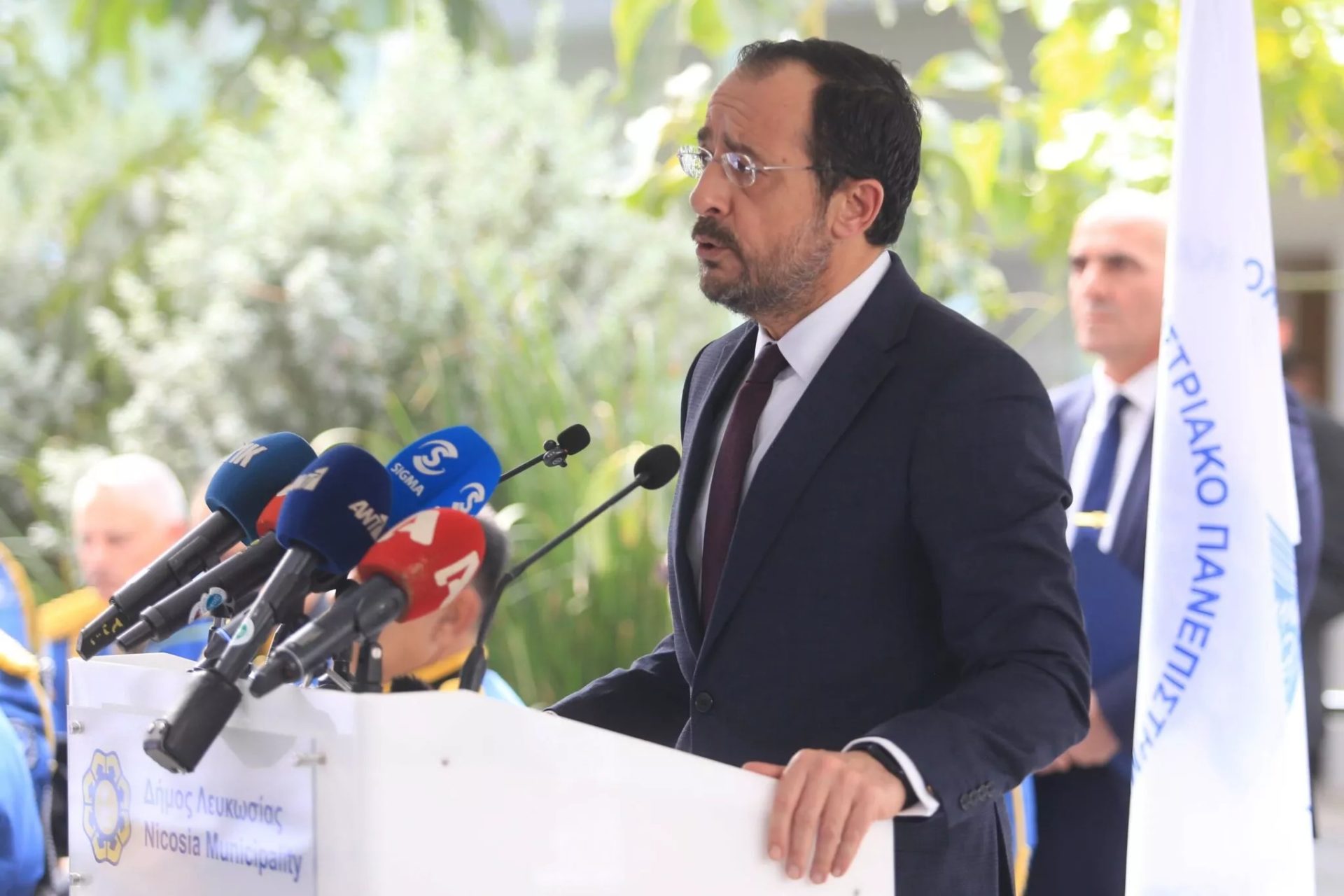
President Nikos Christodoulides called today a historic milestone as he inaugurated the National and Kapodistrian University of Athens Cyprus branch in old Nicosia.
The university, founded in 1837, becomes the first Greek institution to operate a branch outside Greece. Its Cyprus campus includes four schools and eight departments offering courses in Greek and English in Nicosia and Larnaca.

The opening ceremony marked the launch of the Medical School and student residences in the heart of the old city, near the municipality building.
The Archbishop of Cyprus, the House president, former presidents, ministers and the first medical students attended the event, with students receiving their white coats and beginning classes immediately.

The university also maintains two offices at Eleneion Primary School and will use the Achilleion Library, with equipped reading rooms, laboratories, student residences and lecture halls.
Christodoulides, himself a graduate of the Athens institution, said the university ranks as Greece’s largest and oldest, the first across the Balkan Peninsula and the wider Eastern Mediterranean region, with global recognition and prestige.

The president said the branch marks a milestone in efforts to internationalise and upgrade higher education in Cyprus, strengthening the strategic goal of establishing the country as a regional centre for knowledge, research and innovation with significant benefits for society, the economy and the country’s international image.
He highlighted benefits including expanded academic and research development, new prospects for students and researchers, and strengthened ties with Greece.

The government backs every effort that upgrades higher education and expands international cooperation with universities and research centres, Christodoulides said, with a vision for Cyprus to emerge as a recognised hub of excellence and innovation on the global academic map.

“Taking into account relevant international developments, within our strategy, we are strengthening the connection between higher education institutions and the labour market, implementing targeted policies to monitor employment trends and map the skills required by the modern economy, aiming to shape study programmes that respond to the real needs of the market,” the president said.
He also spoke about practical support for research, innovation and entrepreneurship, boosting economic competitiveness and creating new high-specification jobs.
“Our first and main goal is for Cyprus to establish itself as an international educational centre of excellence, capable of attracting students, researchers and academics from around the world, through the internationalisation of our universities, the formation of international partnerships and our participation in European and international higher education networks. Within this framework, the establishment and operation in Cyprus of the branch of the National and Kapodistrian University of Athens contributes decisively to achieving our goals,” he said.

Archbishop Georgios, also a graduate of the institution, spoke of its invaluable contribution to Cypriot Hellenism, noting that for many years the university accepted thousands of Cypriots without examinations, regardless of school-leaving grades, and educated many generations with Greek values at a time when the British sent graduates to their own universities “with the aim of de-Hellenisation”.
The archbishop referenced the university’s high level and the high achievements worldwide of its graduates, who continue to receive praise from major foreign universities.

He also spoke about the importance of Greek education on an island like Cyprus that has known so many conquerors throughout its long history, calling it the main factor in the failure of efforts to de-Hellenise Cypriots, saying that without education’s contribution, they would not have survived and would have disappeared.

Rector Gerasimos Siasos spoke about the university’s role in supporting Cypriot Hellenism through the years with various actions and initiatives, promoting programmes and dissertations, missions and excavations.

He called the branch establishment a historic step and added that after the Medical School, classes begin in Nicosia in 2026 for the Nursing Department, Business Administration Department, Primary Education Pedagogy Department, the English-language Classical Studies programme, and in Larnaca for the Psychology Department and the Port and Shipping Management Department.
Siasos said more undergraduate programmes will operate in the future with research promotion and attraction of students from other countries.

He particularly thanked those who worked hard in Greece and Cyprus to make this step possible, stressing that the mutual love between Cyprus and the university and the relationship between Greece and Cyprus through the centuries left no room for neglect in implementing this historic undertaking.

Nicosia mayor Charalambos Prountzos noted the enormous benefits for divided Nicosia from the branch of the leading Greek university, saying the city opens a hospitable embrace to professors, students, researchers and staff, and that the university’s presence honours the city.

Prountzos said the presence has exceptional significance because it symbolises the deepening of educational relations between the two countries and strengthens Nicosia’s role as an education hub.

He said that with approval of the application to establish the branch, investment interest in Nicosia has taken on “the form of an avalanche” and called on the president to consider extending the student residence subsidy scheme that operated under the recovery fund.
He said Nicosia moves forward with confidence and assured students the city will stand by them and support them in whatever they need.

(information from CNA)

