


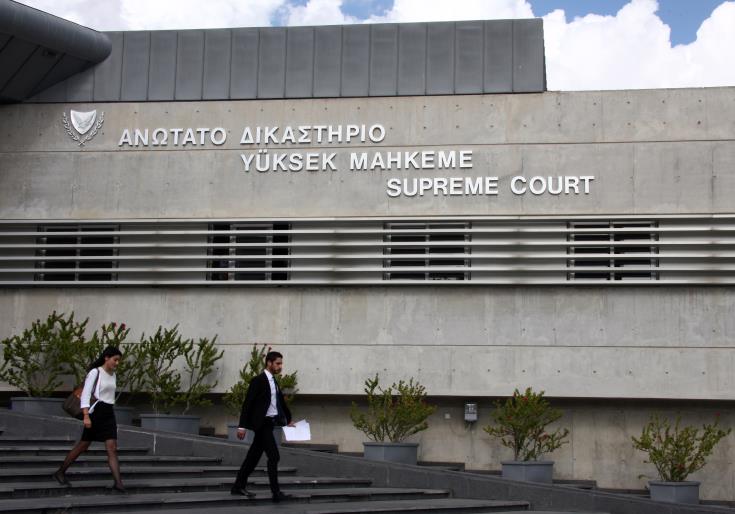
The Supreme Court has rejected for a second time an application by law firm Areti Charidimou and Associates LLC and 11 other individuals seeking to annul a search warrant issued during investigations into the naturalisation of five persons.
Police initially conducted a search at the law firm on 5 April 2024 based on a warrant that was challenged at the Supreme Court, with the application rejected. However, on appeal by the 12 applicants, the decision was overturned and the matter returned to court.
Supreme Court judge Lena Dimitriadou Andreou heard both sides on Wednesday and rejected the law firm and its associates-employees’ application, finding the new search warrant issued on 8 October 2024 was properly granted.
Police investigating conspiracy and money laundering offences
According to facts recorded in the Supreme Court decision, based on a police investigator’s affidavit, the investigation was conducted on the basis of reasonable suspicion that evidence exists at the law firm, including documents in electronic form, electronic correspondence and other evidence related to and providing proof of the offences under investigation: conspiracy to defraud, conspiracy to commit felonies, offences under the Prevention and Suppression of Money Laundering Activities Law, false declarations under Article 116(1) of the Population Registry Law, failure to comply with laws and regulations under Article 88 of the Population Registry Law 2002, and forgery of travel documents under Article 89(1)(e) of the Population Registry Law.
According to the affidavit content on which police based their application, the offences under investigation were committed in the Republic of Cyprus from 2015 until the warrant issue date and related to exceptional naturalisations as Cypriot citizens under the Cyprus Investment Programme provisions for the following persons (investors) and their dependents: E.K. and D.T. from Russia, L.G.D. from Venezuela, V.D. from Russia, and A.Z. from Russia.
Electronic data may have been deleted from firm’s server
As the investigator’s affidavit further stated, it was established that some electronic data may have been altered through deletion from the law firm’s central server, resulting in their not being located during the 5 April 2024 search. Additionally, the affidavit stated the search warrant issue was reasonably necessary to restore data that may have been deleted or altered and related to the offences under investigation, through technology.
The law firm challenged the search warrant issue, arguing that for police to access such communication legally, they must first obtain a court order under Articles 21-23 of the Protection of Private Communication Confidentiality (Conversation Monitoring and Access to Recorded Private Communication Content) Law N.92(1)/1996. This would have no basis as such an order can only be issued if at least one of the offences under investigation falls within the scope of Constitutional Article 17.2.B.
Court approves retrieval of potentially erased evidence
The Attorney General’s side, represented by Prosecutor Polina Efthyvoulou with lawyer M. Fotiadou, stated the purpose of retrieving electronic data, including professional communication, was to locate evidence and electronic data (electronic correspondence) that may have been deleted or altered and could not be located during the previous police search on 5 April 2024. As emphasised, what police sought was location, not processing of data.
The court president agreed with the prosecutor’s position, stressing that what police requested and what the lower court authorised was location and receipt, as things and objects, of documents and data in electronic form, including professional electronic correspondence that may have been deleted or altered and could not be located in the initial search, not access and processing of such data.
As correctly noted by the Attorney General’s learned counsel, the judge noted, in the modern digital age criminal investigation inevitably leads to intangible evidence kept on computers and servers. Often retrieval or movement of such digital devices is impractical, whilst more practical is extraction and abstraction of data found within such devices which, of course, does not entail, as appears to be the applicants’ understanding based on their relevant submissions, access and processing of such data.
Following this conclusion, the court dismissed the law firm’s application, opening the door for access to evidence that was retrieved.

