


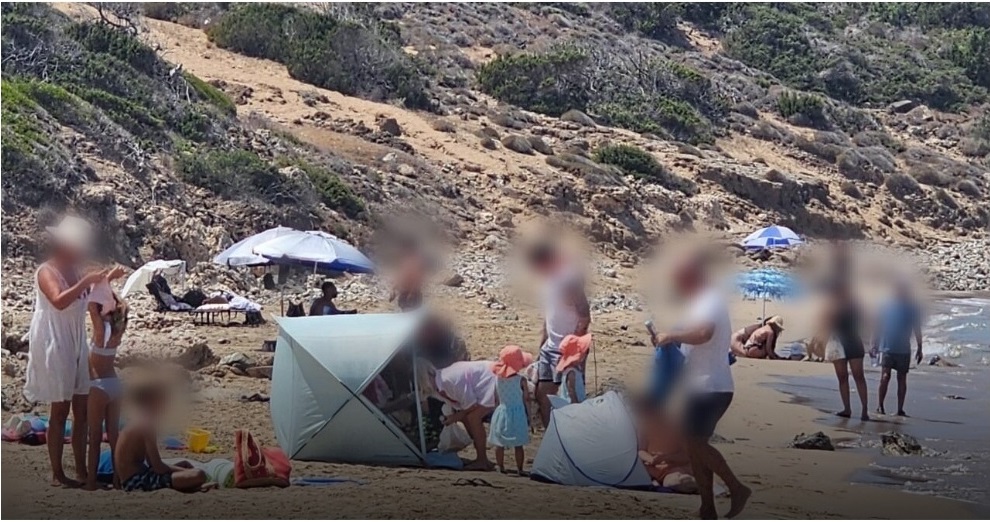
Beachgoers placed umbrellas and tents on Lara beach in the Akamas. This came despite clear prohibitions in force during the sea turtle nesting and hatching season, the Federation of Environmental Organisations of Cyprus (POEK) has said.
POEK said it was expressing strong indignation and concern over the new violations recorded in the protected Lara area.
Under existing rules, between June 1 and September 30 each year, it is prohibited within the protected Lara-Toxeftra area to place umbrellas, beds, tents, caravans or similar structures. Staying on the beach at night, from one hour before sunset, is also prohibited, as is fishing by any method other than rod fishing from the shore.
Questions raised
POEK said the images and information that have come to light do not fit an area under a strict protection regime.
The federation said this raises serious questions, among them how the regulations were breached despite earlier patrols, and how frequent and effective checks actually are. It also questioned what measures are taken when violations are found, and whether the penalties provided for in law are applied or whether protection is limited to recommendations and awareness efforts.
POEK described Lara as one of the most important breeding habitats in Cyprus and the Mediterranean for the green turtle (Chelonia mydas) and the loggerhead turtle (Caretta caretta), rather than an ordinary beach for development.
Legal protection status
The Lara-Toxeftra area has been protected since 1989 under the Fisheries Law and related regulations. It is included in the EU’s Natura 2000 network, and has been on the List of Specially Protected Areas of Mediterranean Importance (SPAMI) since 2013.
POEK said this protection is not an optional policy choice, cannot depend on the sensitivity of visitors, and cannot be limited to the presence of informational signage.
POEK’s demands
POEK called on the government, the Department of Fisheries and Marine Research, the Department of Environment, the parliamentary Environment Committee, the Commissioner for the Environment and Animal Welfare, and every relevant authority to proceed immediately with substantive action and effective checks.
Among its demands, POEK is calling for an immediate and full investigation of all reported violations in the area, the immediate removal of any installation or activity not provided for or permitted under the law, and strict enforcement of all measures protecting the area.
It is also calling for responsibility to be assigned if failures or inadequate supervision are identified, and for continuous and effective surveillance of the area, particularly during the turtle breeding and nesting season. POEK further wants a stronger presence of relevant officers so that enforcement does not depend solely on complaints from members of the public, along with full public disclosure of the checks carried out, the violations found, and the measures taken as a result.
POEK said the state cannot introduce protective regulations and designate an area as protected while at the same time being unable to prevent or effectively address practices that degrade it, adding that this does not amount to substantive protection.
The federation warned that tolerating violations sets an extremely dangerous precedent, not only for Lara and Akamas but for all protected areas in Cyprus. It called on the state to act now, applying the law with the same strictness to everyone, without exceptions or discounts when it comes to environmental protection, adding that when illegality is tolerated in a protected area, the issue is no longer just about Lara but about the credibility of environmental policy and the rule of law itself.
POEK said Lara must be protected and that its protective measures must be applied in practice, not remain only on paper.

