


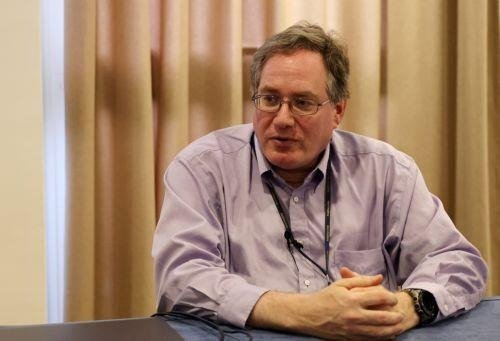
Media literacy is necessary, to be able to figure out what is false and what is true among so much questionable information on the internet and social media, US expert Louis Jacobson told CNA.
It is important, he said, to use critical thinking and be more cautious when sharing things online, particularly those that emotionally motivate us.
Jacobson, senior correspondent with PolitiFact and an expert in media literacy, integrity in journalism, and identifying disinformation, was in Cyprus last week, for a series of presentations and discussions on these issues with organisations, journalists, and educational institutions, organised by the US Embassy in Cyprus.
In an interview with CNA, and, when asked whether media literacy was useful, Jacobson said that it was more than just useful, “it’s really necessary”. “There’s so much questionable information on the internet and social media that people really have to fend for themselves, what is false and what is true”, he said.
Journalistic outlets like the one he works for, he added, can help with that. “We try to provide reliable information about what is true or false, or somewhere in between but ultimately people have to use their own critical thinking and their own sense of judgement and not just simply share the first thing that crosses the social media cue”, he said.
He urged internet users to pause a second and think about whether it might not be true, look deeper into the sources cited and look at what other websites and social media are saying about the same information.
He referred to the importance of teaching people from a very early age, kindergarten through high school, to use their critical thinking and not just simply assume things that they see are correct. “It should be internalised with people, being sceptical about what they see, having the skills to really look deeper and not just blindly share things, but rather try to figure out if they make sense if they are true or not”, Jacobson adds.
Asked about the risks of not questioning everything we see on social media and share them with everyone, he said it was a combination of the risks between the individual and the social media platform. He explained that many social media platforms are about getting engagement, liking, sharing, and commenting.
“The platforms are structured so that they feed you information similar to information you’ve liked or shared in the past”, he said, noting that the reason for this is that they want to keep users paying attention to their platform, while advertisers want to see traffic on that platform, “and the best way to do that is to serve up posts that are similar to the ones that they know you already like”.
The problem with that, he said, is that social media sites then tend to become sort of “echo chambers” where one only sees information that they already agree with, while rarely seeing information they disagree with.
This, according to Jacobson, reinforces people’s own beliefs and makes it very hard for people who have other beliefs to have any common ground with them. “So, that is why is always good to have a diet of news and information that is diverse, so that you get all kinds of perspectives, and that you don’t simply fall back upon whatever you already believed in”, he said.
On how institutions and people, in general, can overcome the problem of misuse of digital media, he said that some of the people they work with in the US, at the Poynter Institute, have free programmes where people can learn tips about how to be a better social media and internet consumer of information. “It will be great if there can be more efforts at the school level, to do this”, he also said, noting that there are efforts in the US to try to do this, but that anywhere it can be done, was “a positive thing”.
Asked about how one can distinguish between real news and fake news, in this age of artificial intelligence, Jacobson pointed out that, artificial intelligence is not at the point where it is dominating “our lives as fact checkers”.
He said, however, that it has “a very intriguing possibility for the future”, about being able to fool people into thinking things are said in a certain way that they aren’t, and creating completely fake videos.
“There’s a bit of that, but at this point, the so-called cheap fakes, are more common and potentially more damaging than the deepfakes”, he said. He explained that deepfakes use AI techniques to show a video or give audio of a person that sounds like they saying something they didn’t say, or that is very different from what they would say in real life.
“There has been some of that, but the technology is not perfected yet, but frankly you don’t have to even use that advanced technology to create content that is questionable, and try to share it”, he said.
One can use more basic technologies, photoshops, or even use real images, but just describe them as things they are not, he added, giving as an example a post on social media showing a field with many abandoned cars that said that this is what happens when electric vehicles’ battery dies, they have to throw the car away.
He said they discovered through a reverse image on the internet that the photo was real but was not taking place in France as the post claimed but concerned a Chinese company that had gone out of business and those were all their cars. “Somebody tried to make a political point about electric vehicles being bad, and were using an image that was real but completely unrelated to that point”, Jacobson added.
He also noted that fact-checking organisations are forced to transition, to be able to keep up with technology advancement and its use for the production of fake news.
Jacobson, replying to whether, in his experience, it was getting more common for people to believe anything on social media said, it was hard for him to say whether this was happening more and more often, but that “it certainly hasn’t gotten less”. He said that it takes time for people to do research into every post in their feed that seems questionable as well as a certain number of skills, and practise.
“So, I can understand why people don’t want to take extra time to try to validate everything they see”, he said, adding that it was important to use critical thinking, “be sceptical, maybe it’s right, but don’t just assume it’s right and to really be more cautious in sharing things, particularly things that motivate you in an emotional way”.
Fear, Jacobson notes, “is a great motivator”. He said that people feel the need to comment on breaking news when the very definition of breaking news is that there is not a lot of coverage of it yet, and that’s the most important time when they need to be cautious and pause and don’t share on social media anything that they see because it happened to agree with them or fascinates them. “Pause and think if that claim that you are going to circulate in an hour, a day, turns out to be wrong, that will be embarrassing for you”, he said.
Fake news spreads very quickly and the debunking spreads much more slowly, he also said, urging people not to immediately share things until the information has been proven.

