


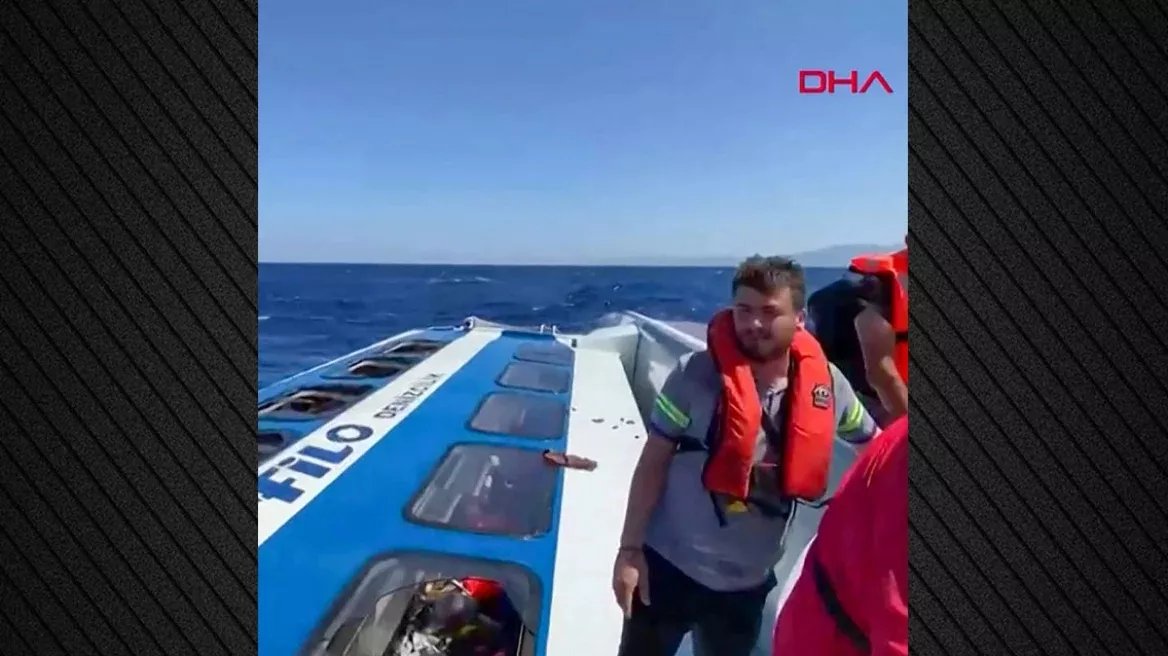
New details have emerged about the conditions under which the Filo Jet catamaran was allowed to leave the occupied port of Kyrenia on its final voyage, which ended in the ship’s sinking and the deaths of at least eight people. The vessel’s own history, including a past water ingress incident in 2003, has also come under scrutiny as investigations continue.
The self-styled “Prime Minister” of the occupied north, Unal Ustel, revealed that the “Port Department” initially would not let the Filo Jet leave port due to poor weather conditions. About an hour later, however, the catamaran set sail for Tasucu, near Mersin.
Shortly after leaving port, while roughly four nautical miles off the Kyrenia coast, the ship began taking on water, developed a severe list and capsized. It later sank at a depth of 514 metres.
Questions over the reversed decision
The initial refusal and subsequent approval have sparked anger in the north. Turkish Cypriot journalist Aysemden Akin has called for the publication of the departure document, the inspection reports and the route operating permit.
The central question is who reversed the initial decision, what changed within the space of an hour, and who ultimately signed off on the departure permit.
The “Port Department,” which is responsible for the relevant checks, falls under Erhan Arikli, the “minister” responsible for transport.
Inspected two months earlier
Arikli said Turk Loydu, the Turkish classification society, had inspected the Filo Jet at the Akdeniz shipyard about two months before the accident. The scope and results of that inspection have not been made public, and it remains unclear whether it covered the watertightness and structural integrity of the catamaran’s two hulls, its stability, or its emergency systems.
The exact causes of the disaster, Arikli said, would be established by examining the ship’s data recorder. Recovering it is expected to be particularly difficult, since the wreck lies at a depth of more than 500 metres.
Read more:

