


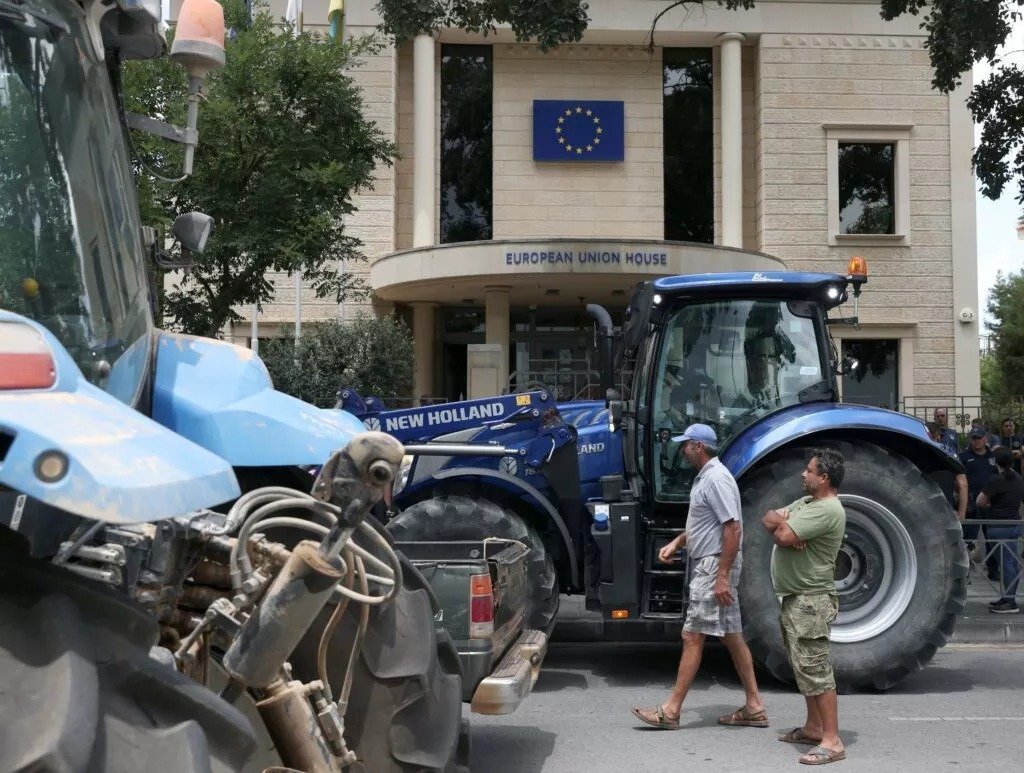
As protests by farmers escalate across Europe, a second major pan-Cyprian mobilization is underway in less than a year, with tractors taking to the streets next Thursday heading to the House of Europe in Nicosia.
The previous protest in Cyprus took place on 19/6/2023, where once again farmers submitted a memorandum to the Presidential Palace and the House of Europe.
At that time, they warned that any implementation of the European regulation on plant protection would lead to the abandonment of the majority of agricultural land in the free areas of the Republic of Cyprus.
Last June, farmers expressed their strong opposition to this specific regulation, emphasizing that they “oppose policies and decisions made without any serious impact assessment and without providing any scientific and economic support to themselves”.
Now they are taking to the streets with the same demands, as the green tax increases production costs, while measures taken by the EU through the free trade agreement with Latin American countries, as well as the agreement allowing a plethora of Ukrainian agricultural products to flood the European market without adhering to the strict standards governing the production of European products, raise issues of unfair competition.
On Thursday, from early in the morning, farmers will begin to gather at two points.
Protesters from western Nicosia will gather at 8:30 am at the Packaging Factory of Akaki with tractors and agricultural vehicles.
Farmers from the areas of Aradippou, Kiti, Atheniou, Lympia, Dali, Yeri, and Tseri will gather with tractors at 10:00 am at the GSP stadium.
At the same time, farmers from Limassol and free Famagusta will gather at GSP with their double-cabin vehicles.
The event is organized by the Cyprus agricultural movement initiated by the agricultural organizations Pek, Eka, Panagrotikos, Neos Agrotikos, and Euroagrotikos, addressing both farmers and consumers “with the aim of protecting agricultural production, ensuring food security, and securing the future of our children”.
Essentially, the agricultural organizations raise the issue of their survival, as they will bear the cost of compliance with EU requirements themselves and, therefore, demand from the government an economic package to enable them to implement them, so that the prices of agricultural products are fairer for producers and to narrow the gap between producer and consumer.
They argue that the reason for their uprising is also the fact that they cannot compete with products produced in third countries, even in the occupied areas, which do not follow the same rules.
They note that while pesticides are withdrawn from the European market, no alternatives are provided.
At the same time, they denounce the banned EU pesticides being used both in the occupied areas and in third countries that import products throughout Europe and Cyprus.
The increasing concern is that products from third countries will be cheaper than European ones, and after flooding Europe and removing domestic products from the market, European agricultural production will disappear, and eventually the multinational companies that distribute them will raise prices, making it more expensive for consumers.
The agricultural organizations unite their forces and voices with the entire agricultural movement of Europe “against the EU’s misguided policies on the common agricultural policy”.
According to the agricultural organizations, “the situation has gotten out of hand, production costs are out of touch, green taxation is imposed on water, land, animals, trees, plants, seeds, and generally across the entire food chain”. They emphasize that “freight charges and export costs are increasing, while imports from Ukraine and other third countries are uncontrolled”.
At the same time, they point out, “the EU is moving forward with a trade agreement with Latin American countries for the import of agricultural products that do not meet European quality standards, promoting unfair competition”.
They release, they continue, “huge financial resources for wars instead of tractors, agricultural machinery, and seeds to produce cheaper food for European citizens and call on European farmers to implement the green deal themselves, bearing the full cost of this transition, essentially leading to the disappearance of European agriculture”.
As stated in the announcement, the procession will stop at the House of Europe, where a resolution will be issued addressed to the European Commission.
Farmers call on consumers to join them “because it is a matter that concerns all consumers and every household”.
The agricultural movement notes that it is not opposed to improvement measures that further ensure the safety and quality of products, as well as measures aimed at mitigating the impacts on the planet from climate change. Under the new European regulation on plant protection, “spraying is prohibited in Natura 2000 areas, where there are dams, rivers, flora, fauna, sensitive, and inhabited areas”.
It is added that with this provision, a huge percentage of agricultural land, about 79%, is lost, from what remains for farmers.
The farmers’ demands are on the agenda of the plenary session of the European Parliament meeting this week in Strasbourg.
According to the agenda, MEPs will discuss on Wednesday morning, among other topics, how the Parliament will respond to the farmers’ demands and those of their communities, and how it will promote fair remunerated agriculture in the EU.
Amidst increasing protests in several European countries, including Greece, France, Belgium, Italy, Germany, Spain, and Lithuania, MEPs are expected to urge the Commission and the Belgian Presidency of the Council to initiate dialogue with farmers to maintain a sustainable agricultural sector, including fair remuneration for producers.
Farmers are particularly concerned about EU environmental and trade policies and their presumed negative impact on agriculture.
The socio-economic situation of farmers and rural areas was also discussed during the previous plenary session on January 17, with an emphasis on ensuring a fair transition, food security, and fair prices.
In an effort to address farmers’ concerns, the European Commission proposed this week a temporary exemption from the rules of the Common Agricultural Policy that require farmers to keep certain areas out of production.

