


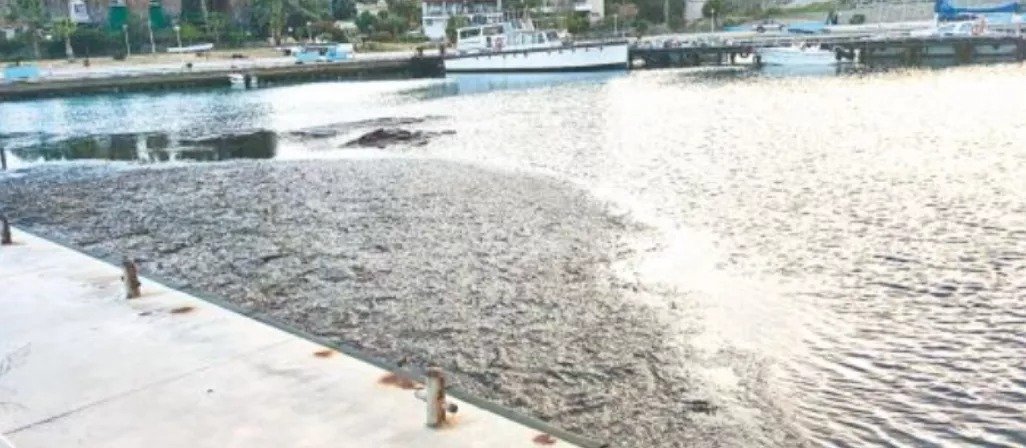
While the state requires coastal private businesses to manage their wastewater in a way that does not discharge it into the sea, the Department of Fisheries and Marine Research, the competent authority for protecting the marine environment, takes no measures to manage wastewater within the fishing shelter of the community of Kato Pyrgos Tillyrias.
This is not a baseless assumption but rather the findings of another competent service, the Department of Environment, following an on-site visit by its officers on June 25, to investigate the management of wastewater from hotels, restaurants, a school, and the fishing shelter located along the community’s coastal front.
During the investigation, three seawater samples were taken, one of which was collected from within the fishing shelter’s basin.
According to the analysis results, there appears to be a slight contamination of the water within the fishing shelter with microbiological load, chlorophyll A, and organic matter (COD), which can be justified by the type of use of the space.
The increased organic matter may originate from oils, petroleum products, and sewage, while the elevated chlorophyll A indicates eutrophication.
At locations with a high concentration of tourist accommodations and in front of the Pyrgos Tillyrias Health Centre, there is a slightly elevated level of organic matter in the water.
During the on-site visit, the fishing shelter was inspected, where two underground wastewater tanks with a capacity of 10 cubic metres each were identified, according to information provided by an employee of the Kato Pyrgos Tillyrias community council.
These two tanks are part of an old biological station constructed by the Department of Fisheries and Marine Research several years ago but never operated.
Additionally, within the fishing shelter, the Public Works Department constructed a building for the Harbour Police, designed to discharge wastewater into the two underground tanks.
During the visit, the community leader of Kato Pyrgos Tillyrias, Nikos Kleanthous, stated that these tanks have never been emptied in the last seven years of his tenure as community leader.
Considering this information, there is a reasonable suspicion that there is a leakage of wastewater from these tanks into the fishing shelter’s basin.
Furthermore, the community leader emphasised the need for constructing a sewage system, as the cost of collecting and transporting wastewater (sewage) from tourist accommodations to the licensed wastewater management unit in Paphos is enormous (around €400 for 16 cubic metres), and the operators cannot afford it.
There are also reports of skin rashes in children
In addition to the above, it has been observed that the wastewater from the Kato Pyrgos Tillyrias Gymnasium-Lyceum also ends up in a “sealed” pit with a capacity of approximately 20 cubic metres, which is emptied approximately once a year.
This creates reasonable suspicion that there is a leakage of wastewater into the sea from there as well.
The same applies to the wastewater from the Pyrgos Tillyrias Health Centre, which ends up in two absorption pits located at the back of the building and have never been emptied.
It is noted that recently, within a week, six cases of skin rashes in children were recorded after swimming in the sea near the hotels, without confirming or ruling out the possibility that this is due to sewage leakage into the sea.
Wastewater from establishments ends up in bathing areas
In the context of investigating related complaints submitted to the Department of Environment, additional on-site visits were made to hotels and restaurants neighbouring the area where the development of greenery was observed on the coastal front, to determine the management of wastewater (sewage) generated by their activities.
The operators of these hotels and restaurants were asked to present relevant evidence of the collection of sewage by licensed collectors/managers of these wastes. Most were unable to provide proof of delivery of sewage to a licensed collector/transporter.

