


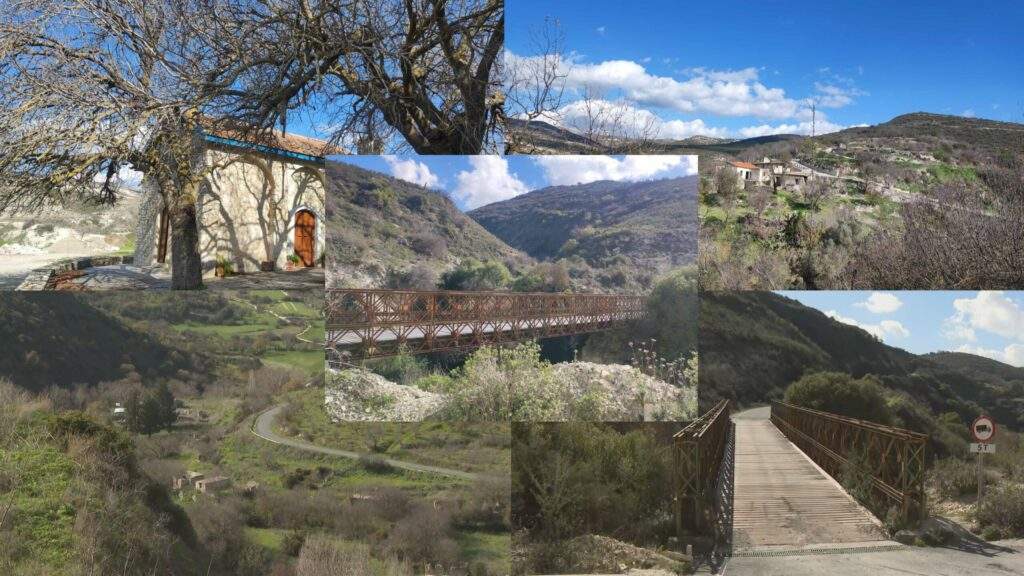
The Movement of Ecologists – Citizens’ Cooperation has called on the authorities to examine a proposed development in the abandoned Limassol village of Trozena with what it describes as due seriousness, warning that the project would alter rather than revive the Cypriot countryside.
A company with Israeli interests has applied for planning permission to build 60 homes, a campsite and a winery in Trozena, according to information provided to Phileleftheros by Limassol District Local Government Organisation (DLGO) president Giannis Tsouloftas. No planning permit has been issued. The applications were not submitted as a single unified proposal: two separate applications cover the 60 homes, with a further application each for the winery and the campsite. The DLGO and the Environment Department will assess all four together.
The story came to light following social media posts claiming the village had been sold to Israelis, which prompted Phileleftheros to seek clarification from the authorities.
The Ecologists say the conversion of an entire village, or a large part of it, into a private investment with dozens of new homes, a campsite and a winery cannot be treated as a straightforward planning matter. The party argues it touches on rural identity, architectural heritage, the natural environment and the right of local communities to have a say in the future of their area.
Particularly concerning, the party says, is that the development would involve the demolition of existing traditional buildings and the construction of new ones in their place. The Ecologists describe this as the loss of a piece of Cyprus’s architectural and historical memory — in a village that, despite its abandonment, has survived the passage of time.
The entire area falls within the Natura 2000 protected zone, a European network covering flora, fauna, birds and habitats under EU Directives 92/43/EEC and 2009/147/EC. The Environment Department has told Phileleftheros that it considers the area’s flora and fauna particularly rich and in need of protection, and has requested further details on the type and scale of the development before assessing its potential impact. The Ecologists say the Natura 2000 designation makes strict environmental assessment and full transparency in the process all the more urgent.
The homes and winery are planned for the core of the former settlement, where the village’s inhabited area once stood, while the campsite is planned for the outer perimeter, according to Phileleftheros. The dominant planning zone is H1, a residential classification that typically permits buildings of up to three storeys and 11.4 metres in height. However, Phileleftheros reports that the Natura 2000 designation may require a more in-depth environmental assessment before any development can proceed.
The Ecologists argue that gentler, sustainable forms of tourism and agrotourism development — based on the restoration of existing buildings, the preservation of traditional architecture and a connection with local production and history — are applied successfully elsewhere and could be adapted for Cyprus. The party points to European goals for the renovation and upgrading of building stock, arguing that abandoned villages should be treated as living heritage to be restored and reused rather than as vacant land for new construction.
Tsouloftas confirmed that the DLGO had assigned the review to an experienced official with a background in similar developments, and that the official’s findings would be taken into account alongside other factors before any decision is reached.
Trozena’s population peaked at 133 at the 1946 census, having stood at 64 in 1931 and 106 in 1960, according to Phileleftheros.
Read more:

