


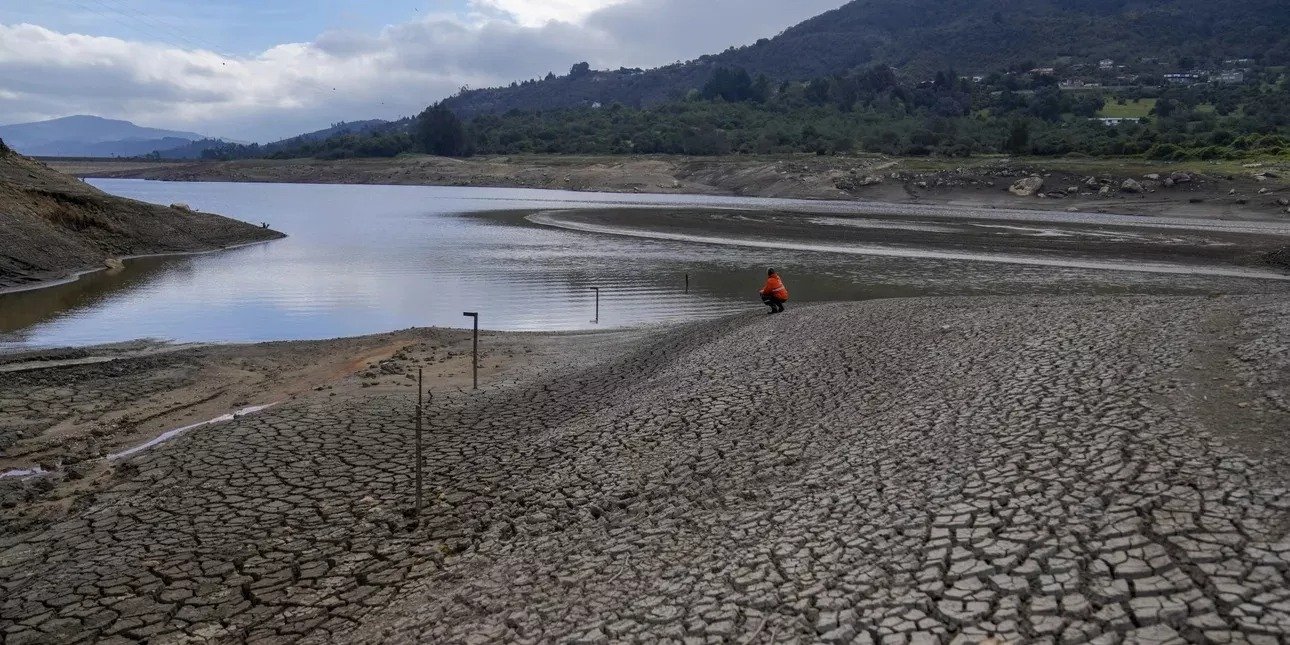
Cyprus faces its worst water crisis in 10 years, with reservoir levels dropping to critical lows that threaten drinking water supplies and could devastate the agricultural sector, according to Water Development Department data.
Water reserves stood at 32.2 million cubic metres on October 24, representing 11.1% capacity, compared with 76.8 million cubic metres and 26.4% capacity a year earlier, according to department data.
The prolonged drought has forced authorities to warn farmers against planting new crops without securing alternative water sources for 2026 and raised the prospect of household water rationing.
Critical shortages expected in southern regions
The provinces of Limassol, Nicosia, Larnaca and Famagusta, supplied by the Southern Conveyor System, face serious water deficits during 2026 even with maximum operation of existing desalination plants, the department said in scenarios it prepared.
These areas could face cuts to drinking water supplies, with irrigation water provided only for livestock needs and industry, the department warned.
Paphos province will not face drinking water shortages but will experience severe irrigation restrictions to ensure adequate household supplies, according to the department.
The Water Development Department said water would not be available for seasonal crops, greenhouses or frost protection if conditions do not improve. Officials are studying whether to cut supplies to sports fields, parks and green spaces.
A study is underway to assess the impact and manage reactions from golf courses and football pitches, the department said.
Farmers warned via text message
The department sent text messages to all farmers urging them not to plan new plantings without first securing adequate water for 2026.
The department, working with the Agriculture Department, is examining financial support measures for farmers affected by irrigation restrictions to limit socioeconomic consequences.
Government expands desalination capacity
The government is implementing an “Action Plan to Address Water Scarcity” backed by cabinet decisions, with five large permanent desalination plants now operating at 235,000 cubic metres per day capacity, covering more than 70% of needs for major urban and tourist centres.
The plants are located at Dhekelia (60,000 cubic metres daily), Larnaca (60,000), Vasilikos power station (60,000), Episkopi in Limassol (40,000) and Paphos (15,000).
Authorities are installing mobile desalination units at key locations to operate before summer 2026. A 12,000 cubic metre daily capacity unit is being expanded at Kissonerga, with a 2,000 cubic metre unit currently operating and additional units of 5,000 cubic metres to be added by late October and another 5,000 by late November.
A 15,000 cubic metre unit operates at Moni power station, with a 10,000 cubic metre unit to start at Garyllis River in Limassol in December 2025 and another 10,000 unit at Limassol port in January 2026.
The department plans to install new mobile units with 10,000 cubic metres daily capacity in Limassol, Larnaca and Famagusta before summer 2026, with tenders issued or consultations underway for units at Episkopi (10,000), Vasilikos (10,000) and Ayia Napa (10,000).
New permanent desalination plants planned
Two new permanent desalination plants are planned for eastern Limassol (60,000-80,000 cubic metres daily) and Dhekelia, where the existing unit will be replaced with an 80,000-100,000 cubic metre facility.
Feasibility studies will examine permanent use of mobile desalination units and possible expansion of their capacity and operating duration.
Private desalination units approved
Under simplified procedures approved in March 2025, hotels, provincial sewerage boards, communities serving as water authorities and local authorities can install small desalination units of up to 1,500 cubic metres daily for irrigation purposes.
The scheme includes €3 million in grants, with applications accepted until September 30, 2026. Thirteen applications from hotels have been submitted, with seven approved.
Water loss reduction projects receive €10.5 million
The department, working with provincial sewerage boards and communities, is implementing projects to reduce water losses with €10.5 million funding from the THALEIA 2021-2027 programme.
Funding is allocated to Famagusta (€2.32 million), Larnaca (€2.62 million), Limassol (€1.90 million), Nicosia (€1.83 million) and Paphos (€1.90 million).
Authorities approved 13 community projects costing €640,000 and will cover costs of water transportation by tanker to areas facing emergency supply problems. Forty-three applications for water loss reduction project funding have been submitted.
EU-backed national strategy under development
A contract was signed in July 2025 with EY Cyprus for a 24-month project to develop a national strategic plan to reduce water losses and comply with EU drinking water directives, funded by the European Commission’s Technical Support Instrument.
The project will estimate water leakage levels for department and sewerage board networks, assess networks not yet integrated into sewerage boards, prepare national and local strategic plans, and develop staff capacity.
Direct community water supply projects
The department is executing immediate projects to strengthen water supplies in communities affected by drought or deteriorated networks through its development budget.
Thirty-one projects are completed or underway in Nicosia, 18 in Limassol, nine in Paphos, six in Larnaca and one in Famagusta, involving replacement of aged pipes, maintenance of reservoirs and water towers, and utilisation of new boreholes.
The Geological Survey Department has drilled 13 successful boreholes, whilst the Water Development Department has completed 23 utilisation projects and is studying 11 others.
Read more:

